


Notes
1. Nephi states that he makes the record “in the language of my father, which consists of the learning of the Jews and the language of the Egyptians” (1 Ne. 1:2). Many Hebrew words are used herein to explain possible context and meaning heretofore missed. It is possible that the nuanced meanings were lost because Nephi was not, in fact, writing in Hebrew. However, we must understand the “learning of the Jews” if we are to understand the world of Nephi and the people around him, and nuanced Hebrew terms become critical in understanding the background context (such context being lost either in the translation to Egyptian [or reformed Egyptian] or the translation to English). As will be read in this article, quite a bit of explanation is needed to explain the difference between the Hebrew words naʿar and ʿebed. We do not have words that easily distinguish between the two, and so the English word for both has been the same: servant. Whether the distinction was lost in Egyptian or English, the “learning of the Jews,” together with the context provided by Nephi, helps provide evidence of the historicity of the Book of Mormon and its connection to Jerusalem. Though Nephi states that he used the “language of the Egyptians,” Jerry D. Grover Jr. has proposed that the small plates containing Nephi’s writing “were not exclusively the original small plates, but rather were a version that included a set that had been translated/interpreted into reformed Egyptian.” Potential problems with lost meaning in translation apply equally to Egyptian or reformed Egyptian. See Jerry D. Grover Jr., “Possibilities of a Reformed-Egyptian Version of the Small Plates,” Book of Mormon Scientific and Linguistic Research, December 6, 2019, https://www.academia.edu/40525518/Possibilities_of_a_Reformed_Egyptian_Version_of_the_Small_Plates.
2. John W. Welch has not yet published or written anything relating to his idea that Laban was possibly the commander of the fortress. However, the idea that Laban held this title belongs to John W. Welch alone. He verbally communicated the idea to me and handed me a copy of the Schniedewind article (see footnote 5 herein). The possibility of Zoram being the (chief) naʿar of the commander of the fortress springs directly from the exploration of Welch’s initial idea that Laban may have been the commander of the fortress.
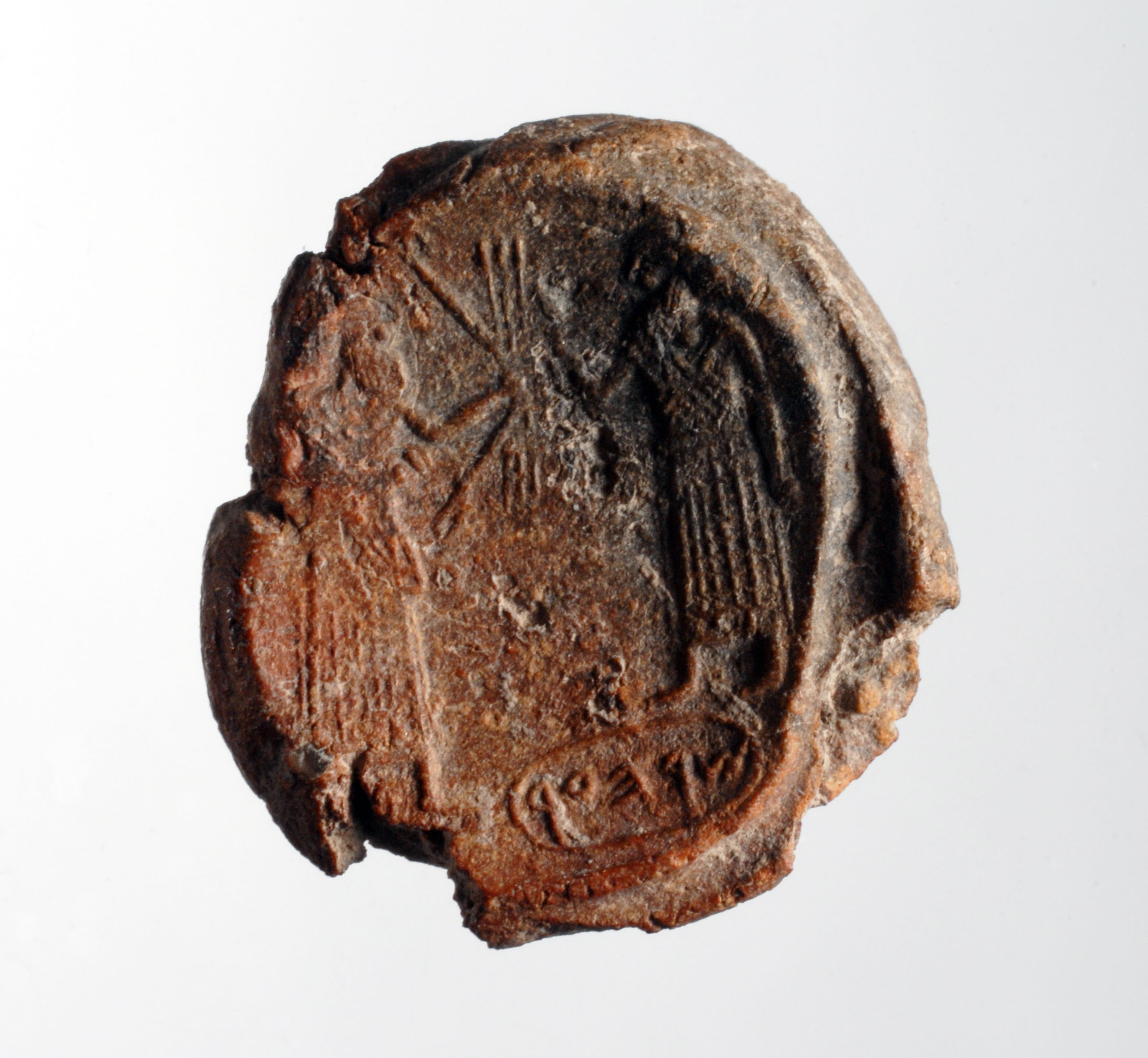
3. Sealing in the ancient world “was a fundamental tool of the administration and was used for both official and private purposes to secure and authenticate rooms, containers, and correspondence. Large assemblages of sealings have been found in contexts of storerooms (treasuries), both domestic and royal, and both sacred and secular” (internal citations omitted). Zachi Dvira and Gabriel Barkay, “Clay Sealings from the Temple Mount and Their Use in the Temple and Royal Treasuries,” Jerusalem Journal of Archaeology 2 (2021): 55–56, https://jjar.huji.ac.il/sites/default/files/jjar/files/dvira_barkay_2021_jjar_2_41-75.pdf.
4. Tel Arad is one of Israel’s most important archaeological sites, located west of the Dead Sea. Remains of a temple and fortresses where the kings of Judah lived were excavated there. Archaeological finds date back to 950 BC. “During the period of the kingdoms of Israel and Judah (10th–6th centuries BCE), successive citadels were built on the hill of Arad as part of a series of fortifications protecting the trade routes in the Negev and the southern border of the kingdom against marauding nomads. . . . The Israelite temple discovered at Arad is the only one known outside of Jerusalem.” “Archeology in Israel: Ancient Arad,” Jewish Virtual Library: A Project of AICE, accessed March 12, 2024, http://www.jewishvirtuallibrary.org/ancient-arad.
5. William M. Schniedewind, “Commander of the Fortress?: Understanding an Ancient Israelite Military Title,” Biblical Archaeology Review 45, no. 1 (January/February 2019): 39–44.
6. Schniedewind, “Commander of the Fortress,” 39; Yohanon Aharoni, “Excavations at Tel Arad: Preliminary Report on the Second Season, 1963,” Israel Exploration Journal 17, no. 4 (1967): 233–49; Ze’ev Herzog and others, “The Israelite Fortress at Arad,” Bulletin of the American Schools of Oriental Research, no. 254 (1984): 1–34, https://doi.org/10.2307/1357030.
7. Schniedewind, “Commander of the Fortress,” 40. “Kuntillet ‘Ajrud sits in the barren wilderness of the central Sinai . . . [and] was first discovered in 1969.” It is a site that would likely have been water source sites along ancient trade routes, though “the function of the site has been [a] hotly debated subject in the scholarly literature.” See Jeremy Smoak and William Schniedewind, “Religion at Kuntillet ‘Ajrud,” Religions 10, no. 3 (2019): 211.
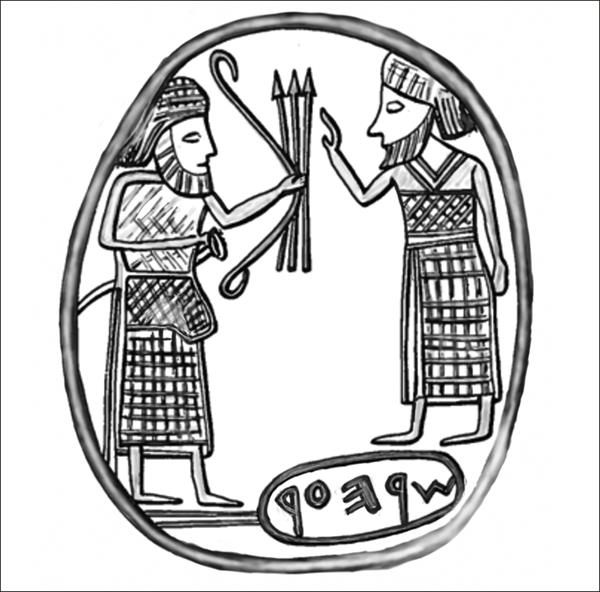
8. Schniedewind, “Commander of the Fortress,” 40. Note that, based on the dating of the seal, this could have been the impression of the seal Laban himself used or made, if he were indeed commander of the fortress.
9. See Smoak and Schniedewind, “Religion at Kuntillet ‘Ajrud,” 211.
10. Schniedewind, “Commander of the Fortress,” 40–43.
11. Schniedewind, “Commander of the Fortress,” 43, emphasis added. “The inscriptions contain commands regarding supply of commodities (wine, oil, and flour) to military units and movement of troops, set against the background of the story events in the final years before the fall of Judah. They include orders that came to the fortress of Arad from higher echelons in the Judahite military command system, as well as correspondence with neighboring forts.” Shira Faigenbaum-Golovin and others, “Multispectral Imaging Reveals Biblical-Period Inscription Unnoticed for Half a Century,” Plos One 12, no. 6 (2017), https://doi.org/10.1371/journal.pone.0178400.
12. Interestingly, Schniedewind points out an “obvious Egyptianizing element” of the later seals—“placing the title of the figure within a cartouche.” Schniedewind, “Commander of the Fortress,” 43. This too lends credibility to Egyptian culture having influence in Israelite society. The adoption of “Egyptianizing element[s]” in Israelite society may possibly be historical support regarding Nephi identifying that the “language of [his] father . . . consists of the learning of the Jews and the language of the Egyptians” in 1 Nephi 1:2.
13. Schniedewind, “Commander of the Fortress,” 43.
14. Schniedewind, “Commander of the Fortress,” 44.
15. Schniedewind, “Commander of the Fortress,” 44.
16. For a full analysis of Laban, see Hugh Nibley, “Portrait of Laban,” in An Approach to the Book of Mormon, 3rd ed., ed. John W. Welch (Salt Lake City: Deseret Book; Provo, Utah: Foundation for Ancient Research and Mormon Studies, 1988), 120–31. See also John W. Welch, “2: 1 Nephi 1–7,” John W. Welch Notes (2020), https://archive.bookofmormoncentral.org/content/1-nephi-1-7. Please note that an in-depth analysis of each trait of Laban is not given here. Analysis in this article is limited to whether the few specific facts given about Laban in the Book of Mormon are consistent with the hypothesis that Laban could have held the position of commander of the fortress.
17. Nibley, Approach to the Book of Mormon, 126–27.
18. Nibley, Approach to the Book of Mormon, 126–27.
19. Joseph Offord, “Archaeological Notes on Jewish Antiquities,” Palestine Exploration Fund Quarterly 48, no. 3 (1916): 148.
20. In addition to Laman and Lemuel’s concerns, Laban’s apparent disposition to kill the brothers for their attempts to gain the plates and his corresponding power to see it done are confirmed by both Lehi and Sariah. While their sons are traveling back from Jerusalem, Sariah complains to Lehi, believing that she will never see her sons again. In 1 Nephi 5:5, Lehi responds to Sariah, “Yea, and I know that the Lord will deliver my sons out of the hands of Laban, and bring them down again unto us in the wilderness.” After Nephi and his brothers return, Sariah says, “Now I know of a surety that the Lord hath commanded my husband to flee into the wilderness; yea, and I also know of a surety that the Lord hath protected my sons, and delivered them out of the hands of Laban” (1 Ne. 5:8). The danger and risk involved with sending their sons to try to get the plates from Laban seems to have never been in question, and their delivery from Laban is seen as nothing short of a miracle.
21. Avraham Eitan, “Rare Sword of the Israelite Period Found at Vered Jericho,” Israel Museum Journal 12 (1994): 61–62. See also William J. Adams Jr., “Nephi’s Jerusalem and Laban’s Sword,” Journal of Book of Mormon Studies 2, no. 2 (1993): 194–95; and “Book of Mormon Evidence: Laban’s Steel Sword,” Evidence Central, January 4, 2021, https://evidencecentral.org/recency/evidence/labans-steel-sword.
22. Eitan, “Rare Sword of the Israelite Period,” 62. See also Hershel Shanks, “BAR Interviews Avraham Eitan,” Biblical Archaeology Review 12, no. 4 (1986): 33; Neal Rappleye, “Vered Jericho Sword,” Nephite History in Context 3 (August 2018): 1–3.
23. Jeffrey R. Chadwick, “Lehi’s House at Jerusalem and the Land of His Inheritance,” in Glimpses of Lehi’s Jerusalem, ed. John W. Welch, David Rolph Seely, and Jo Ann H. Seely (Provo, Utah: Foundation for Ancient Research and Mormon Studies, 2004), 114. Note that Chadwick makes a very convincing argument that Lehi and his sons were metallurgists (first proposed by John A. Tvednes); Chadwick, “Lehi’s House at Jerusalem,” 113–17.
24. For a comparison of a Hittite dagger with a gold hilt and steel blade found in King Tutankhamen’s tomb, see John W. Welch and Greg Welch, “Ancient Steel Weapons,” chart 11-139, (Provo, Utah: Foundation for Ancient Research and Mormon Studies, 1999), https://archive.dev-bookofmormoncentral.org/content/ancient-steel-weapons. See also “How Could Laban Have Possessed a Sword of ‘Most Precious Steel’?,” Book of Mormon Central, February 1, 2018, https://bookofmormoncentral.org/qa/how-could-laban-have-possessed-a-sword-of-%E2%80%9Cmost-precious-steel%E2%80%9D; and “What Was the Sword of Laban Like?,” Book of Mormon Central, January 23, 2018, https://knowhy.bookofmormoncentral.org/knowhy/what-was-the-sword-of-laban-like.
25. Schniedewind, “Commander of the Fortress,” 43.
26. See Daniel N. Rolph, “Prophets, Kings, and Swords: The Sword of Laban and Its Possible Pre-Laban Origin,” Journal of Book of Mormon Studies 2, no. 1 (1993): 73–79. See also “Why Was the Sword of Laban So Important to Nephite Leaders?,” Book of Mormon Central, February 27, 2018, https://knowhy.bookofmormoncentral.org/knowhy/why-was-the-sword-of-laban-so-important-to-nephite-leaders. The analysis discusses the similarities between Nephi and Goliath, each having a sword that “became a national heirloom, as well as an enduring symbol of divine deliverance and royal legitimacy.” See also Brett L. Holbrook, “The Sword of Laban as a Symbol of Divine Authority and Kingship,” Journal of Book of Mormon Studies 2, no. 1 (1993): 39–72.
27. Nibley, Approach to the Book of Mormon, 115–17.
28. For information on what armor in Laban’s day may have looked like, see Boyd Seevers, Warfare in the Old Testament (Grand Rapids, Mich.: Kregel Publications, 2013). Though “neither biblical texts nor pictorial evidence tells us what Israelite armor may have looked like,” there are depictions of Israelite weapons, shields, and helmets in Assyrian reliefs of Lachish. Seevers, Warfare in the Old Testament, 66. Because Israelite armor may well have followed the trends of the day, reviewing Assyrian, Egyptian, Median, and Persian armor may give some idea of what Laban’s armor would have looked like.
29. If one believes that the term servants here is simply referring to regular domestic servants, one must ponder how likely it would have been that regular, nonmilitary trained servants would have been tasked with leaving the house to kill four men, at least one of whom was specifically noted as being “large in stature” (1 Ne. 4:31).
30. Schniedewind, “Commander of the Fortress,” 42.
31. Schniedewind, “Commander of the Fortress,” 42.
32. MacDonald, “Status and Role of the Naʿar,” 147–70.
33. MacDonald, “Status and Role of the Naʿar,” 147.
34. MacDonald, “Status and Role of the Naʿar,” 169.
35. MacDonald, “Status and Role of the Naʿar,” 169.
36. See Dvira and Barkay, “Clay Sealings from the Temple Mount,” 41–75.
37. Schniedewind, “Commander of the Fortress,” 43.
38. There is reasonable debate on whether the brass plates were the property of the king or another important individual, or whether they were the personal property of Laban himself. The text of the Book of Mormon does not give a definitive answer. “For behold, Laban hath the record of the Jews and also a genealogy of my forefathers, and they are engraven upon plates of brass” (1 Ne. 3:3). Upon Lehi’s examination of the plates, Nephi comments, “And thus my father, Lehi, did discover the genealogy of his fathers. And Laban also was a descendent of Joseph, wherefore he and his fathers had kept the records” (1 Ne. 5:16). While there are those who would conclude that the comment “wherefore [Laban] and his fathers had kept the records” indicates a personal record, there are other explanations. If the word translated as kept stems from the ancient Hebrew word shamar, the word means “to guard or to exercise great care over.” The “noun . . . (shomra) means guard.” If that same word instead stems from the ancient Hebrew word mishmeret, the word “literally mean[s] ‘with the function of watching’ used in the sense of a charge or obligation: an official function of guarding.” Abarim Publications’ Biblical Name Vault, s.v. “שמר,” accessed February 19, 2024, https://www.abarim-publications.com/Dictionary/si/si-m-r.html. Additionally, even though Nephi makes a point that from the first command of his father, he and his brothers are to go to the “house of Laban” when seeking the records (1 Ne. 3:4, 11, 23), the implication from the text is that Nephi understands that the brass plates are not actually at the personal house of Laban. Given Laban’s reaction to the two requests for the plates, it is unlikely (and the text does not indicate) that Laban tells the brothers where the plates are housed.
39. See also John W. Welch’s examination of Laban’s accusation that the brothers are “robbers” in John W. Welch, “Legal Perspectives on the Slaying of Laban,” Journal of Book of Mormon Studies 1, no. 1 (1992): 119–41, especially 136–37.
40. See Vincent J. M. Eras, Locks and Keys throughout the Ages (Watchung, New Jersey: Artisan Ideas, 2019), 26–27.
41. Eras, Locks and Keys, 26.
42. Eras, Locks and Keys, 26. See a depiction of an “Arab carrying keys on his shoulder” on page 27.
43. For further analysis, see “Who Were the ‘Elders of the Jews’ Mentioned by Zoram?,” Book of Mormon Central, September 4, 2018, https://knowhy.bookofmormoncentral.org/knowhy/who-were-the-elders-of-the-jews-mentioned-by-zoram.
44. Nibley, Approach to the Book of Mormon, 96.
45. Nibley, Approach to the Book of Mormon, 97.
46. Nibley, Approach to the Book of Mormon, 97, citing Henrich H. Graetz, “Die Zeit de Königs Chizkija und der zeitgenössischen Propheten,” MGWJ 19 (1870): 49–51.
47. Graetz, in Nibley, Approach to the Book of Mormon, 97.
48. Graetz, in Nibley, Approach to the Book of Mormon, 97–98.
49. Nibley, Approach to the Book of Mormon, 96.
50. See Jeremiah 36:26. See also John W. Welch, “The Trial of Jeremiah: A Legal Legacy from Lehi’s Jerusalem,” in Welch, Seely, and Seely, Glimpses of Lehi’s Jerusalem, 337–56; and Jeremiah 20; 26; 36–38; 43–45.
51. For example, Tertullian recorded that Jeremiah was stoned. See Tertullian, “Adversus Gnosticos,” in Patrologia Latina, vol. 2, col. 137, as quoted and cited in Edward Lipinski and others, “Jeremiah,” Jewish Virtual Library, accessed January 17, 2024, https://www.jewishvirtuallibrary.org/jeremiah.
52. See, for example, the account of the trial of Jeremiah 26:1–15.
53. See, for example, 1 Nephi 18–20.
54. See, for example, 1 Nephi 1:4.
55. Russell explains, “An entire nation rises from his seed.” Collin Charles Russell, “Meeting Zoram,” Interpreter: A Journal of Mormon Scripture 24 (2017): 11.
56. See, for example, Alma 16:5 and 30:59.
57. Russell, “Meeting Zoram,” 11.
58. It should be noted that “king of the Lamanites” appears in quotes because Ammoron’s brother, Amalickiah, had caused an insurrection among the Nephites (Alma 45–46). Amalickiah, desiring power, had desired to be king of the Nephites (Alma 46:4–5). Moroni had forced Amalickiah and his followers out of the land (Alma 46:33). Amalickiah thereafter went to the Lamanites “and did stir up the Lamanites to anger against the people of Nephi” (Alma 47:1), using this war and intricate machinations to seize the throne of the Lamanites (Alma 47:4, 8, 16–35).
59. Interestingly, it does not appear that Amalickiah used this argument when attempting to take the Nephite throne.
60. See A. Keith Thompson, “Who Was Sherem?,” Interpreter 14 (2015): 11; Matthew L. Bowman, “‘See That Ye Are Not Lifted Up’: The Name Zoram and Its Paronomastic Perjoration,” Interpreter 16 (2016): 114, 118.
61. Russell, “Meeting Zoram,” 19.
62. Nibley, Approach to the Book of Mormon, 128.
63. W. F. Albright, “The Seal of Eliakim and the Latest Preexilic History of Judah, with Some Observations on Ezekiel,” Journal of Biblical Literature 51, no. 2 (1932): 79.
64. Albright, “Seal of Eliakim,” 79–80. Albright specifically refers to Clermont-Ganneau, Kautzch, Lidzbarski, and Torrey.
65. Albright, “Seal of Eliakim,” 80.
66. Albright, “Seal of Eliakim,” 80.
67. See Russell, “Meeting Zoram,” 18. Russell uses the term royal officer, which is used exactly by Albright to define the category of ʿebed. Note that Nibley relied upon Albright’s analysis but does not use the term royal officer, instead choosing official representative. Nibley does not articulate his arguments based upon ʿebed or naʿar, or to which category Nibley believed Zoram belonged. Nibley’s analysis is limited to the following: “For Zoram, as Laban’s private secretary and keep of the keys, was himself an important official, and no mere slave. Professor Albright has shown that the title ‘servant’ by which Nephi designates him meant in Jerusalem at that time something like ‘official representative’ and was an honorable rather than a menial title.” Nibley further states, however, “Plainly with all his influence and privileges Zoram did not think of himself as a free man.” Nibley, Approach to the Book of Mormon, 128, 130.
68. Albright, “Seal of Eliakim,” 82.
69. Albright, “Seal of Eliakim,” 82.
70. MacDonald, “Status and Role of the Naʿar,” 147. Interestingly, MacDonald’s analysis of the use of the term naʿar directly contradicts analysis by Schniedewind. Schniedewind sets forth a possible inscription interpretation found on one of the fortress walls at Kuntillet ‘Arjud. Relying upon biblical scholar Erhard Blum’s reconstruction of an expression found on the fortress wall as “naʿare sar ʿir,” he believes it refers to “apprentices of the commander of (the) fortress.” However, Schniedewind uses the previously understood definition of naʿar and uses Judges 8:20 to support the idea. Schniedewind states that in the example we find in Gideon, the naʿar Gideon encounters “was a simple boy. . . : ‘But the naʿar did not draw his sword, for he was afraid, because he was still a naʿar’ (8:20). In this context, naʿar seems to be a young person in training with the military, but not a seasoned soldier.” Schniedewind, “Commander of the Fortress,” 41–42. Additionally, Schniedewind explains that if a naʿar killed a king outside of the battlefield, the penalty would be death by another naʿar (p. 169). MacDonald specifically addresses the use of naʿar in Judges 8 but reaches a very different conclusion. When discussing the phrase “still only a naʿar,” MacDonald writes, “One might argue that this means that he was too young, only a lad; however, would a mere lad be expected to despatch [sic] two warriors? Jether was Gideon’s firstborn! Yet we may easily miss some point about the status and role of the naʿar here by too ready assumption. Verse 5 may supply the answer, for there we learn that the two victims were kings. It may well be, therefore, that according to some sort of knightly code a naʿar did not rank high enough (indeed no one but a king did) to slay a king, especially when the killing was not in self defense. . . . Gideon himself had to carry out the execution. The next verse (22) reveals Gideon’s potential role of king. It was more appropriate for a man of equal rank to dispatch men of his own rank.” MacDonald, “Status and Role of the Naʿar,” 169.
71. MacDonald, “Status and Role of the Naʿar,” 151, emphasis added.
72. MacDonald, “Status and Role of the Naʿar,” 149. MacDonald repeats this conclusion on page 150: “Naʿar stands out, let it be repeated, as descriptive of high-born male young.”
73. It should be noted that MacDonald does not address or analyze Albright’s work. However, Albright acknowledges that an ʿebed typically meant a slave, unless it was in the context of an ʿebed to the king himself; see Albright, “Seal of Eliakim,” 80. This aligns with the findings of MacDonald. “Any naʿar below the king himself is a ʿebed (subject) of the state (king) and of the royal house or palace.” MacDonald, “Status and Role of the Naʿar,” 156. MacDonald theorizes that a naʿar may be able to achieve a status greater than that of a princely naʿar, if he were a commander’s naʿar. After giving many examples of neʿarim who refused to kill a superior, MacDonald recounts, “Was an army commander of superior rank to a princely naʿar? . . . Absalom, prince and naʿar, finally died at the hands of ten neʿarim who were armor-bearers of Commander Joab.” MacDonald, “Status and Role of the Naʿar,” 164. It should be noted, however, that even a princely naʿar’s title would shift to ʿebed when referencing the relationship between servant and king.
74. MacDonald, “Status and Role of the Naʿar,” 153.
75. MacDonald, “Status and Role of the Naʿar,” 155.
76. MacDonald, “Status and Role of the Naʿar,” 155–56.
77. MacDonald, “Status and Role of the Naʿar,” 155–56.
78. MacDonald, “Status and Role of the Naʿar,” 156.
79. MacDonald, “Status and Role of the Naʿar,” 156.
80. MacDonald, “Status and Role of the Naʿar,” 157.
81. Schniedewind, “Commander of the Fortress,” 41–42.
82. Laban’s position as an important military leader is explored in section 1. Notable scholars have confirmed this position. John W. Welch has referred to Laban as a “commanding officer of the city.” See Welch, “Legal Perspectives,” 137. Hugh Nibley supposes that Laban “is cut from the same cloth as Jaush, his contemporary and probably his successor as ‘military governor of this whole region, in control of the defenses along the western frontier in Judah, and an intermediary with the authorities of Jerusalem.’” Nibley, Approach to the Book of Mormon, 120–21.
83. Even without the benefit of MacDonald’s meticulous research, Russell explored a military leader as a possible role for Zoram under Laban’s command. Russell, “Meeting Zoram,” 15–17.
84. MacDonald traces many stories when a naʿar seems to appear, “almost inconsequentially, in a story and promptly disappears from the scene without further mention—a sure sign that the literary story teller is making no point as far as the naʿar is concerned. His place beside his lord is taken for granted.” MacDonald, “Status and Role of the Naʿar,” 159, emphasis added.
85. MacDonald, “Status and Role of the Naʿar,” 159.
86. MacDonald, “Status and Role of the Naʿar,” 159.
87. MacDonald, “Status and Role of the Naʿar,” 159.
88. MacDonald, “Status and Role of the Naʿar,” 159.
89. MacDonald further observes that David was no mere shepherd but made a particular point of the fact that David “went back and forth from Saul to feed his father’s sheep.” The fact “that David was a naʿar (v. 42) in the military sense is quite clear from the fact that when Saul commissioned him to take up the Philistine challenge Saul at once clothed him in his own armor, helmet, and coat of mail—the full military gear of a top ranking warrior in Israel. . . . In 1 Sam. 20, we find further confirmation of our thesis that the naʿar was a distinctive military figure. First we observe that David had a place at court, as befitted a knight. He sat at the royal table (v. 5), as did the army commander Abner (v. 25).” MacDonald, “Status and Role of the Naʿar,” 160–61.
90. It is difficult to miss the likeness between these commands to kill and the command Laban gives to his “servants” (perhaps originally identified as his neʿarim).
91. MacDonald, “Status and Role of the Naʿar,” 165.
92. MacDonald, “Status and Role of the Naʿar,” 166.
93. MacDonald, “Status and Role of the Naʿar,” 169.
94. It is also possible that, as a higher ranking or chief naʿar, he would have led the other neʿarim in pursuit of Lehi’s sons.
95. “What astonishes the western reader is the miraculous effect of Nephi’s oath on Zoram, who upon hearing a few conventional words promptly becomes tractable, while as for the brothers, as soon as Zoram ‘made an oath unto us that he would tarry with us from that time forth . . . our fears did cease concerning him.’ The reactions of both parties make sense when one realizes that the oath is the one thing that is most sacred and inviolable among the desert people and their descendants: ‘Hardly will an Arab break this oath, even if his life be in jeopardy.’ . . . But not every oath will do. To be the most binding and solemn an oath should be by the life of something, even if it be but a blade of grass. The only oath more awful than that ‘by my life’ or (less commonly) . . . ‘by the life of God.’ . . . So we see that the only way that Nephi could possibly have pacified the struggling Zoram in an instant was to utter the one oath that no man would dream of breaking, the most solemn of all oaths to the Semite: ‘As the Lord liveth, and as I live.’” Nibley, Approach to the Book of Mormon, 128–29, emphasis original (internal citations omitted).
96. Russell, “Meeting Zoram,” 17–19, emphasis added.
97. MacDonald, “Status and Role of the Naʿar,” 158.
98. Nibley, Approach to the Book of Mormon, 130. It should be noted that while Nibley declares that the relationship was “not one of trust and affection,” it appears he meant on the part of Zoram. Laban had sufficient trust in Zoram that Zoram had the keys of the treasury, Zoram was aware of Laban’s meeting with the elders of the Jews at night, Zoram was sufficiently comfortable to continue asking questions about the meeting, and one can infer from the lack of mention in Nephi’s record that Zoram was not surprised to be accompanying his (supposed) master on a secret mission outside the walls of the city. The descriptions in the text indicate that Laban wholly trusted Zoram, and Zoram knew it.
99. However, there is yet another possibility as to why Zoram would not have been invited to return to Jerusalem, and many questions that are helpful in creating theories. It seems likely that there would have been more confusion surrounding Laban’s death if Zoram never returned to give his story. The people within Jerusalem woke to find the body of Laban lying in the street, stripped of his clothing, armor, and sword. His naʿar, responsible for the keys to the treasury, was missing. We know from Nephi that the brass plates were (at least relatively) current. How quickly would the plates have been missed? Instead of immediately suspecting the sons of Lehi, who had just recently been asking for the plates, suspicion may have fallen elsewhere. If Lehi and Sariah believed it was only by a miracle that their sons had been delivered from Laban, would there have been any in Jerusalem who would have believed the sons of Lehi could have overcome Laban, his naʿar, and any other servants ready and able to fulfill orders to kill? It seems likely that Laban’s meeting with the elders of the Jews would have been kept from general knowledge, so there would have been very few who would have understood why Laban was out in the streets alone. Would there have been additional keys to the treasury, or did the keys simply disappear with Zoram? Did the missing keys play a role to give space between the sons of Lehi asking after the plates and the discovery that they were missing? How quickly could a replacement for Laban be appointed? If Zoram wasn’t suspected in the death of Laban, it’s possible that some would believe that Jerusalem’s enemies had stealthily crept into the city and assassinated Laban, and Zoram either fled or was taken captive.
100. Ariel E. Bybee, “A Woman’s World in Lehi’s Jerusalem,” in Glimpses of Lehi’s Jerusalem, ed. John W. Welch, David Rolph Seely, and Jo Ann H. Seely (Provo, Utah: Foundation for Ancient Research and Mormon Studies, 2004), 133.
101. “The most significant event in the life of a woman in ancient Israel was marriage. From birth, a woman was prepared by her parents to become a wife and mother.” Bybee, “Woman’s World,” 133. Noting that girls typically married between the ages of twelve and fourteen (and there is no reason to believe Ishmael’s family deviated from the tradition), it is possible that some of Ishmael’s daughters were being married at a significantly younger age than women today or were not married until they arrived at the appropriate age during the sojourn. Nothing in Nephi’s account states that they were all married at once. If Zoram married the eldest, he may have been the first to wed, or wed the eldest daughter while one or two of the other brothers married younger daughters that were also of age. In the event Zoram was the first to wed one of the daughters, one might suppose that it was due to his age or status. Therefore, perhaps Zoram was either (1) older than Laman, or (2) considered to be of higher status, such that he might have been the first to have children in the wilderness. See also Michael L. Satlow, Jewish Marriage in Antiquity (Princeton: Princeton University Press, 2001), 104–111, which discusses the tradition of a father selecting the spouse for his daughter. If that tradition were followed here, it would mean that Ishmael selected Zoram for his eldest.
102. Lehi’s final blessings upon his children are found in 2 Nephi 1:1–4:11.
103. It is possible that Zoram was adopted into Lehi’s family when he agreed to go into the wilderness with them (or at some point thereafter). The case for adoption in Israelite society seems to be a source of great disagreement. See “Adoption,” Jewish Virtual Library, 2008, https://www.jewishvirtuallibrary.org/adoption. The most compelling arguments that adoption was practiced in ancient Israelite society are typically relating to childless couples seeking an heir. Obviously, that would not have been the case here. While at no point does Lehi refer to Zoram as a “son,” which would be the strongest argument for some type of adoption, he does appear to include Zoram in references he makes to “my sons” (see 2 Ne. 2:14, 28–30). A formal or informal type of attachment to Lehi’s family cannot be proven but should not be disregarded. Nephi’s word to Zoram in 1 Nephi 4:34 at least hints at his position: “Therefore, if thou wilt go down into the wilderness to my father thou shalt have place with us.” John W. Welch has compellingly proposed that Zoram was indeed actually given “full status as [a] family [member]” by Lehi, since “adult adoption was legally permissible and normal enough in the ancient Near East.” See John W. Welch, “Lehi’s Last Will and Testament: A Legal Approach,” in The Book of Mormon: Second Nephi, the Doctrinal Structure, ed. Monte S. Nyman and Charles D. Tate Jr. (Provo, Utah: Religious Studies Center, Brigham Young University, 1989), 73. Certainly, members of The Church of Jesus Christ of Latter-day Saints adhere to the idea that Jacob adopted Joseph’s sons Ephraim and Manasseh (see chapter heading of Gen. 48 as well as Gen. 48:5).
104. John L. Sorenson, John A. Tvedtnes, and John W. Welch, “Seven Tribes: An Aspect of Lehi’s Legacy,” in Reexploring the Book of Mormon: The F.A.R.M.S. Updates, ed. John W. Welch (Provo, Utah: Foundation for Ancient Research and Mormon Studies, 1992), 93.
105. Sorenson, Tvedtnes, and Welch, “Seven Tribes,” 93. One interesting result of dividing the sons of Lehi and Ishmael in this way has been proposed by John W. Welch. Welch proposed (in unpublished lectures) that Zoram was intended to be a “tiebreaker” amongst the sons.
106. Sorenson, Tvedtnes, and Welch, “Seven Tribes,” 94.
107. Sorenson, Tvedtnes, and Welch, “Seven Tribes,” 94.
108. “Division of these people into kin-based tribes served several functions—religious, military, political, and legal. The Israelite tribe of Levi was given priestly duties, as was the family of Jacob and his recordkeeping posterity in the Book of Mormon.” Sorenson, Tvedtnes, and Welch, “Seven Tribes,” 94–95. If Lehi were trying address the four aforementioned functions of the various tribes, the naʿar of the commander of the fortress would be able to help meet the military needs of the people.
109. “And it came to pass that when the servant of Laban beheld my brethren he began to tremble, and was about to flee from before me and return to the city of Jerusalem” (1 Ne. 4:30).
110. “And it sufficeth me to say that forty years had passed away, and we had already had wars and contentions with our brethren” (2 Ne. 5:34).
111. See Chadwick, “Lehi’s House at Jerusalem,” 116.
112. Additionally, it is possible that Zoram appreciated and understood the need for hierarchies, which has been typical of military men of all ages. Laman and Lemuel were dismissive and irreverent towards the hierarchical structure in which the family operated—specifically, they were rebellious towards the patriarch Lehi. Given that Nephi was deferential to Lehi and respected his authority, it may be that Zoram identified more closely with Nephi than Laman and Lemuel.
113. See “As a Free Man” analysis above. While it is possible that Zoram may have been required to make an oath of loyalty to Laban (or, possibly to the position of the commander of the fortress rather than to Laban himself), Zoram’s oath to Nephi may be further evidence that Zoram realized his master must be dead.
114. For example, see 2 Nephi 1:28–29; 3:25.
115. If Zoram were a righteous servant of an evil master, he would not have been the first. A young, righteous David was a loyal servant of a fallen and wicked Saul (see 1 Sam. 18–26). In spite of Saul’s wickedness, David continued to be loyal to him and serve him.
116. John A. Tvedtnes, “Book of Mormon Tribal Affiliation and Military Castes,” in Warfare in the Book of Mormon, ed. Stephen D. Ricks and William J. Hamblin (Salt Lake: Deseret Book; Provo, Utah: Foundation for Ancient Research and Mormon Studies, 1990), 305.
117. It should be noted that the genealogy of Amalickiah, and therefore of his brother Ammoron, appears to conflict throughout the story. “And it came to pass that they [the Lamanites] returned to the land of Nephi, to inform their king, Amalickiah, who was a Nephite by birth, concerning their great loss” (Alma 49:25). Thereafter, Ammoron identifies himself differently. “And behold now, I am a bold Lamanite; behold this war hath been waged to avenge their wrongs, and to maintain and to obtain their rights to the government” (Alma 54:24). However, as noted earlier, Ammoron also identifies that he is a direct descendent of Zoram. It does seem that the reference to Amalickiah as a Nephite is likely contributed to the custom identified in Jacob 1:13–14: “Now the people which were not Lamanites were Nephites; nevertheless, they were called Nephites, Jacobites, Josephites, Zoramites, Lamanites, Lemuelites, and Ishmaelites. But I, Jacob, shall not hereafter distinguish them by these names, but I shall call them Lamanites that seek to destroy the people of Nephi, and those who are friendly to Nephi I shall call Nephites, or the people of Nephi, according to the reigns of the kings.” Ammoron’s reference to himself as a bold Lamanite and his cause for war appears to be a reference to his adoption of a new people and part of his war propaganda to continue gathering support from the Lamanites.
118. Tvedtnes, “Book of Mormon Tribal Affiliation,” 320.
119. Tvedtnes, “Book of Mormon Tribal Affiliations,” 320.