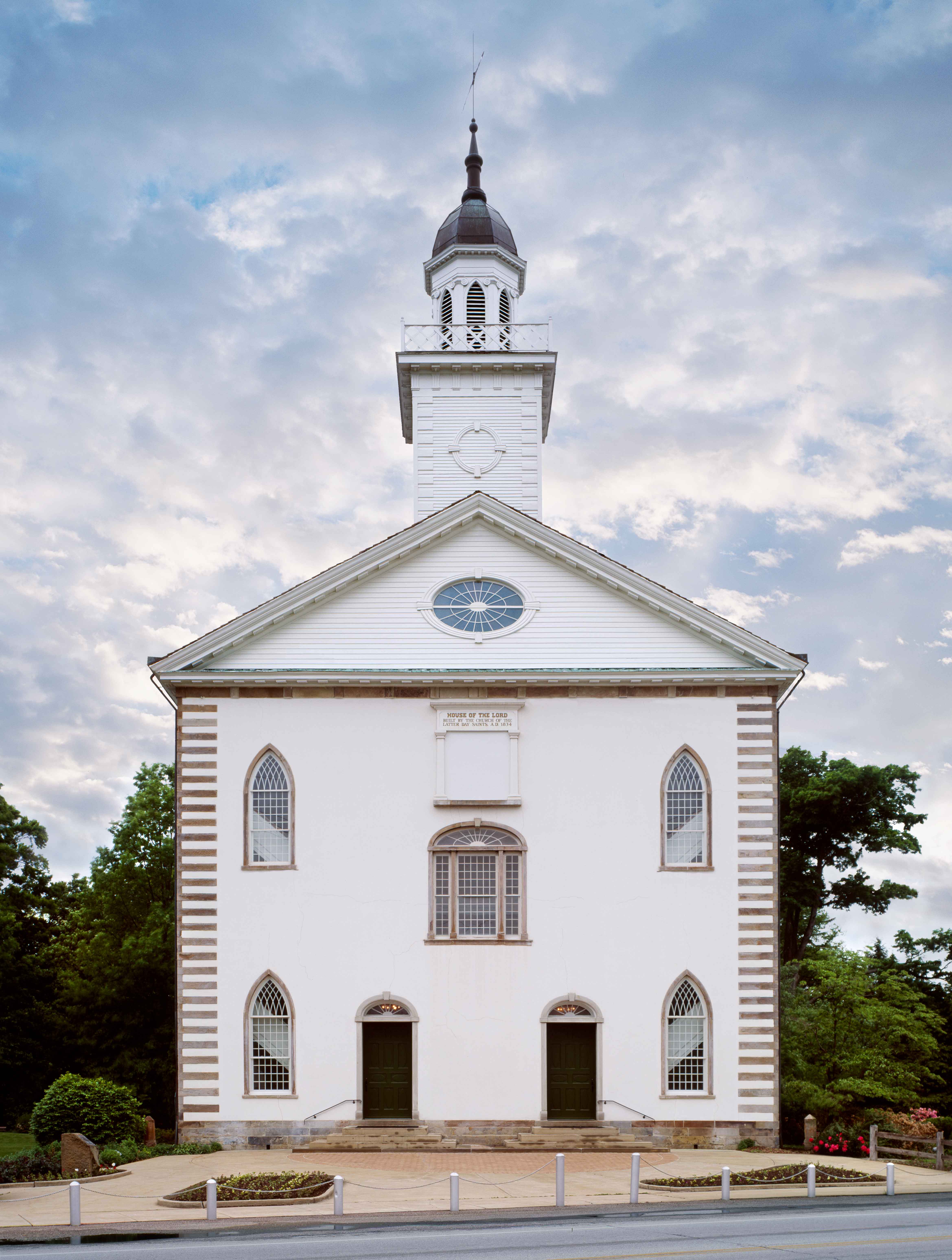
 Figure 1.
 The Kirtland Temple. Photograph by Val Brinkerhoff. Courtesy Church History Library.
On March 5, 2024, The Church of Jesus Christ of Latter-day Saints and Community of Christ jointly announced that “the responsibility and ownership for the Kirtland Temple (fig. 1), several historic buildings in Nauvoo, and various manuscripts and artifacts” had “officially transferred” between the two churches. In the joint statement of announcement, President Russell M. Nelson observed, “We are deeply honored to assume the stewardship of these sacred places, documents, and artifacts. We thank our friends at Community of Christ for their great care and cooperation in preserving these historical treasures thus far. We are committed to doing the same.” For Latter-day Saints, the transaction involves materials that relate to significant events and people in the Restoration of the gospel of Jesus Christ, including places visited by heavenly messengers and sites of revelation and divine instruction. Collectively, these materials bear witness that the Redeemer invites us to come unto him, receive the ordinances of salvation, and gain enduring joy.
The Kirtland Temple headlined most coverage of the transaction, with notice also of the Joseph Smith–related properties in Nauvoo—his first (Homestead) and second (Mansion House) homes and his Red Brick Store. In addition to those headliner properties, the transaction also included the visitor center, the maintenance shop, and three residential homes in Kirtland as well as Nauvoo’s visitor center, maintenance shop, several historic homes, and most of the property on the south end of the city. Further, the transfer included significant documents and artifacts, such as the manuscripts and the Bible used in the Joseph Smith Translation of the Bible, seven letters from Joseph Smith to his wife Emma, John Whitmer’s history of the Church, original portraits of Joseph and Emma Smith, the cornerstone of the Nauvoo House, the original door of Liberty Jail, and a document titled “Caractors,” which may contain a sample of inscriptions from the gold plates. Each of the items included in the transfer will receive detailed attention below.
Community of Christ (known until 2001 as the Reorganized Church of Jesus Christ of Latter Day Saints or RLDS) has preserved, cared for, and given access to these sacred sites for well over a century. This transaction comes at a significant moment in the history of the relationship between the two churches. During the nineteenth century, the churches positioned themselves rhetorically against one another, competed for membership, and engaged in polemical and legal efforts to undermine one another. This religious rivalry translated onto historic sites in the twentieth century in the form of competitive land acquisition and dueling messaging to site visitors. But historical activities also became the place to find common ground. During the 1960s and 1970s, scholars from both churches began to cooperate on historical and scriptural studies, including careful manuscript analysis of the materials related to Joseph Smith’s inspired translation of the Bible. Members of both churches have participated in memorial services that honor Joseph Smith and celebrated the Relief Society’s origins in what is called the Red Brick Store. Community of Christ loaned artifacts to the Church History Museum in Salt Lake City for a bicentennial exhibit about Joseph Smith in 2005, while conservators from the Church History Library have provided conservation and digitization services for documents in the Community of Christ Library-Archives. For the past two decades, Community of Christ has contributed to the Joseph Smith Papers project by allowing the digitization of dozens of documents and participating in public events, including the release of the volume on the Printer’s Manuscript of the Book of Mormon and a podcast about Nauvoo. After collaboration on numerous historical and humanitarian projects, the two churches today enjoy a respectful and friendly relationship. As authors whose day-to-day work involves Church history, we are grateful for Community of Christ’s care and partnership in past, present, and future history work.
Besides this extensive cooperation in historical work, there have been two previous significant transactions between the two churches. In 2012, the Church of Jesus Christ purchased several properties, including the Hawn’s Mill Massacre site in Missouri and the Joseph and Emma Smith home in Kirtland. That home was subsequently restored and opened to visitors in 2023. In 2017, Community of Christ sold the printer’s manuscript of the Book of Mormon to the Church of Jesus Christ.
The Church of Jesus Christ has made clear that the Kirtland Temple as well as the significant Nauvoo properties—the Smith Family Homestead, Joseph and Emma Smith’s Mansion House, and the Red Brick Store—will remain historic sites, open to the public at no charge. Indeed, as a manifestation of this intent, the sites reopened to the public on March 25, 2024, less than three weeks after the announcement of the transfer. New visitor experiences were created for each site, and updated visitor information is available on the websites for both Historic Kirtland and Historic Nauvoo. Many of the significant documents and artifacts in the transfer also went on display on March 25 at the Church History Museum in Salt Lake City.
Because of the historic nature of this transaction and the significance of the properties and items involved, we thought it would be appropriate to provide a description and evaluation of each of the properties and items. Where relevant, we also make observations about context and provenance.
In Kirtland, Ohio
The core of the transaction is the Kirtland Temple, with its attendant grounds, visitor center, and maintenance shop. Additional adjacent properties were also transferred (figs. 2 and 3). The transfer in Kirtland involved property on the west side of Chillicothe Road—and nothing on the east side across from the Kirtland Temple, where Community of Christ has a chapel and other properties.
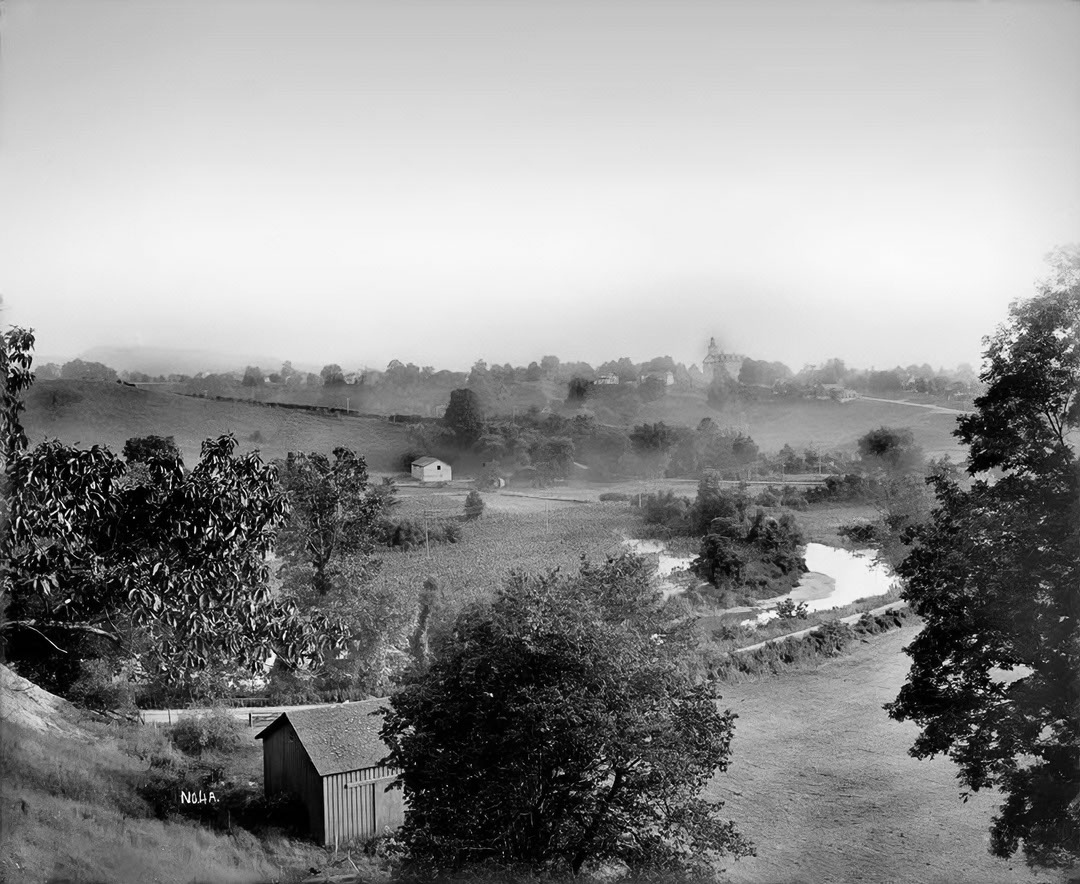 Figure 2.
 The temple and Kirtland Village in 1907. Photograph by George Edward Anderson. Courtesy Church History Library.
.png) Figure 3.
Figure 3. Map of historic sites in Kirtland. Courtesy Church History Library.
Kirtland Temple (9020 Chillicothe Road). The House of the Lord in Kirtland must be counted among the most significant holy sites in the world. Located in what is now a suburb of Cleveland in northeastern Ohio, the Kirtland Temple was the first temple built by Latter-day Saints. Revelations in the Doctrine and Covenants outlined its purposes and directed its construction. Its cornerstone was laid July 23, 1833, and its construction involved significant personal sacrifice by individual members of the early Church. During the dedicatory services on March 27 and 31, 1836, and in the solemn assembly on March 30, Joseph Smith and others reported glorious spiritual manifestations, including heavenly visions and speaking in tongues. On Easter Sunday, April 3, 1836, Joseph Smith and Oliver Cowdery experienced a vision of Jesus Christ and visitations from several biblical prophets. A few months earlier, on January 21, 1836, while in the nearly finished temple, Joseph Smith had seen a vision of the celestial kingdom, in which he viewed several members of his family and notable biblical figures.
The temple comprises three stories with large rooms for assemblies on the first two floors (figs. 4 and 5) and five rooms or offices on the attic floor. Known officially as the “House of the Lord,” the temple was used for a variety of purposes before and after its dedication, including confirmations, ordinations, quorum meetings, washings, anointings, an Elders School, and a Hebrew School. After the majority of the Saints left Kirtland in 1838, the building was used by a few different groups. In 1880, the RLDS initiated legal efforts to secure a clear legal title that was eventually established by 1901 based on the continuous occupation of the property (a process known as adverse possession). The Church maintained the original structure for more than a century. The temple was named a national historic landmark in 1976, and it has served as a place of pilgrimage for nearly two centuries.
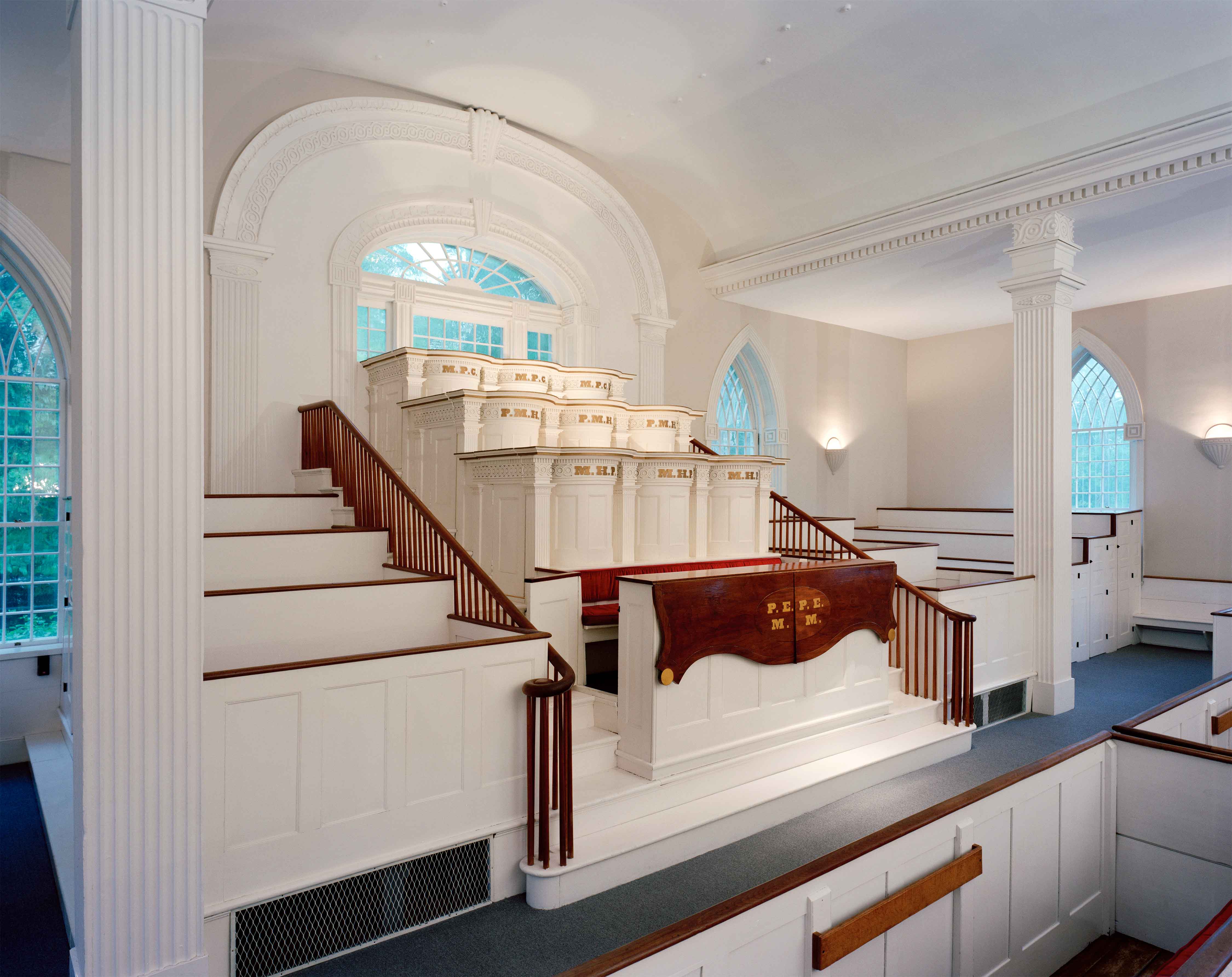 Figure 4.
 The Melchizedek Priesthood pulpits on the first floor of the Kirtland Temple. Photograph by Val Brinkerhoff. Courtesy Church History Library.
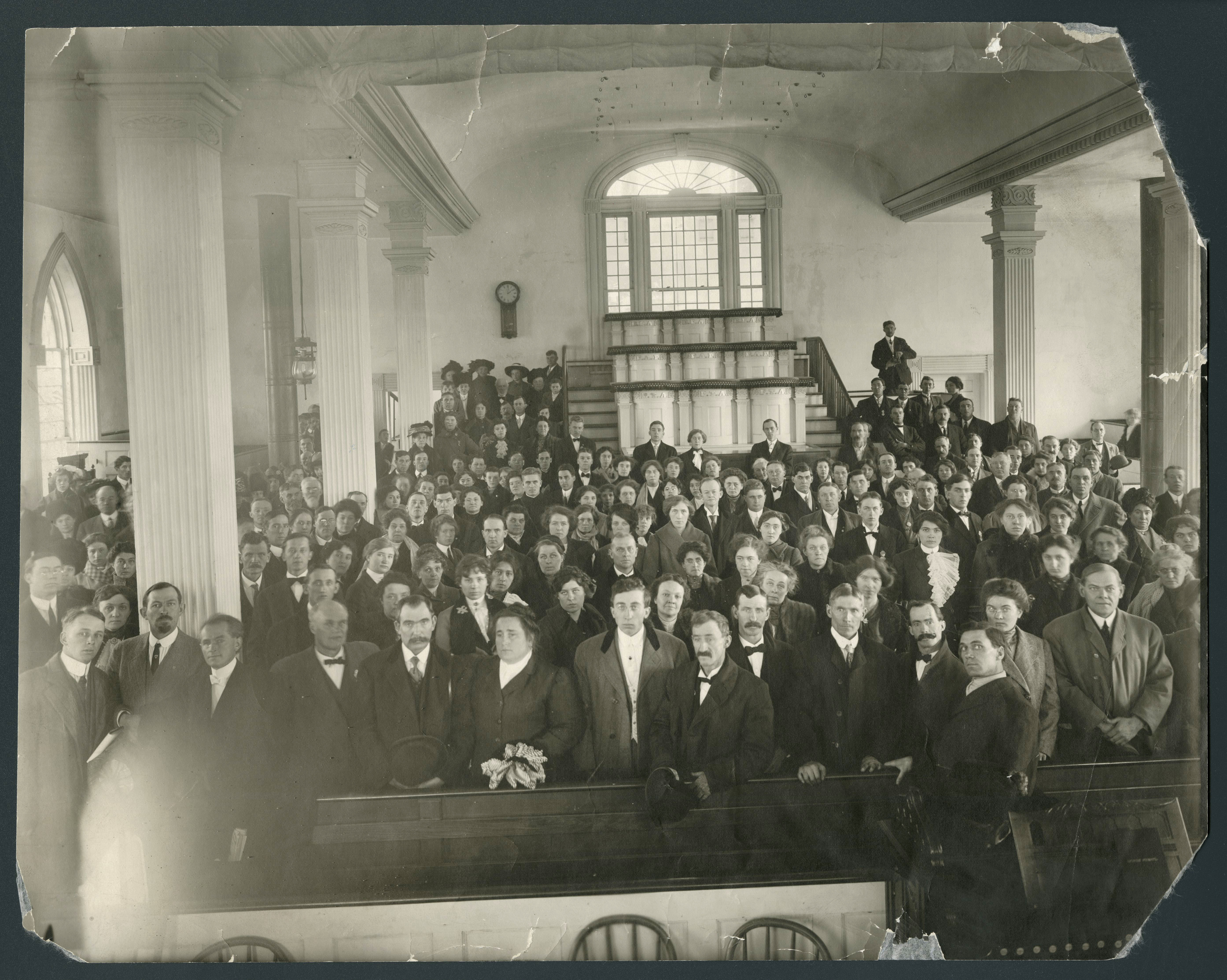 Figure 5.
 Members of the Tabernacle Choir visit the Kirtland Temple in 1911. Cour- tesy Church History Library.
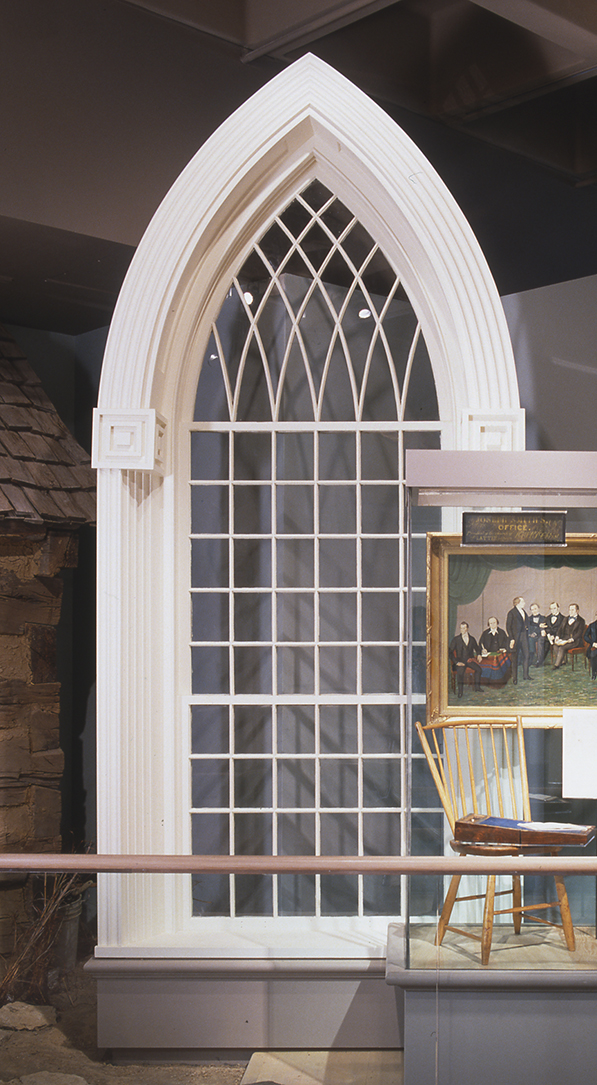 Figure 6.
 A window of the Kirt- land Temple, on display in the Church History Museum. Cour- tesy Church History Museum.
Original Kirtland Temple architectural elements. Original architectural elements that have been stored in different locations were also included in the transfer—the original oval window frame from the east face, many of the surviving original gothic windows (fig. 6) (except three kept for display by Community of Christ), the frame and keystone to one of the front doors, a stone arch, and pieces of original stucco and sandstone.
Historical artifacts in the Kirtland Temple. The transfer includes a writing desk associated with Joseph Smith and an 1820s couch associated with the Whitney family.
Kirtland Temple visitor center (9076 Chillicothe Road). Opened in March 2007, the center hosted a theater and exhibit, classroom, worship, and office spaces. The building features view windows of the Kirtland Temple and will continue to serve as the starting point for tours of the temple.
Other property in Kirtland. The transfer also included the grounds around the temple, a maintenance shop, three private residences (7788 Maple Street, 7799 Joseph Street, 9120 Timothy Lane), and an undeveloped lot on Joseph Street.
In Nauvoo, Illinois
The transfer in Nauvoo involved eighteen city blocks on the south end of the historic Nauvoo community that had previously been called the Joseph Smith Historic Site by Community of Christ. The core of the transaction revolves around the Joseph and Emma Smith properties. Emma Smith was deeded many of the properties in 1843. The Community of Christ chapel on Durphy Street was not included, nor was the Smith Family Cemetery. Many adjacent properties were transferred. The blocks and lots referenced below refer to an 1842 map of Nauvoo.
Smith Family Homestead (935 South Main Street on block 155, lot 1). When the Smiths moved to the area that would later be named Nauvoo following the Latter-day Saint expulsion from Missouri, Joseph and Emma first lived at what became known as the Smith Family Homestead. They stayed there with their four children from May 1839 to August 1843. This two-story log house sits near the eastern shore of the Mississippi River, and the main part of the home was built in 1823. A steady stream of visitors prompted Joseph to add a single-story addition on the north side around 1840 (fig. 7); sometime later, a two-story addition was also made on the west side. While principally a center of Smith family life, the home also provided the setting for hosting guests and various meetings, including one at which Joseph gave instructions about heavenly beings that were added to the Doctrine and Covenants as section 129 in 1876. To the northwest of the home is a tiny reconstruction made in the 1970s of the home of Joseph and Lucy Mack Smith that later served as a summer kitchen. After Joseph and Emma Smith moved to the Mansion House, this home was known as the “Old House” and hosted court sessions, prayer meetings, and priesthood councils. The lot was among the properties deeded to Emma Smith in July 1843, and in 1858, Joseph and Emma’s oldest son, Joseph Smith III, returned to the old homestead, completed the final addition, and raised his family there.
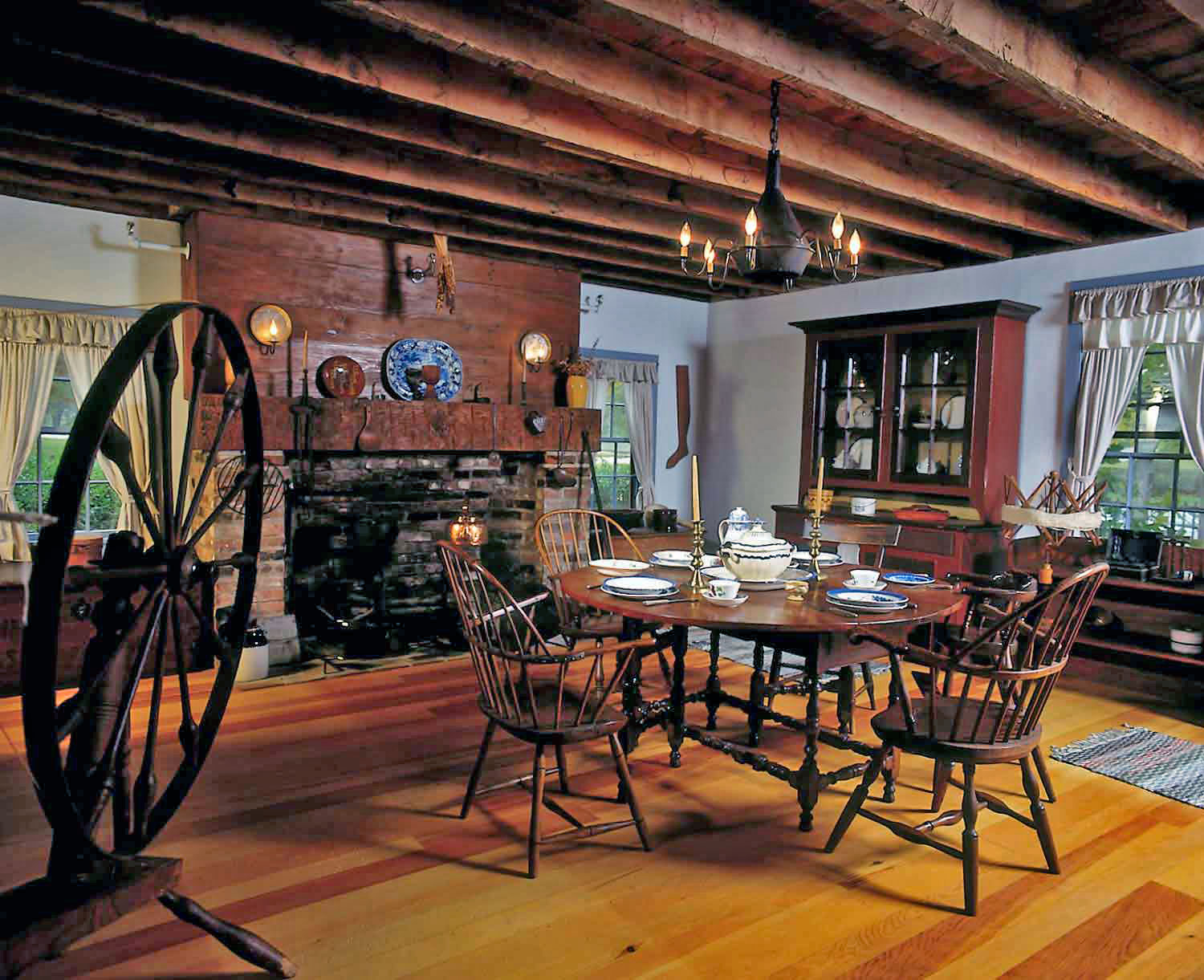 Figure 7.
 Inside the kitchen of the Joseph and Emma Smith Homestead, home of the Smith family from 1839 to 1843. Courtesy Community of Christ.
Joseph and Emma Smith’s Mansion House (890 South Main Street on block 147, lot 3, figs. 8 and 9). Joseph and Emma Smith moved their family to this two-story Greek Revival frame home in August 1843. Soon, a new (now no longer existing) wing on the east side of the home brought the total number of rooms to twenty-two, and this larger home served as a hotel to accommodate Joseph’s numerous guests. In January 1844, Joseph leased the home to Ebenezer Robinson, who managed the hotel with a provision that the Smith family retain rooms for their residence. The bar room served as a general gathering place, and the home hosted civic and Church councils and the mayor’s court. After their deaths, the bodies of Joseph and Hyrum Smith lay in state in the dining room in June 1844. Emma Smith continued to live here until 1871. The original residence still stands but the hotel addition was demolished in 1890. The Homestead and Mansion House are part of a new tour that describes the home life of Joseph and Emma and provides context for early Nauvoo history.
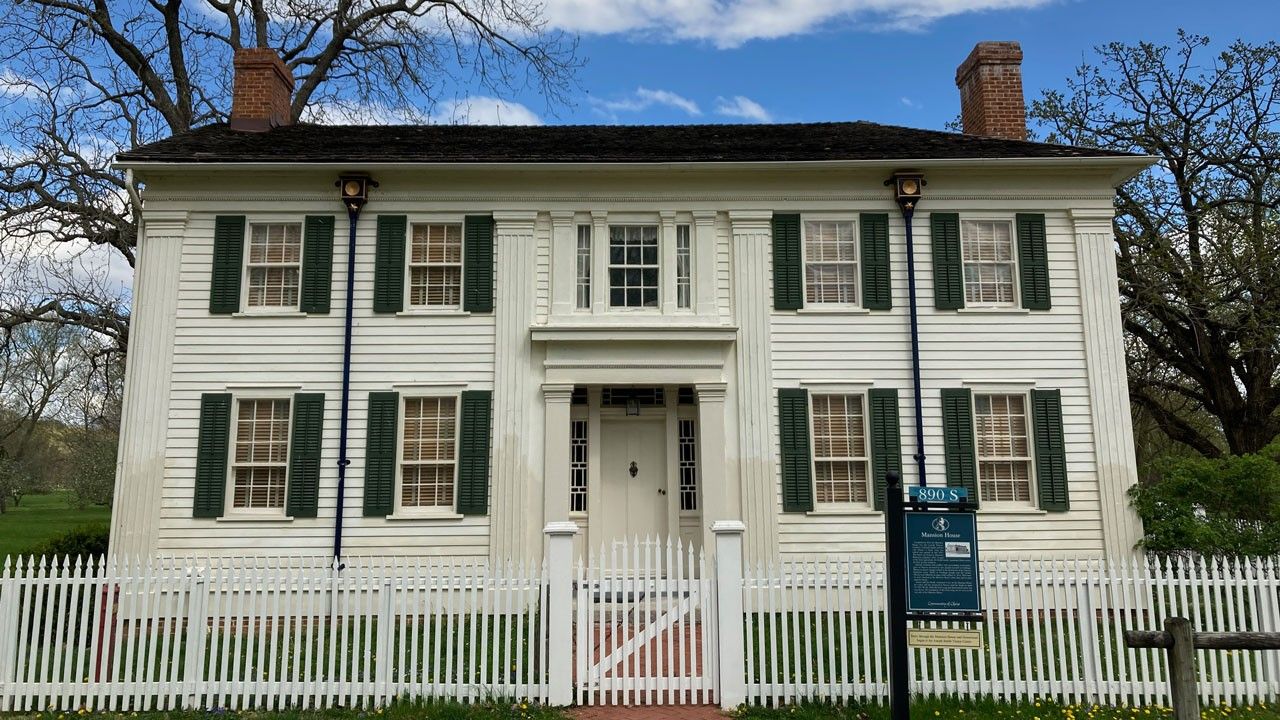 Figure 8.
 Joseph and Emma Smith moved their family to the Mansion House in 1843. Courtesy Church History Library.
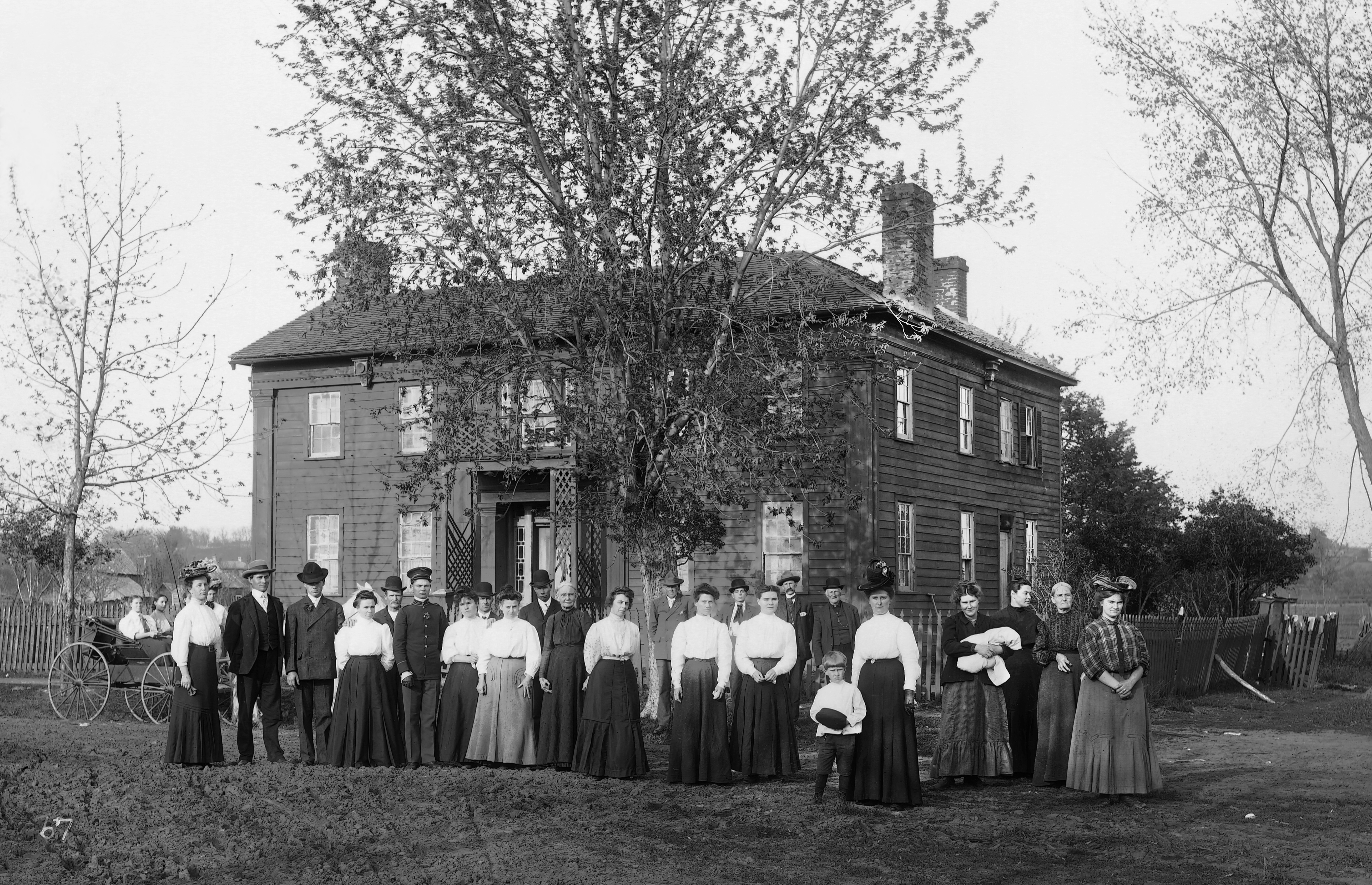 Figure 9.
 Visitors in front of the Mansion House in 1907. Photograph by George Edward Anderson. Courtesy Church History Library.
Reconstruction of Joseph Smith’s Red Brick Store (610 Water Street on block 155, lot 2, fig. 10). After its completion in 1841, this two-story brick building served as a store and meeting place throughout the remainder of Joseph’s life. The store opened for business on January 5, 1842, and, while owned by Joseph, it was managed mostly by others. The first floor housed the store and a counting room that served as Bishop Newel K. Whitney’s office, where he received and recorded tithing. On the second floor, a small room served as Joseph’s private office, where he and others prepared the Book of Abraham for publication.
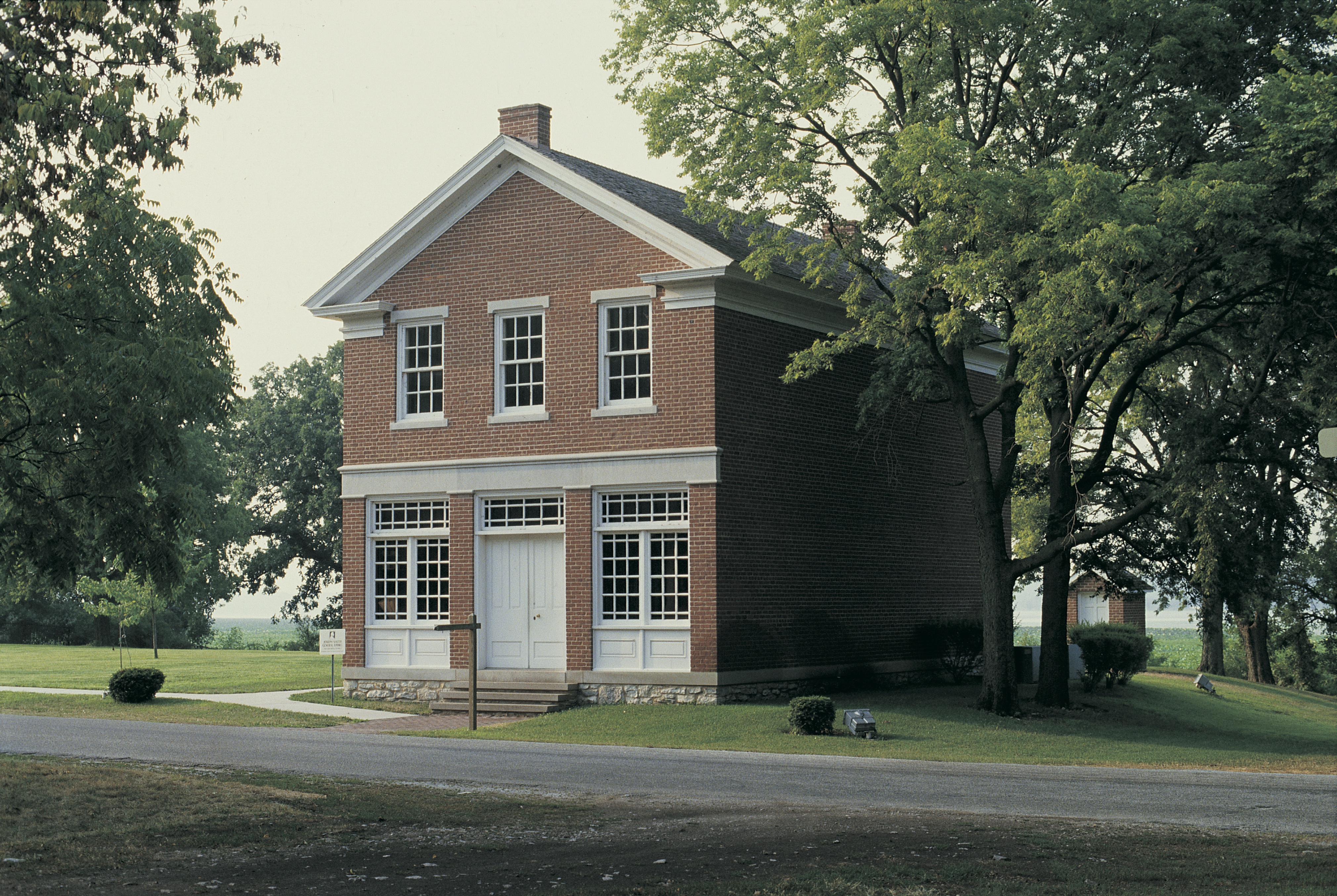 Figure 10.
 Joseph Smith’s Red Brick Store. Courtesy Church History Library.
The large upper room on the second floor was used as an assembly room where two significant events made the space sacred and shaped the future of the Church of Jesus Christ (fig. 11). First, on March 17, 1842, the Female Relief Society of Nauvoo was organized when twenty women of Nauvoo gathered along with Joseph Smith and two Church Apostles. The women selected Emma Smith as their president, decided on a name for their group, and defined their purpose as both helping others and saving souls. A few months later, on May 4–5, 1842, Joseph gathered a small group of men and introduced a religious ceremony known as the temple endowment that narrates the story of the Creation, Fall, and redemption of humans as a backdrop for introducing covenants that prepare participants to return to live with God again. The assembly room also hosted meetings of priesthood quorums, temple committees, the Nauvoo municipal court, the mayor’s court, the Masonic lodge, the Nauvoo Legion, and the Council of Fifty, as well as theatrical presentations, debates, lectures, and University of Nauvoo classes. The original building was torn down in 1890, and the present reconstruction opened in 1980. The Red Brick Store is featured in a new tour that describes the purpose of the store and focuses on the spiritual significance of the founding of the Relief Society and the beginning of the temple endowment.
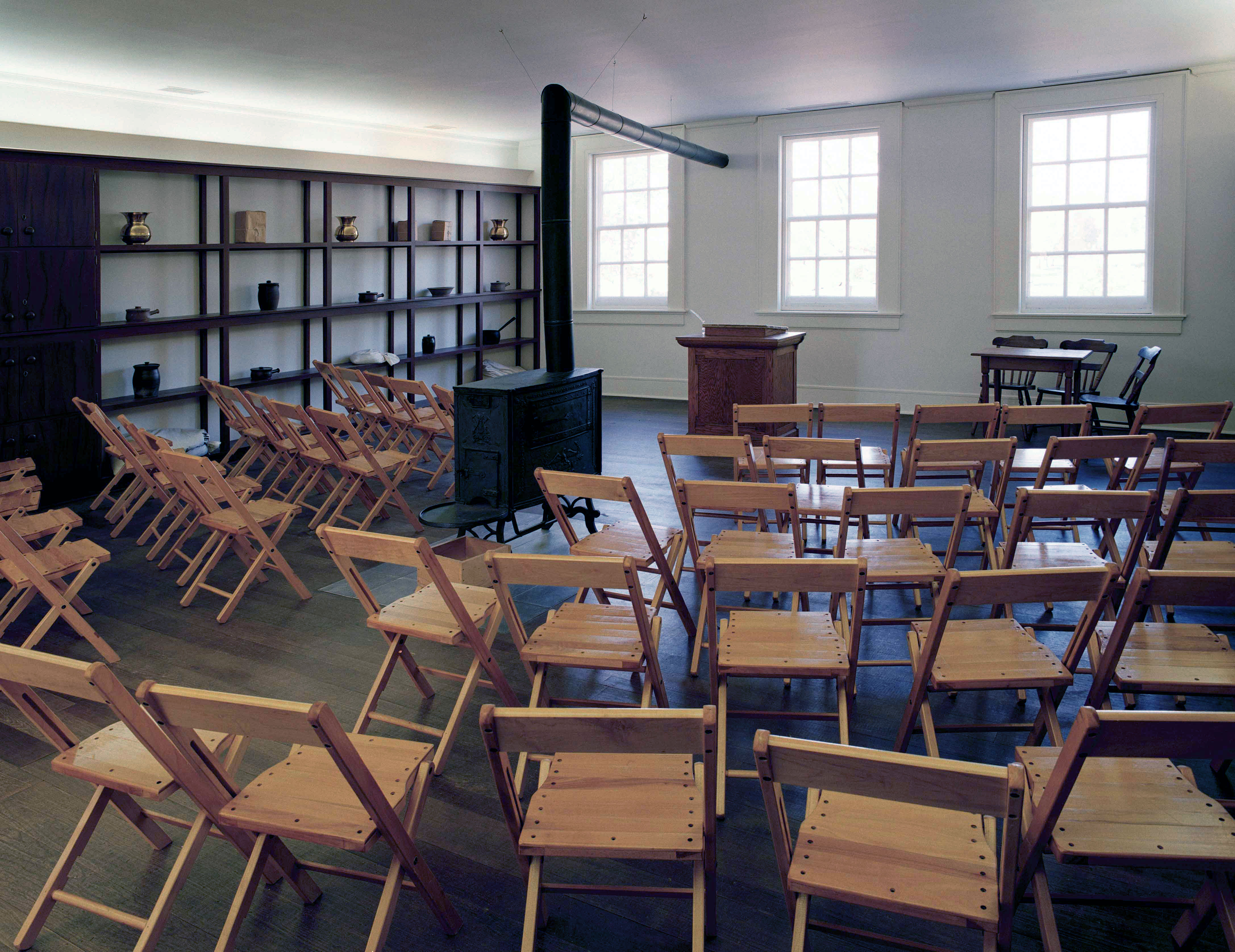 Figure 11.
 The assembly room on the upper floor of the reconstructed Red Brick Store. Photograph by Val Brinkerhoff. Courtesy Church History Library.
Remains of the Nauvoo House (950 South Main Street on block 156, lot 3, figs. 12 and 13). In January 1841, Joseph Smith received a revelation, now known as section 124 of the Doctrine and Covenants, in which the Lord commanded the Saints to build the Nauvoo Temple and a boarding house for travelers and immigrants. This building would come to be known as the Nauvoo House. A group of investors set out to raise funds by selling shares of stock, and while the cornerstone was laid in October 1841, the building was not completed beyond the windows of the second story. Before his death, Joseph instructed the Saints to stop work on the Nauvoo House so that resources could be used for the temple. After their deaths, the bodies of Joseph and Hyrum Smith were temporarily buried in the basement of the uncompleted structure on the night of June 29–30, 1844. All work on the building ceased when the Saints left Nauvoo in 1846, leaving the building not quite three stories high. After 1865, Emma Smith’s second husband, Lewis Bidamon, finished part of the building and repurposed some of its materials to create a stone stable (950 South Main Street on block 156, lot 2). He operated the house as a boarding house called the Riverside Mansion, and Emma lived here during the last eight years of her life, 1871–1879. The interiors of both buildings have been modernized and rented to visitors in the past.
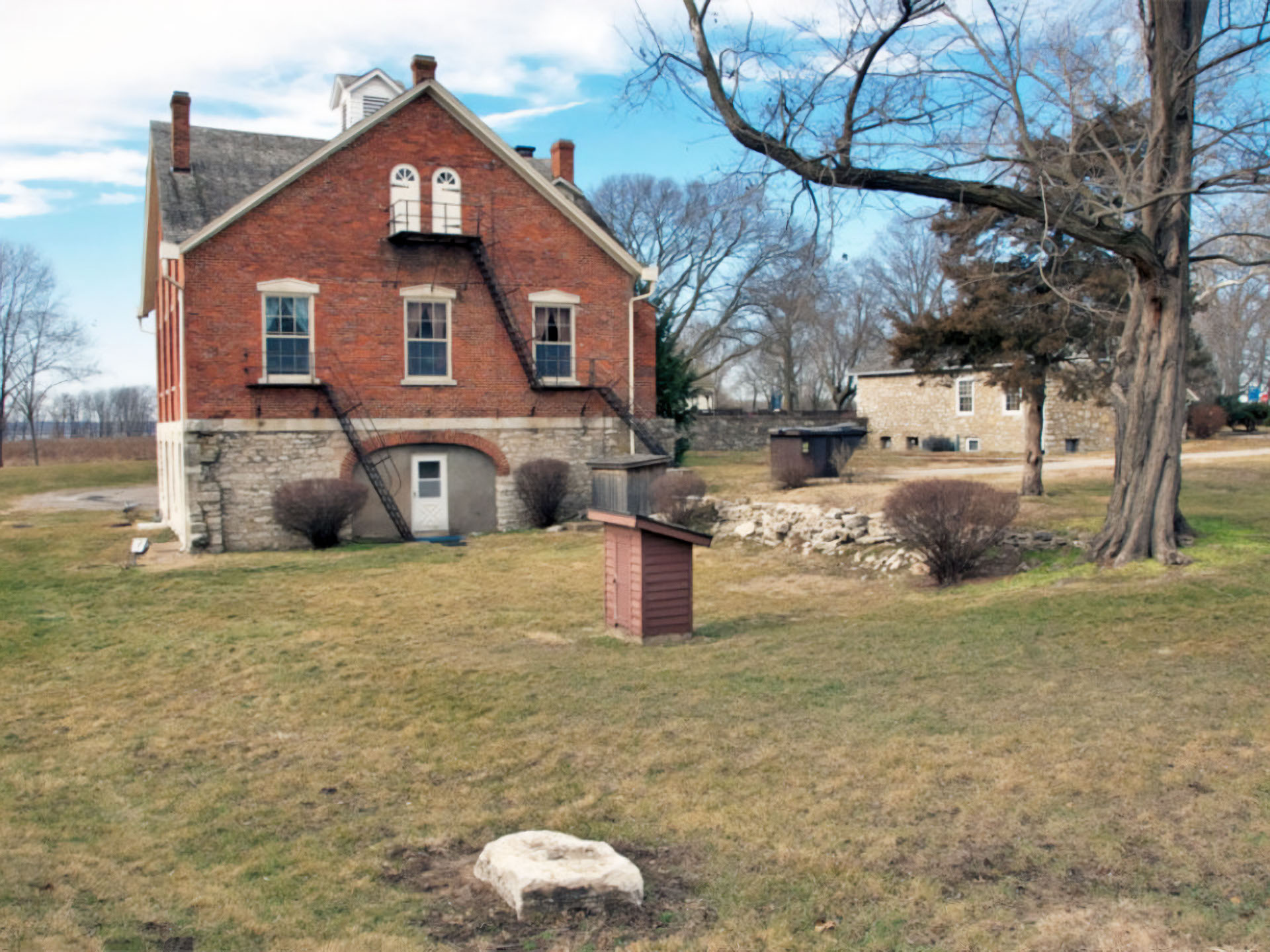 Figure 12.
 Remains of the Nauvoo House—a brick mansion and stone stable. The original location of the cornerstone identified by a white stone in the foreground. Courtesy Church History Library.
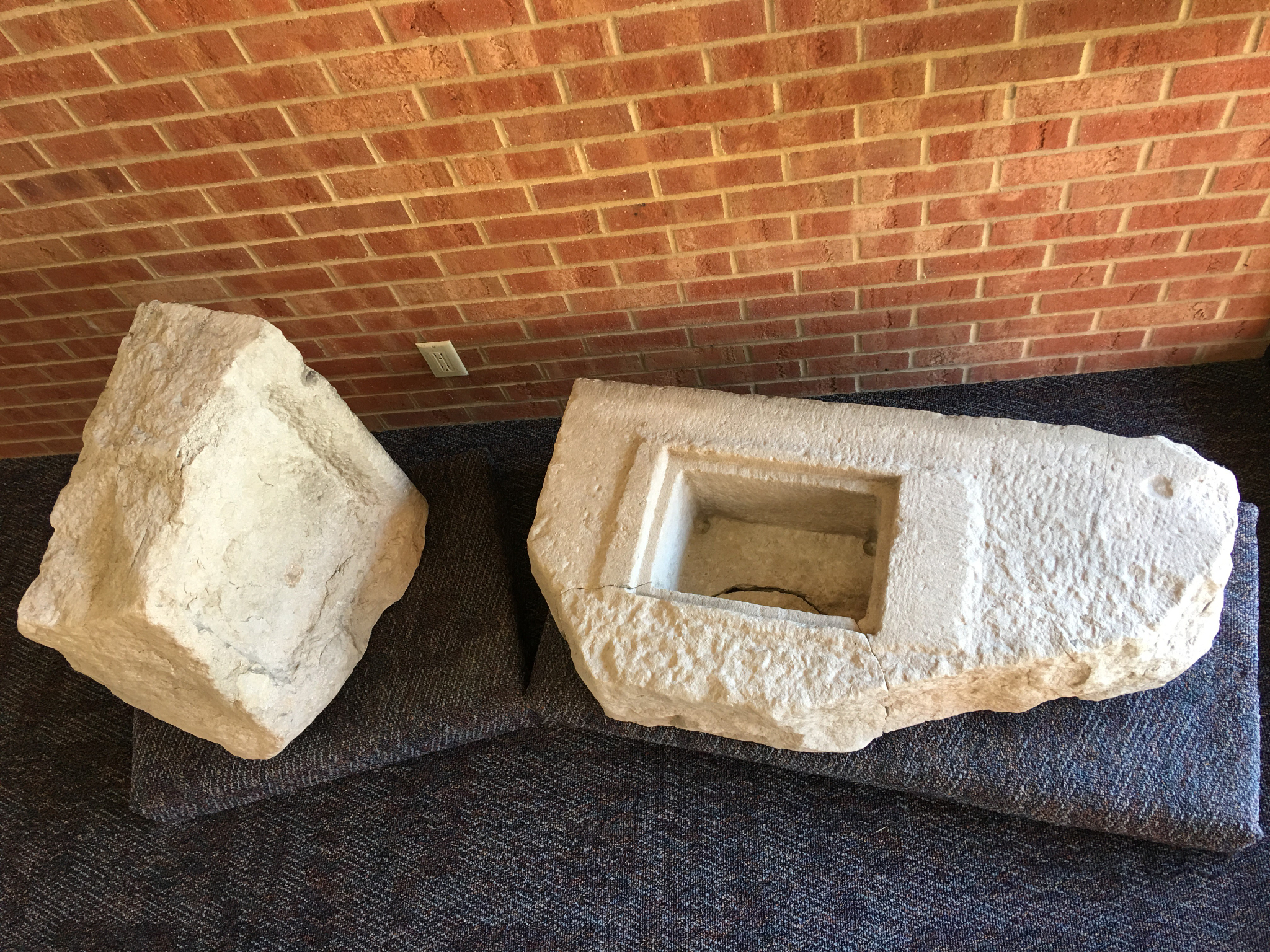 Figure 13.
 Nauvoo House cornerstone. Courtesy Community of Christ.
Historical buildings with modernized interiors. Included in the transfer are several historical homes that began as historic structures in Nauvoo in the 1840s but have been adapted and modernized over time (fig. 14). In recent years, they have served as residences for permanent and seasonal staff. The Sidney and Phebe Brooks Rigdon Home (860 South Main Street on block 147, lot 2) was built in the early 1840s and also served as the post office. Several additions have been made to the original home. Phebe urged her husband to join the Church in 1830 and offered stalwart support as Sidney served as scribe for Joseph Smith, counselor in the First Presidency, and running mate in Joseph Smith’s 1844 campaign for the United States presidency. The William and Rosannah Robinson Marks Home (575 Water Street on block 149, lot 4) was built in the early 1840s in a typical New England saltbox style. Rosannah was an early member of the Relief Society and among the first group of women to receive the endowment; William served as president of stakes in Kirtland and Nauvoo and as a member of the Nauvoo Legion and Council of Fifty. A barn has been added behind the home. The Jonathan and Rebecca Wheeler Wright Home (455 Water Street on block 150, lot 4) was built in the 1840s. Additions have been made to the side and back of the original home. Jonathan served as a missionary, but Rebecca died in Council Bluffs, Iowa, one month before her family emigrated west and settled in Brigham City, Utah. The Aaron and Polly Kelsey Johnson Home (475 Water Street on block 150, lot 43) was built in the early 1840s, and there has been an addition made to the rear of the home. Polly and Aaron served a mission together in 1848, and she passed away en route to Utah in 1850. Aaron served as justice of the peace and a member of the Nauvoo high council. He participated in plural marriage in Nauvoo and later served as a bishop in Springville and as a member of the Utah Territorial Legislature. The Hiram and Thankful Gill Clark Home (790 Soth Hyde Street on block 147, lot 1) also dates to the 1840s. Thankful and Hiram served a mission in England, and he served as steward of the Nauvoo Masonic Lodge. The south wing of the First Hotel (795 South Main Street on block 139, lot 4) was also known as the City Hotel and Mill’s Tavern.
-1.png) Figure 14.
Figure 14. Map of historic sites in Nauvoo. Courtesy Church History Library.
Sites with foundation stones or other remains. Several locations on the transferred property contain remains of past dwellings, many of which have been subject to archaeological excavation over the past decades. The first site of the Times and Seasons newspaper was in the cellar of an old warehouse; only the foundation stones now remain (Water Street on block 149, lot 3). The Times and Seasons published 135 issues between November 1839 and February 1846. The newspaper moved west across the street in 1841 and again in 1845 to Main Street. Joseph Smith served as editor for seven months in 1842 and published the translation and facsimiles of the Book of Abraham, the Wentworth Letter, and early segments of his history of the Church. Other exposed foundation stones exist at the Mansion House east extension, the Samuel H. and Levira Clark Smith home site (block 147, lot 1), the Levi Ward and Clarissa Reed Hancock home site (block 146, lot 4), and the James and Sally Snyder Brinkerhoff home site (block 146, lot 1). Other studied sites without visible remains include the site of Joseph Smith’s brick stable (block 156, lot 1), and the Theodore and Frances Kimberley Turley home site (block 147, lot 4). Frances and Theodore were baptized in England and emigrated to Nauvoo, where Theodore was a member of the Council of Fifty.
Original Nauvoo-era architectural elements. Several original architectural elements that have been stored in different locations were also included in the transfer—one Nauvoo Temple sunstone, two Nauvoo Temple moonstones, and the cornerstone of the Nauvoo House. There are three extant Nauvoo Temple sunstones—one is owned by the Smithsonian and is on display at the National Museum of American History in Washington, D.C.; the second is owned by the state of Illinois and has been loaned to the Church of Jesus Christ since 1991; the third sunstone has been on display in the Community of Christ visitor center in Nauvoo, Illinois. The Nauvoo House cornerstone was hollowed out to hold the Original Manuscript of the Book of Mormon. When Lewis Bidamon, Emma Smith’s second husband, opened this cornerstone in 1882, he discovered that most of the manuscripts had been destroyed through humidity and water damage. He rescued the remaining manuscript and often gave pages to Latter-day Saints passing through Nauvoo. The vast majority of the remaining manuscript is now at the Church History Library.
Historical artifacts in the publicly accessible historic homes. Three of the publicly accessible sites—the Homestead, Mansion House, and Red Brick Store—are home to several historical artifacts that were included in the transfer, including a desk made for Joseph Smith by Levi Hancock, a walking stick and a trunk with a false bottom associated with Emma Smith, a rocking chair associated with Lucy Mack Smith, and two Arrowback Windsor chairs. Other historical artifacts include a washstand associated with Hawn’s Mill, a sampler stitched in Nauvoo in the 1840s, and a bowl and three inkwells excavated from sites in Nauvoo. Three items on loan to Community of Christ in the Mansion House will be loaned to the Church of Jesus Christ: a dresser and mirror purchased by Emma Smith and a clock with hand-tinted engraving on glass.
Period artifacts in the publicly accessible historic homes. The three publicly accessible sites are filled with period artifacts that have been used as teaching aids to interpret the sites for visitors, all of which are included in the transfer. These period artifacts are not connected with the Smith family or other Saints who lived in Nauvoo.
Nauvoo Visitor Center (865 Water Street on block 146, lots 2–3). Opened in 1980 by the RLDS, the Center hosted two theaters and a small museum area. There are parking lots to the east of the Center and to the south of the Mansion House (Water Street on block 156, lot 2). Except for the artifacts noted above, the items that have been on display in the visitor center were not included in the transaction.
Other property in Nauvoo. The transfer also included a maintenance shop (Bain Street on block 150, lot 1), public restrooms (Granger Street on block 149, lot 4), a private residence (960 South Partridge Street on block 158, lots 2–3), undeveloped land, and riverfront property.
In Independence, Missouri
The Community of Christ Temple in Independence is home to a museum and library-archives that preserve numerous significant documents and artifacts from the early Restoration era. Selected items connected with scripture and Joseph Smith were included in the transfer.
Joseph Smith Translation materials. From 1830 to 1833, Joseph Smith worked on a new translation of the Bible. Joseph began this process by reading a copy of the King James Bible and dictating inspired corrections and additions to various people who served as scribes. Among the acquired items is the 1828 copy of the Bible published by H. & E. Phinney, with an inscription inside the front cover indicating it was purchased at the Grandin Book Store in Palmyra. This Phinney Bible does not contain changes or additions but rather employs a variety of different symbols that are keyed to manuscripts where the new content was recorded. There are also five scribal manuscripts—three for the Old Testament and two for the New that constitute 474 pages. Some of the manuscripts contain the full text of the Bible written out with the changes included for Genesis 1–24 and Matthew 1–John 5. Other manuscripts record only the changes made to individual passages indicated by symbols in the Phinney Bible. The manuscript known as “Old Testament Revision 1” also contains Joseph Smith’s revelation about the vision of Moses, the lives of Adam and Eve, the plan of salvation, and the life of Enoch, which is now known as the book of Moses in the Pearl of Great Price. Also included in the transfer is a 428-page manuscript prepared by the RLDS publication committee that produced the 1867 edition of the Holy Scriptures.
Portraits of Emma and Joseph Smith. These colorful, elegant portraits hung in the homes of Emma Smith throughout her life (figs. 15 and 16). Specific details about their creation are unknown, but they have been attributed to artist David Rogers, a Church member from New York who, according to Joseph Smith’s journal, visited the Smith home in September 1842 and spent several days working on a portrait of the Prophet.
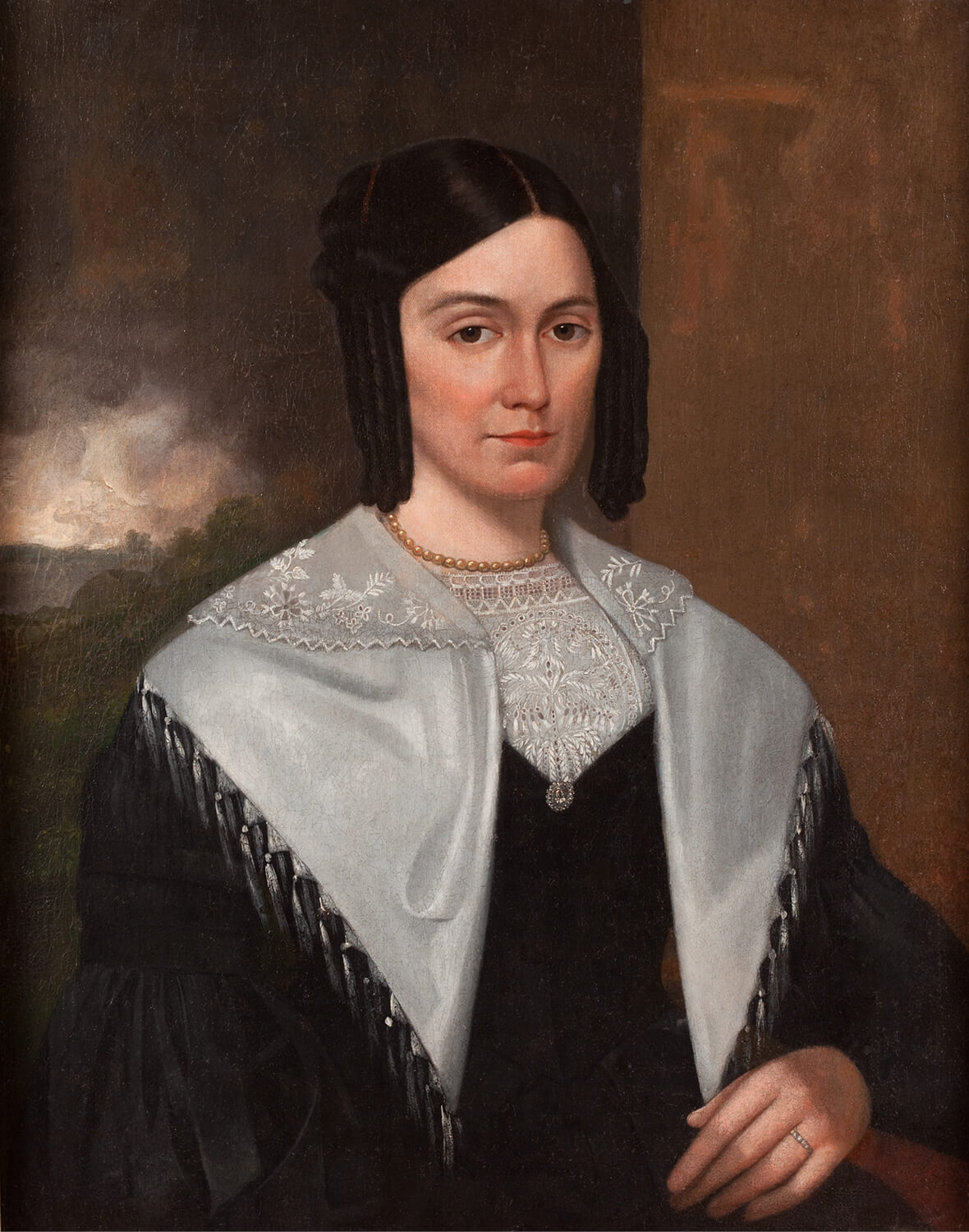 Figure 15.
 Portrait of Emma Hale Smith, attributed to David Rogers, ca. 1842. Courtesy Church History Library.
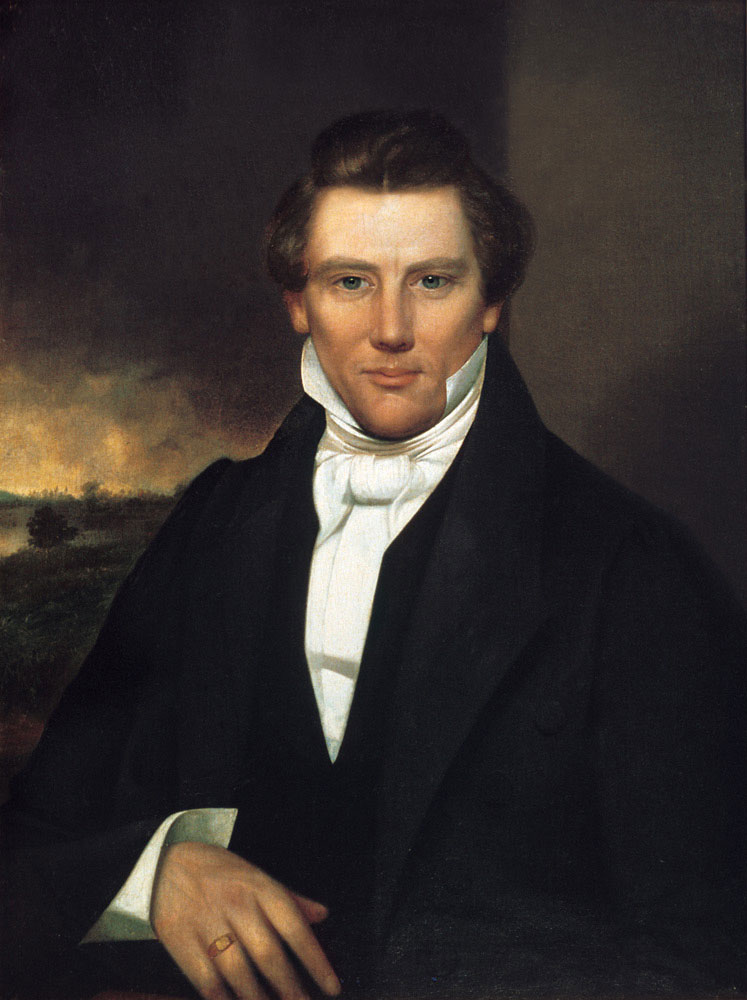 Figure 16.
 Portrait of Joseph Smith Jr., attributed to David Rogers, ca. 1842. Courtesy Church History Library.
Liberty Jail door. Joseph Smith and five other men were imprisoned in a jail in Liberty, Missouri, for crimes allegedly committed during conflicts with other Missourians in 1838. During the five harsh winter months from December 1838 to April 1839, the men experienced hunger, cold, and loneliness. Here Joseph Smith also received significant revelatory insights, dictated into a letter from which excerpts have been published as Doctrine and Covenants 121, 122, and 123. The jail continued in operation until 1856 and then fell into disrepair, but this original door survived. The Church reconstructed a replica of Liberty Jail on its original site in 1963 and continues to operate it as a historic site.
Book of Mormon characters. This copy of Book of Mormon “Caractors” (fig. 17) is sometimes mistaken for the page taken by Martin Harris to Professor Charles Anthon, but it is likely in the handwriting of John Whitmer and was likely made between 1829 and 1831. Though it does not derive directly from the process of Book of Mormon translation, the document may be illustrative of characters copied from the plates. It is one of three existing records of such characters.
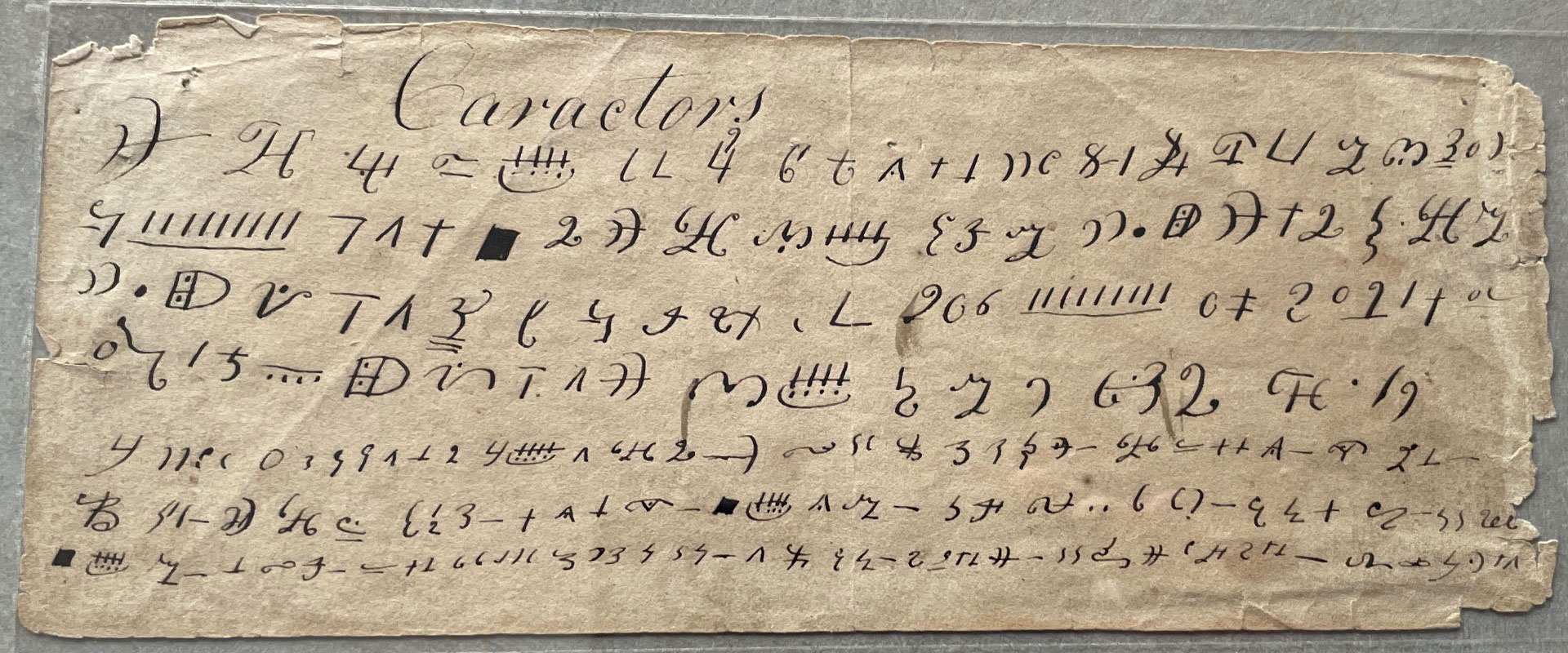 Figure 17.
 Book of Mormon characters, in the handwriting of John Whitmer, ca. 1829–1831. Courtesy Church History Library.
Manuscript pages of early revelations. The earliest act to preserve the revelations given to Joseph Smith was to copy them into a single volume. The book was begun by John Whitmer shortly after the Church was organized; it was titled “Book of Commandments and Revelations.” When published as part of the Joseph Smith Papers, this book was designated as Revelation Book 1. The transfer included four pages previously removed from Revelation Book 1 with writings on both sides. Pages 111–12 contain portions of revelations now known as Doctrine and Covenants 64, 65, and 66; pages 117–18 and pages 119–20 each contain a portion of Doctrine and Covenants 133; and pages 139–40 contain portions of revelations now known as Doctrine and Covenants 76 and 81. With the cooperation of Community of Christ, these pages were previously included in the Joseph Smith Papers and can be viewed on its website. With the addition of these four pages, all pages from Revelation Book 1 are now owned by the Church of Jesus Christ.
Letters from Joseph Smith to Emma Smith. Joseph Smith Jr. married Emma Hale in 1827, and they loved each other deeply. They raised their family through times of happiness and struggle. The seven acquired letters are from Joseph to Emma and are dated October 13, 1832; May 18, 1834; November 4, 1838; November 12, 1838; November 9, 1839; June 23, 1844; and June 27, 1844.
All but one of the letters are in Joseph Smith’s handwriting, and they describe his activities and express his love for his family. For example, in October 1832, Joseph Smith visited New York City for the first time. In his letter to Emma on October 13, Joseph commented on the tall buildings, expressed his longing to hold his little daughter Julia, and reported an effort to tell someone about the Book of Mormon. The May 18, 1832, letter was written while on the march with the Camp of Israel (Zion’s Camp). The two letters from November 1838 were written immediately after Joseph Smith was taken prisoner in Missouri and while Latter-day Saints were being expelled from the state. On November 4, he expressed surprise that he was greeted in Jackson County with a parade rather than jail (November 4). By November 12 he had been imprisoned, and Joseph Smith used an evocative metaphor to describe his situation: “Brother Robison [George W. Robinson] is chained next to me he he has a true heart and a firm mind, Brother Whight [Lyman Wight], is next, Br. [Sidney] Rigdon, next, Hyram [Hyrum Smith], next, Parely [Parley P. Pratt], next, Amasa [Lyman], next, and thus we are bound together in chains as well as the cords of everlasting love, we are in good spirits and rejoice that we are counted worthy to be persicuted for christ sake.” In that same letter, Joseph offered individualized comments to each of his four children and declared to his wife, “Oh my affectionate Emma, I want you to remember that I am <a> true and faithful friend, to you and the chilldren, forever, my heart is intwined around you[r]s forever and ever.” The letter dated November 9, 1839, expresses his anxiety for his family while en route to Washington, D.C., to seek redress for the Saints’ suffering in Missouri.
Joseph Smith wrote the final two letters to Emma in the tumultuous days preceding his murder. On June 23, 1844, he wrote from Iowa Territory as he considered options for how to address the legal charges against him and also to protect the Latter-day Saints. “I do not know where I shall go, or what I shall do,” he told Emma, “but shall if possible endeavor to get to the city of Washington.” Four days later, he had decided to face the charges in Carthage, Illinois, and was imprisoned in a jail there. On the morning of his death, June 27, he expressed his final words to his family: “I am very much resigned to my lot knowing I am justified and have done the best that could be done give my love to the children.”
Church history manuscript. Joseph Smith directed Church historian John Whitmer to prepare a history of the Church. Whitmer served as Church historian from 1831 until his excommunication in 1838. Before his call, he had already performed scribal and clerical duties but was reluctant to undertake the work of writing a historical narrative, so he asked for a revelation, which Joseph received in affirmation of the call (see D&C 47 and 69). Whitmer worked on the history throughout the 1830s and 1840s, and the resulting ninety-six page manuscript treats the years 1830 to 1847.
Interview. Joseph Smith III kept manuscript notes from a February 1879 interview with Emma Smith that was published in October 1879. In the interview, Joseph Smith III asked his mother about the translation of the Book of Mormon and her witness of its translation. In recalling her work as a scribe for her husband, as well as the broader translation process, Emma stated that “Joseph Smith could neither write nor dictate a coherent or well-worded letter, let alone dictating a book like the Book of Mormon. And, though I was an active participant in the scenes that transpired, and was present during the translation of the plates, and had cognizance of things as they transpired, it is marvelous to me, ‘a marvel and a wonder,’ as much as to any one else.” While serving as Joseph’s scribe, she recalled, he would “dictate to me hour after hour; and when returning after meals, or after interruptions, he would at once begin where he had left off, without seeing the manuscript or having any portion of it read to him.” Emma found it “simply impossible” that her husband would have been able to do this without divine aid. “My belief is that the Book of Mormon is of divine authenticity—I have not the slightest doubt of it,” she told her son.
Conclusion
In a press event following the announcement of the transfer, Elder Kyle S. McKay, Church Historian and Recorder, reflected on why the Church of Jesus Christ acquires historical sites, manuscripts, and artifacts. He pointed to the Old Testament when Joshua told his people to create a monument of twelve stones after God parted the River Jordan. In Joshua 4:24, Elder McKay said, “That is where Jehovah says the reason we want this monument there is so ‘all the people of the earth might know the hand of the Lord, that it is mighty.’ . . . And that, ultimately, is the purpose for all of the historic sites, all of the artifacts, all of the documents that we preserve, so that all the people of the earth, including the people in this Church, might know the hand of the Lord, that it is mighty.”
For Latter-day Saints, that is particularly true of the Kirtland Temple. On Easter Sunday, April 3, 1836, Joseph Smith recorded a series of visions in his journal. After helping distribute the sacrament to the congregation, Joseph Smith had gone with Oliver Cowdery to the pulpits of the temple, where a series of veils or curtains were used to provide privacy. “The veil was taken from our minds, and the eyes of our understanding were opened,” Joseph Smith testified.
We saw the Lord standing upon the breastwork of the pulpit, before us; and under his feet was a paved work of pure gold, in color like amber. His eyes were as a flame of fire; the hair of his head was white like the pure snow; his countenance shone above the brightness of the sun; and his voice was as the sound of the rushing of great waters, even the voice of Jehovah, saying: I am the first and the last; I am he who liveth, I am he who was slain; I am your advocate with the Father. . . . I have accepted this house, and my name shall be here; and I will manifest myself to my people in mercy in this house. (D&C 110:1–4, 7)
After the vision of Jesus Christ ended, Joseph Smith recorded that three other ancient prophets came to them. Moses gave to Joseph Smith and Oliver Cowdery “the keys of the gathering of Israel from the four parts of the earth.” Elias “committed the dispensation of the gospel of Abraham, saying that in us and our seed all generations after us should be blessed.” Finally, Elijah delivered keys, or divine authority, to “turn the hearts of the fathers to the children, and the children to the fathers” (D&C 110:11, 12, 15). The divine commission of the Church of Jesus Christ to gather Israel on both sides of the veil rests on the keys delivered that day in the Kirtland Temple.
For Latter-day Saints, historic sites, artifacts, and manuscripts are not just of academic or historical interest, though Church historians and curators use all of the traditional historical methods to learn more about them. Rather, Church leaders and historical professionals view these sites, artifacts, and manuscripts as a sacred trust that testify of the Lord Jesus Christ, of the restoration of his gospel, and of the “hand of the Lord, that it is mighty.”


