The copying of manuscripts is a human activity. Humans make mistakes. The longer the manuscript, the more mistakes. Thus, no two of the more than 5,600 complete or partial manuscripts of the New Testament are identical.1 Textual criticism is the discipline that deals with variations in the text. “It has sometimes been said that textual criticism is the crown and summit of all scholarship. This is not evidently or necessarily true; but it is true that the qualities which make a critic, whether they are thus transcendent or no, are rare, and that a good critic is a much less common thing than for instance a good grammarian.”2
Textual criticism can be used for many different things. For example, it can study the errors that scribes made to determine scribal habits. Although scribes may each have had their own habits, many of these habits fell into general scribal tendencies. Textual criticism can also be used to group similar textual variations together. Going further, establishing relationships between manuscripts or groups of manuscripts allows the construction of a stemma of those relationships, which can allow one to reconstruct which manuscripts might be closer to the original. In theory, one can use textual criticism to reconstruct the original reading of the text, but this is the case only if the original reading has survived. Scholars know this, and they sometimes conjecture readings that they think are original but did not survive. Conjectured readings, however, “should have no place in a Greek New Testament text.”3 While many of these conjectures are reasonable, they are also speculative, and there is no empirical way of verifying whether the guess is accurate. The danger of the conjectural reading is that we may be rewriting the text to say what we want it to say rather than what it actually said. The more cautious, responsible approach is to limit ourselves to readings that are attested in the manuscripts, not because they are perfect but because, as mere scholars, we should not trust ourselves to rewrite them.
It is precisely the ability of scholars to rewrite the text that leads cautious and alert individuals to suspect that there is something fishy about textual criticism and that textual critics cannot be trusted. They note that “any attempt to analyse good or bad readings in a Greek New Testament is both selective and subjective.”4 Therefore, they think that, when it comes to textual criticism, “the sins committed by biblical scholars in connection with the Greek N[ew] T[estament] are far too numerous.”5 Some suspect that textual critics, rather than restoring the original text, are merely manipulating it for personal or theological ends: “New Testament textual criticism from the time of Erasmus onward has been detrimental to Christian virtues. It has turned out to be a breeding ground of rabies theologorum. It should be abolished for ethical reasons. Fortunately, even comprehensive NT commentaries do care very little for textual criticism anyhow.”6
Latter-day Saints should have other reasons for being interested in textual variants7 since prophets have stated that parts of the Bible have been corrupted. Joseph Smith is famously reputed to have stated, “I believe the Bible as it read when it came from the pen of the original writers. Ignorant translators, careless transcribers, or designing and corrupt priests have committed many errors.”8 Textual criticism bears this out.
Manuscript variation can be deliberate or accidental. Accidental variation is usually called scribal error. Deliberate variation is editorial work by the scribe. Determining whether variation is accidental or deliberate is often difficult because it requires ascertaining the intentions of the scribe. Unless it can be argued otherwise, one generally assumes that the change in the text is accidental—especially if it fits in a known category of accidental mistakes.
This survey will not cover even a fraction of the textual changes in the New Testament. As one textual critic put it: “The best estimate is that there are between 300,000 and 400,000 textual variants among the manuscripts,”9 of which about 10,000 appear in the better critical editions.10 This study will attempt to cover all the major categories of textual changes. It will also provide real examples of textual corruption that make a difference in how the text was read and thus understood. It will also identify places where one can argue that plain and precious things have been lost from the traditional text.
Frequency of Scribal Errors
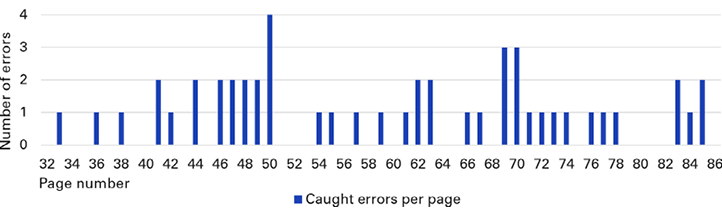
To get an idea about the frequency of scribal errors, consider a literary text that is not part of the New Testament. Looking at places where the scribe catches his mistake and corrects it (also called corrections in scribendo) gives some idea of the frequency of mistakes if we assume that the scribe is likely to catch his mistakes. As an illustration, for the Gospel of Thomas and the Gospel of Philip in Nag Hammadi Codex II,11 we have the following chart of the number of errors per page:
As is clear from the chart, one expects the scribe to have caught an error roughly every other page, but as time goes by, more mistakes were made. After the beginning of a new book (at p. 51 and p. 86), there is a huge drop in the number of mistakes caught. Presumably the scribe would have taken a rest at the end of the book, and when he started again, he was fresh and thus making fewer errors. Over the course of fifty-five pages, the scribe made forty-six mistakes, for an average of slightly less than one per page. These, of course, are only the errors that the scribe caught and corrected.
By comparison, in early New Testament manuscripts, the error rate ranges between 1.0 and 7.9 per hundred words,12 with a mean of 4.2 and a median of 4.9. This means that scribes made a mistake on average every twenty to twenty-five words. Even the most highly trained scribes typically made one mistake every hundred words, while an average scribe made four times as many errors and a poor scribe made significantly more errors. These examples deal with honest, well-meaning individuals—most New Testament scribes fit that category—not those who deliberately altered the text. There were some of those too.
Types of Scribal Errors
Scribal errors fall into general categories, including orthographic and grammatical errors, linguistic updating, omissions, additions, harmonization, and doctrinal adjustments. We will examine these one at a time.
Orthographic Errors
Biblical manuscripts, like other ancient documents, often contain spelling errors. Text editions, even critical editions, almost always correct these spelling errors, making them invisible to the modern reader.13 Consequently, most discussions of textual criticism ignore orthographic variants.14
Many of the orthographic variants come from sound shifts, which indicate changes in how a letter is pronounced.15 Common sound shifts can be tracked over time.16 The following table illustrates orthographic variations over time by displaying the number of spelling errors caused by particular sound shifts17 found in twenty random papyri from each century.18 Although this particular random sample does not include all sound shifts, it does demonstrate the range of shifts and how they changed over time. (Bolded rows highlight sound shifts that survive in modern Greek.)
Shift
4th c. BC
3rd c. BC
2nd c. BC
1st c. BC
1st c. AD
2nd c. AD
3rd c. AD
4th c. AD
5th c. AD
α → ε
2
1
1
α → ο
1
2
αι → α
1
2
αι → ε
1
3
1
8
9
4
αυ → α
1
1
4
1
ε → α
2
2
7
ε → αι
1
7
35
3
ε → ει
1
1
ε → η
1
1
1
1
ε → ι
1
1
ε → ο
1
1
1
ει → ε
1
2
1
1
ει → η
2
3
2
1
4
ει → ι
9
35
23
7
38
73
24
η → ε
3
2
η → ει
5
1
1
η → ηι
1
2
2
5
η → ι
1
2
η → ω
1
ηι → η
3
ι → ε
1
1
2
ι → ει
3
12
18
14
22
7
10
ι → υ
2
ο → α
1
2
1
ο → ω
8
4
16
4
6
οι → αι
3
2
οι → ο
1
1
2
1
οι → υ
5
4
2
1
ου → ο
5
2
1
1
1
ου → ω
1
1
6
υ → η
2
υ → οι
1
υ → ου
1
2
1
υι → ει
1
ω → ο
1
3
5
19
6
9
9
2
ω → ου
1
2
5
1
ω → ωι
1
6
5
6
2
It is important to recognize that some of these sound shifts (like ει ↔ ι and ο ↔ ω) took place before the New Testament was written.19 We cannot expect that the New Testament authors wrote their works in correct classical orthography. Later copyists would have corrected the orthography and therefore edited the manuscripts they were copying. The unevenness of the spelling errors in the manuscripts indicates that virtually all scribes acted as editors of the texts that they copied—not just as copyists.
While spelling errors from a shift in pronunciation might indicate scribes taking dictation as someone read the text,20 it can also be caused by subvocalization—where a scribe sounds out the words in his mind.21 In the ancient world, reading was almost always done aloud.22 Augustine relates that Ambrose of Milan was an exception: “But when he was reading, his eye used to be guided through the pages, and his heart used to search out the meaning, but his voice and tongue were immobile.”23 Although subvocalization likely occurred, the most common ancient practice was for scribes to read the words aloud while copying.
Other sound shifts came after the New Testament was written. These sound shifts can create textual variants. For example, in Matthew 24:7, the standard printed text has καὶ ἔσονται λιμοὶ καὶ λοιμοὶ καὶ σεισμοὶ κατὰ τόπους, “and there will be famines and plagues and earthquakes in places.” By the second century, λιμοὶ (limoi) and λοιμοὶ (loimoi) were pronounced identically.24 The fourth-century Codex Vaticanus collapsed these two words to one word: λιμοὶ (limoi), “famines.” Patristic Greek drops the term λιμὸς (limos), “famine,” and keeps λοιμὸς (loimos), “plague,” but changes the gender to feminine: λοίμη (loimē), “plague.”25 Because the scribes could not distinguish “famine” from “plague” in pronunciation, the scripture was simplified. In this case, the earlier manuscripts do not preserve the more accurate reading.
The sporadically attested sound shift ου → ω26 might be the cause of a textual variant in Matthew 25:1, where εἰς ὑπάντησιν τοῦ νυμφίου (nymphiou), “to the meeting of the groom,” becomes εἰς ὑπάντησιν τῷ νυμφίῳ (nymphiō), “to meeting the groom,” in the fifth-century Codex Ephraemi Rescriptus. Another explanation is that while the verb ὑπαντάω (hypantaō) normally takes the dative (such as Matt. 8:28), it can also take the genitive,27 and the scribe may have corrected the text to the more common dative usage. Thus, this might be an example of a grammatical error.
One of the clearest instances where the orthography presents a problem is with the personal pronouns. By the first century AD, η (eta) was being written for υ (upsilon), and by the end of the first century υ (upsilon) was written for η (eta).28 There was a complete confusion of the two letters. This means that the first- and second-person plural personal pronouns (“we” and “you”) were pronounced identically. Eventually, a new form of the second-person plural pronouns was introduced, and it has survived into modern Greek.29 These errors permeate the places in the New Testament where these pronouns are used most often: the Epistles. The identical pronunciation happens in all grammatical cases, and it can significantly change or confuse the meaning. Context does not always determine the correct pronoun easily. According to 2 Corinthians 6:16, are “we” the temple of the living God or are “you”? Confusion in the manuscripts appears in the following places:
Similar variation in derived forms appears in Luke 16:12 (ἡμέτερον / ὑμέτερον [hēmeteron, “our own” / hymeteron, “your own”]) and Acts 27:34 (ἡμετέρας / ὑμετέρας [hēmeteras / hymeteras]).
Although orthographic variants are usually ignored by textual editions, they can make a big difference in how the text is understood.
Grammatical Errors
Few of the New Testament authors were native Greek speakers. Luke seems to have been one, but he may have been the only one. Even Paul, who grew up in Tarsus, which at least was a Greek area, does not seem to have been a native speaker. The Christian scholar Origen, himself a native speaker, commented on how bad Paul’s Greek was.30 Even Luke wrote in Koine Greek and not good classical Greek. The New Testament writers wrote in the best Greek that they knew, but their grammar was not always perfect—a fact that bothered some later native speakers.
Certain copyists insisted on fixing the bad Greek of the New Testament writers. In James 3:3, the fourth-century Codex Sinaiticus has εις το πιθεσ‵θ′αι αυτους ημιν (eis to pithesthai autous hēmin). The fourth-century Codex Vaticanus has εις το πειθεσθαι αυτ‵ο′υ‵ς′ ημιν (eis to peithesthai autous hēmin). The fifth-century Codex Alexandrinus has προς το πειθεσθαι ημιν αυτους (pros to peithesthai hemin autous), all of which translate as “that you may obey us.” Normally in classical Greek, the dative, or indirect object, precedes the accusative, the direct object. The opposite is true of Hebrew. The earlier manuscripts preserve the original unusual order in James. Codex Alexandrinus (as is somewhat typical of this manuscript) transposes the words to make it fit normal Greek syntax.
Linguistic Updating
Over time, as manuscripts were copied, archaic or obsolete passages would sometimes be updated to reflect the most current language. This phenomenon is better known from the Hebrew Bible. For example, in Genesis 12:15, the Masoretic text has ותקח האשה בית פרעה “and the woman was taken (to) the house of Pharaoh” where the preposition “to” is missing, though the earlier form of Hebrew did not require it. The Samaritan Pentateuch, an older manuscript, has ותקח האשה ביתה פרעה “and the woman was taken to the house of Pharaoh.”
The Samaritan Pentateuch preserved the locative “he” in construct for the noun “house,” a linguistic phenomenon that only occurs in preexilic Hebrew texts.31 The Masoretic text has dropped this archaic feature and linguistically updated the text. In this particular instance, the change makes no difference in the translation.
Linguistic updating applies to all textual versions and is not necessarily uniform across all versions. For example, in some places, the Dead Sea Scrolls may preserve an older form, while in a different place in the same book, the much later Masoretic text may preserve the same older form.
Linguistic updating or correction also occurs in the New Testament. In Matthew 27:5, the reading variants deal with whether Judas threw the money ἐν τῷ ναῷ (en tō naō [dative]) or εἰς τὸν ναὸν (eis ton naon [accusative]); both translate as “into the temple.” The fourth-century manuscripts (Sinaiticus and Vaticanus) read εἰς τὸν ναὸν, and the fifth-century manuscripts (Alexandrinus and Ephraemi) read ἐν τῷ ναῷ. The older Greek form was to use ἐν + dative to indicate motion toward a place.32 By the time the New Testament was being written, this expression began to be replaced by εἰς + accusative.33 In this example, the earlier manuscripts, which are still about three centuries after the original account was written, do not attest the linguistically earlier reading.
The famous passage in James 1:5 reads in English, “Let him ask of God who giveth to all men liberally and upbraideth not.” The fourth-century Codex Sinaiticus has αιτιτω παρα του διδοντος ΘΥ πασιν απλως και μη ονιδιζοντο‵ς′. The fourth-century Codex Vaticanus has αιτειτω παρα του διδοντος ΘΥ πασιν απλως και μη ονειδιζοντος. The fifth-century Codex Alexandrinus, however, has αιτειτω παρα του ΘΥ του διδο(ν)τος πασιν απλως και μη ονιδιζοντος.
All these versions would be translated the same way in English because English cannot follow the flexible syntax of Greek. In classical Greek, it was common to place the attributive participle (διδόντος [didontos], “giving”) before the noun (θεοῦ [theou], “of God”) and, separated from its adjuncts, the words that modify it (πᾶσιν ἁπλῶς [pasin haplōs], “to all sincerely”).34 In Koine Greek, this was more unusual and awkward, and so it most often included the adjuncts with the participle between the article and the noun.35 Starting in the second century AD, it was more common to place the participle with its adjuncts after the noun it modifies,36 which is the order followed in Codex Alexandrinus. Though this syntactic difference is invisible in translation, it is still an indication of linguistic updating.
Omissions and Additions
When comparing two manuscripts wherein one has material that the other does not, what looks like an addition from the view of one manuscript will look like an omission from the view of the other manuscript. Which reading is correct? This may not be obvious for any given reading.
It might be helpful to know the relative frequency of additions to omissions. Which mistake was more common? Most textual editors assume that additions were more frequent than omissions. But the method employed for the most part by editors over the last hundred years from Tischendorf and Hort to the 2012 Greek New Testament issued by the United Bible Societies has been to apply “two simple rules: A. Follow the Alexandrian uncials (principally א B and the early papyri); B. When in doubt, select the shorter reading.”37 This is normally formulated as a rule (in Latin): lectio brevior potior, “the shorter reading is to be preferred.” This rule assumes that additions are more common than omissions.
Although this rule is widely held, many have questioned it. Unfortunately, there have been few empirical tests of the proposition. This occurs in part because most text critics come from the humanities and thus tend to have an aversion to mathematics. Another reason comes from an analogy put forth by the most readable textual critic A. E. Housman:
[Textual criticism] is not susceptible of hard-and-fast rules. It would be much easier if it were; and that is why people try to pretend that it is, or at least behave as if they thought so. Of course you can have hard-and-fast rules if you like, but then you will have false rules, and they will lead you wrong; because their simplicity will render them inapplicable to problems which are not simple, but complicated by the play of personality. A textual critic engaged upon his business is not at all like Newton investigating the motions of the planets: he is much more like a dog hunting for fleas. If a dog hunted for fleas on mathematic principles, basing his researches on statistics of area and population, he would never catch a flea except by accident. They require to be treated as individuals; and every problem which presents itself to the textual critic must be regarded as possibly unique.38
We need to make a distinction between individual problems in any particular passage, which should be treated on an individual level, and general (rather than hard-and-fast) rules that should correspond to the empirical reality for entire texts.
How frequent are omissions? One method proposed for measuring the changes is to look at the singular readings of a manuscript. Singular readings are readings in one manuscript that are not found in other manuscripts. They are thus less indicative of a general trend in the text and more indicative of the idiosyncrasies for that particular manuscript. One can only talk about singular readings where there are a large number of manuscripts, like the books of the Bible or the works of Homer. Most ancient works have a handful of manuscripts at most, and so singular readings cannot be an issue.
On the one hand, singular readings can show characteristics of one particular scribe; on the other hand, if multiple scribes coincidentally make the same mistake, then the reading is no longer singular; consequently, looking at singular readings will not identify the scribe’s error. Looking at New Testament papyrus manuscripts, we notice that, of the singular readings in 𝔓45, 28.6 percent are omissions.39 Many of these are of more than one word. Of the singular readings in 𝔓46, 35.6 percent are omissions.40 Many of these are of more than one word. Depending on how they are counted, either 28.3 percent or 30.2 percent of singular readings in 𝔓47 are omissions.41 In 𝔓66, 18.3 percent of the singular readings are omissions, but this is after later correctors restored many omitted phrases, words, and parts of words.42 Of the singular readings in manuscript 𝔓72, 29.7 percent are omissions.43 In manuscript 𝔓75, 32.1 percent of the singular readings are omissions.44 In manuscript 𝔓127, 30.5 percent of the singular readings are omissions.45 Thus the attested range of omissions among singular readings in early New Testament papyrus manuscripts is between 18.3 percent and 35.6 percent. By itself, this observation is incomplete.
How frequent were additions to the text? Of the singular readings in 𝔓45, 13.8 percent are the result of addition; all but four are a single word.46 Of the singular readings in 𝔓46, 11.5 percent are additions; only two additions are two words rather than one word.47 Among singular readings in 𝔓47, 11.3 percent or 13.2 percent are additions. Of the additions, the only one more than a single word is a dittography.48 In 𝔓66, between 13.8 percent and 15.6 percent of the singular readings are additions.49 Only three of them are two words long; the rest are a single word. Of the singular readings in manuscript 𝔓72, 18.9 percent are additions.50 These additions are only one word, with one exception that adds four. In manuscript 𝔓75, 10.4 percent of the singular readings are additions.51 In manuscript 𝔓127, 17.2 percent of the singular readings are additions.52 Hence, additions account for between 10.4 percent and 18.9 percent of the singular readings. On average they occur about half as often as omissions.
If one pools the manuscripts together and drops the ambiguous cases, then 43.1 percent of the singular readings are omissions and 13.0 percent are additions, which means that there are 3.3 times as many omissions as additions among singular readings.
Another way to look at the problem is to look at errors that the scribe corrected while copying—corrections in scribendo, as they are termed in Latin. In the same set of manuscripts,53 omissions account for 32.0 percent of the corrections in scribendo, while additions account for 12.5 percent of the corrections in scribendo. Of these corrections, omissions are 2.6 times as frequent as additions. One can also look at corrections by later hands, which were presumably comparing the manuscript with others. This yields 27.8 percent of the errors being omissions and 0 percent additions.54 By various ways of checking for errors, omissions are 2.6 to 3.3 times as likely as additions. J. M. Ross stated, “It usually requires more effort to add than to omit, so that mere carelessness would tend to shorten rather than enlarge the text.”55
After examining the evidence, James R. Royse asked “how earlier scholars could have formulated a rule that so clearly—as it turns out—goes against the scribal activity evidenced in our papyri.”56 He answers his question, in part, as follows:
The frequency with which scholars such as Hort and Metzger appeal to the preference for the shorter reading is doubtless in part due to the ease and objectivity of its application. Whether a particular reading fits the style of the author, is grammatically smoother, follows Semitic idiom, or is theologically more acceptable, is usually very much a matter of debate, and reaching any decision on such issues would involve the weighing of a great deal of evidence. But deciding whether one reading is shorter than another is, at least usually, a perfectly straightforward task. It is therefore convenient to reduce textual questions to questions of length, and then to decide accordingly.57
While this does not mean that there are no additions to the text, omissions are significantly more likely to occur than additions, so textual critics should not rely on a rule that gives them the wrong answer the majority of the time.
Omissions. The most common scribal mistake is to drop something, such as a letter, a word, or a phrase. The technical term for this mistake is haplography. Most omissions are accidental, but some are intentional: “A scribe may have omitted material which he deemed to be superfluous, harsh or contrary to pious, liturgical usage or ascetical practice.”58
Dropping a letter is a frequent occurrence that is mostly obvious and readily detectable by comparing one manuscript to another. Sometimes, however, the word missing a letter is also a word and may make sense on its own. In 1 John 5:10, the text reads: ὁ πιστεύων εἰς τὸν υἱὸν τοῦ θεοῦ ἔχει τὴν μαρτυρίαν ἐν ἑαυτῷ (en heautō, “within himself” [last two words]), “He who believes in the Son of God has the testimony within himself.” A number of later manuscripts drop a single letter, giving ὁ πιστεύων εἰς τὸν υἱὸν τοῦ θεοῦ ἔχει τὴν μαρτυρίαν ἐν αὐτῷ (en auto, “in him” [last two words]), “He who believes in the Son of God has the testimony in him.” By dropping a single letter, the pronoun changes its referent from the believer to the Son of God—no small change in meaning.
An example of dropping a word is found in Romans 9:31–32. Most manuscripts have Ἰσραὴλ δὲ διώκων νόμον δικαιοσύνης εἰς νόμον οὐκ ἔφθασεν δικαιοσύνης. διὰ τί; ὅτι οὐκ ἐκ πίστεως ἀλλ’ ὡς ἐξ ἔργων νόμου· “When Israel pursued the law of righteousness in the law, they did not obtain righteousness. Why? Because it was not from faith but from the works of the law.” Several manuscripts drop the last word νόμου (nomou), “of the law.” Paul otherwise uses the phrase ἔργων νόμου, “works of the law.”59 The scribe of Codex Sinaiticus omitted the word νόμου as one of three omissions in as many lines of text.60
An example of dropping a phrase is Matthew 28:7. Where most manuscripts have Ἠγέρθη ἀπὸ τῶν νεκρῶν (Ēgerthē apo tōn nekrōn), “he is raised from the dead,” the late fifth-century Codex Bezae Cantabrigiensis (D) has simply Ἠγέρθη (Ēgerthē), “he is raised.”
Sometimes an entire verse or more might be dropped from the text. The following verses are missing in some manuscripts of the New Testament: Matthew 9:34; 12:47; 17:21; 18:11; 21:44; 23:14; Mark 7:16; 9:44; 11:26; 16:9–20; Luke 5:39; 12:21; 17:35; 19:25; 22:17–20, 43–44; 23:17; 24:12, 40; John 5:4; 7:53–8:11; 12:7–8; 14:14; Acts 8:37; 15:34; 24:6–8; 28:29; Romans 16:24–27; 1 Corinthians 14:34–35; and 1 John 5:7–8. Whether these are omissions or additions in each case must be determined on an individual basis. The basic scribal tendency, however, was to leave things out.
Special categories of omission are those cases where the scribe’s eye slips from the beginning of a word that either looks similar (homoioarchteon) or is identical (homoarchteon) to another word slightly later in the text, or where the scribe’s eye slips from the end of a word that looks similar (homoioteleuton) or identical (homoteleuton) to another word slightly later in the text. It is easier to argue that these cases are examples of omission. Simply dropping something from the text without explanation, however, is much more common than all of these special cases put together.
An example of homoarchteon is in Matthew 27:40. While most of the manuscripts have σῶσον σεαυτόν, εἰ υἱὸς εἶ τοῦ θεοῦ, καὶ κατάβηθι ἀπὸ τοῦ σταυροῦ, “Save yourself, if you are the son of God, and come down from the cross,” in some manuscripts the scribe’s eye has slipped from the κα (ka) in καὶ (kai) to the κα (ka) in κατάβηθι (katabēthi). Thus the intervening material—in this case the word καὶ (kai), “and”—has been omitted.
Another example of homoarchteon is in Matthew 23:14. Several early manuscripts are missing this verse entirely. The verse is in a series of statements that all begin with οὐαὶ ὑμῖν γραμματεῖς και φαρισαῖοι ὑποκριταί, “Woe to you, bureaucrats and Pharisees, hypocrites!” Though the verse is missing from the fourth-century manuscripts, it does appear in the fifth-century Freer Codex as well as some later manuscripts.
One example of homoioteleuton is in 1 Corinthians 1:14, where Paul says, εὐχαριστῶ τῷ θεῷ ὅτι οὐδένα ὑμῶν ἐβάπτισα εἰ μὴ Κρίσπον καὶ Γάϊον, “I thank God that I baptized none of you except Cripsus and Gaius.” The phrase τῷ θεῷ (tō theō) has dropped out because of homoioteleuton. The sequence of letters in early manuscripts would have looked something like ΕΥΧΑΡΙΣΤΩΤΩΘΩΟΤΙ, and the scribe’s eye would have slipped from the first to the third omega (Ω) in the string, omitting everything in between. The normal syntax for εὐχαριστῶ (eucharistō) is to have the entity thanked in the dative case,61 which argues for including the missing expression.
An example that could be either homoarchteon or homoteleuton is the passage in 1 Corinthians 15:54. The text reads, ὅταν δὲ τὸ φθαρτὸν τοῦτο ἐνδύσηται ἀφθαρσίαν καὶ τὸ θνητὸν τοῦτο ἐνδύσηται ἀθανασίαν, “when this corruption is clothed in incorruption and this mortal is clothed in immortality.” The scribe’s eye skipped from one definite article (τό [to], “the”) to the next and consequently omitted the entire bolded phrase (to phtharton touto endysētai aphtharsian kai to).
Additions. Deletions were more likely to be caused by scribal carelessness or sloppiness, but scribes also added to the text as well. This sort of mistake could have been accidental as well as deliberate.
Possibly the most common accidental addition is called dittography—the repetition of words. This is particularly frequent at the end of a line or page where the last word or words will be repeated at the beginning of the next line or page. For example, in John 1:27, in Papyrus Bodmer II (𝔓66), the scribe wrote τον at the end of the line and repeated it at the beginning of the next line.62
There are deliberate additions as well. One common addition in the New Testament manuscripts is the addition of the word ἀμήν, “Amen,” at the end of New Testament books. This first appeared in the third century AD, but in most cases does not appear at the end of the earliest manuscript or manuscripts.
New Testament Work
Earliest Manuscript Ending without ἀμήν
Earliest Manuscript Ending with ἀμήν
Matthew
א, B, 4th century
A, 5th century
Mark
A, 5th century
C, 5th century
Luke
𝔓75, 3rd century
B, 4th century
John
א, 4th century
C, 5th century
Acts
א, 4th century
Ψ, 8th century
Romans
𝔓46, 3rd century
𝔓46, 3rd century
1 Corinthians
א, B, 4th century
א, 4th century
2 Corinthians
𝔓46, 3rd century
א, 4th century
Galatians
𝔓46, 3rd century
𝔓46, 3rd century
Ephesians
𝔓46, 3rd century
א, 4th century
Philippians
𝔓46, 3rd century
𝔓46, 3rd century
Colossians
א, 4th century
א, 4th century
1 Thessalonians
א, B, 4th century
א, 4th century
2 Thessalonians
א, B, 4th century
א, 4th century
1 Timothy
א, 4th century
א, 4th century
2 Timothy
א, 4th century
א, 4th century
Titus
א, 4th century
א, 4th century
Philemon
א, 4th century
א, 4th century
Hebrews
𝔓46, 3rd century
א, 4th century
James
א, B, 4th century
1505, 11th century
1 Peter
א, B, 4th century
א, 4th century
2 Peter
𝔓72, א, B, 4th century
𝔓72, א, 4th century
1 John
א, B, 4th century
P, 6th century
2 John
א, B, 4th century
1758, 13th century
3 John
א, B, 4th century
L, 8th century
Jude
א, B, 4th century
א, B, 4th century
Revelation
א, 4th century
א, 4th century
Histories, biographies, literary texts, and letters did not end with ἀμήν, but liturgical readings did. Since the reading of scriptures had been a part of worship in Jewish synagogues,63 the Christians continued the practice; reading scripture (the apostles and prophets) as part of the Christian worship service is attested by the second century.64 The office of lector (ἀναγνωστής)—someone who read (or chanted) the scriptures during worship services—is attested as early as the early third century.65 The precise readings generally rotated but were not fixed.66 The large codices, like Sinaiticus, Vaticanus, and Alexandrinus, were deluxe editions created to serve as Bibles to be read in church services. The (mostly later) additions of ἀμήν at the end of the work in a manuscript served a liturgical purpose and seems unlikely to have been part of the original texts, which were not initially written for liturgical purposes.
As an aside, it is worth noting that lectors had another significant impact on New Testament manuscripts. Greek documents were written either in a literary hand, with the letters carefully and distinctly written, or in a documentary hand, which was more quickly written and more cursive, with letters ligatured together. Using lectors, who were not necessarily professional scribes, to read scriptural texts as part of the liturgy required that those scriptural texts be written in the more distinct, and significantly more expensive, literary hand,67 which is why more of the early Greek New Testament manuscripts are in uncial hands.
Another intentional addition to the text is in the Sermon on the Mount. In Matthew 5:22, Jesus says, πᾶς ὁ ὀργιζόμενος τῷ ἀδελφῷ αὐτοῦ ἔνοχος ἔσται τῇ κρίσει· “Anyone who is angry with his brother will be guilty in the judgment.” The variants in the manuscripts also have πᾶς ὁ ὀργιζόμενος τῷ ἀδελφῷ αὐτοῦ εἰκῇ ἔνοχος ἔσται τῇ κρίσει· “Anyone who is angry with his brother without a reason [εἰκῆ, eikē] will be guilty in the judgment.” This other reading is known as early as the second century. Near the end of the second century, Irenaeus wrote that “the teaching of the Lord” (ex Domini doctrina) was that “not only one who slew, would it be the cause of his damnation, but also one who was angry with his brother without a cause” (et non solum qui occidit, reus erit occisionis ad damnationem, sed et qui irascitur sine causa fratri suo).68 However, Irenaeus’s contemporary Origen claimed that some manuscripts had improperly added the term.69 The earliest manuscript of this passage, the late second-century70𝔓64/67, does not have this reading, but most of the rest of the manuscripts do. Someone who is angry can always seem to come up with a reason why they are angry. The purpose of the change, which seems intentional, was “to soften the rigor of the precept.”71 (The Book of Mormon parallel text in 3 Nephi 12:22 also does not have “without a cause.”) This argues that this single Greek word, which significantly changes the intent and meaning of the passage, was a later addition.
Harmonization
Though a couple of Gospel writers based their work on previous accounts, each wrote his own book. Later copyists sometimes harmonized the separate Gospel accounts by bringing phrases from one account to another so that each Gospel provides a similar story or meaning. Part of this harmonizing tendency came from the repetitive hearing of scripture as part of the liturgy read by the lector every week. Some harmonizing also resulted from individual study.72 Part of it stemmed from the frequent early Christian practice of memorizing entire books of scripture.73 Memorization of lengthy passages of the Iliad and Odyssey and textbooks as part of an ancient Greek education was not unusual.74 The Christians just had a different set of books that they memorized. But this memorization could interfere with copying the text. For instance, in Matthew’s account of events in the Garden of Gethsemane, two manuscripts, one from the fifth century (C) and one from the sixth (Φ), added Luke 22:43–44 after Matthew 26:39. The fifth-century manuscript added it into the margin. Other manuscripts were influenced by the liturgy or memorization in harmonizing the passage.75
Doctrinal Adjustments
Sometimes the text of the New Testament was adjusted to reflect changes in teachings of the early Christian Church. An example of this is found in John 1:18. The early Greek manuscript readings, organized roughly chronologically, are as follows:
P. Bodmer II (𝔓66, AD 200–250): θν ουδεις εωρακεν πωποται μο̣νογενης θς ο ων εις τον κολπον τ[ου] πρς εκινος εξηγησατο, “No one has ever seen God; an only-begotten God, who is in the bosom of the Father, he has explained him.”
P. Bodmer XV (𝔓75, AD 200–250): θν ουδεις πωποτε εορακεν ο μονογενης θς ο ων εις τον κολπον του πατρος εκεινος εξηγησατο, “No one has ever seen God; the only-begotten God, who is in the bosom of the Father, he has explained him.”
Codex Sinaiticus (א, AD 300–400): θν ουδεις εωρακεν πωποτε ‵ο′ μ‵ο′νογενης θς ‵ο ων′ ει‵ς′ τ‵ο(ν)′ κολπον του πατρος εκεινος εξηγησατο, “No one has ever seen God; the only-begotten God, who is in the bosom of the Father, he has explained him.”
Codex Vaticanus (B, AD 300–400): θν ουδεις εορακεν πωποτε μον‵ο′γενης θς ο ων εις τον κολπον του πατρος εκεινος εξηγησατο, “No one has ever seen God; an only-begotten God, who is in the bosom of the Father, he has explained him.”
Codex Alexandrinus (A, AD 400–500): θν ουδεις εωρακεν πωποτε ο μονογενης υιος ο ων εις τον κολπον του πρς εκεινος εξηγησατο, “No one has ever seen God; the only-begotten son, who is in the bosom of the Father, he has explained him.”
Codex Ephraemi Rescriptus (C, AD 400–500): θν ουδεις εωρακεν πωποτε ο μονογενης θς ‵σ̣ε̣′76ο ων εις τον κολπον του πρς εκεινος εξηγησατο, “No one has ever seen God; the only-begotten God, who is in the bosom of the Father, he has explained you.”
The key issue is whether to read μονογενὴς θς (monogenēs theos), “only-begotten God,” or μονογενὴς υἱὸς (monogenēs huios), “only-begotten son.” The presence or absence of the definite article, the placement of the adverb, and the spelling are minor issues. Codex Sinaiticus, as is common, drops multiple words in this passage that a later scribe had to insert as corrections. The Byzantine text (the text based on manuscripts from the Byzantine period), like Alexandrinus, has μονογενὴς υἱὸς (monogenēs huios), “only-begotten son.” John elsewhere used the expression “only-begotten son” in the accusative (τὸν υἱὸν τὸν μονογενῆ, ton huion ton monogenē; John 3:16) and the genitive (τοῦ μονογενοῦς υἱοῦ τοῦ θεοῦ, tou monogenous huiou tou theou; John 3:18).
Conjecturally, we could hypothesize that the text originally read ὁ μονογενὴς υἱὸς τοῦ θεοῦ (ho monogenēs hiouos tou theou), “the only-begotten son of God,” which matches John’s usage in John 3:18, and this conjectural reading has support, not in a New Testament manuscript but in early quotations of the passage. Clement of Alexandria paraphrases the passage and gives ὁ μονογενὴς υἱὸς θεὸς (ho monogenēs hiuos theos), “the only-begotten son and God,” in one place77 and υἱὸς μονογενὴς (hiuos monogenēs), “only-begotten son,” in another place.78 Clement’s contemporary Irenaeus quotes this passage twice, though the work survives only in a Latin translation. The quotes differ slightly:
Deum enim, inquit, nemo vidit unquam, nisi unigenitus Filius Dei, qui est in sinu Patris, ipse enarravit. “For, he said, no one has ever seen God, unless the only-begotten son of God, who is in the bosom of the Father, has declared him.”79
Deum nemo vidit unquam, nisi unigenitus Filius, qui est in sinu Patris, ipse enarravit. “No one has ever seen God, unless the only-begotten son, who is in the bosom of the Father, has declared him.”80
The intrusive words introducing the quotation in the first passage can be ignored. Half of the second-century quotations have “son” and half have “son of God.” The presence of “son” in the quotations and the later manuscripts compared to its absence in the earlier manuscripts argues that the earlier manuscripts have dropped the word. The presence of “God” in half of the early quotations and all of the manuscripts argues that “only-begotten son of God” was the probable earliest reading.
The most significant difference in Irenaeus, however, is the addition of nisi, “except, unless,” which is the equivalent of Greek ἐὰν μὴ (ean mē) or εἰ μὴ (ei mē). The expression ἐὰν μὴ (ean mē) appears seventeen other times in John.81 The expression εἰ μὴ (ei mē) appears fourteen other times in John.82 Either expression would be the equivalent of the Latin, and since they both appear approximately the same number of times, it would be difficult to tell which one John might prefer simply based on frequency. But John prefers to use εἰ μὴ (ei mē) before a noun, a prepositional phrase, or a phrase containing the verb εἰμί (eimi) “to be,” and he prefers to use ἐὰν μὴ (ean mē) before verbal phrases. Since this is a verbal phrase, the retroversion from the Latin would be ἐὰν μὴ (ean mē). This reading in Irenaeus predates any of the surviving manuscripts by about half a century. (The Joseph Smith Translation also has “except” here but with additional changes.83 Retroverted into Greek, the Joseph Smith Translation “no man hath seen God at any time, except he hath borne record of the Son” would read θεὸν οὐδεὶς ἑώρακεν πώποτε· ἐὰν [or εἰ] μὴ τὸν μονογενῆ υἱὸν ἐκεῖνος ἐξηγήσατο.)
The reading μονογενης θς (monogenēs theos), “only-begotten God,” was used by Gnostics (and others)84 for whom μονογενής (monogenēs), “only-begotten,” was a term for the first emanation of the invisible (or unseeable) Spirit, who is God or the first being.85 The Gnostics seem to have supported their stance with this scripture. On the other hand, μονογενης υιος (monogenēs hiuos), “only-begotten son,” reflects the wording in the Nicaean Creed, which either could have been pulled from the other usage in John—such as from John 3:16, 18—or through access to a pre-Gnostic manuscript. Either reading could, in fact, support either doctrinal stance, but particular readings more strongly support particular stances.
Only one, and one of the latest, of the pre-sixth-century manuscripts reads υιος (hiuos), “son,” agreeing with the second-century quotations; the rest read θς (theos), “God.” The later reading (“son”) looks to have been doctrinally adjusted—away from a reading that would support Gnostics to one that would support the Nicaean Creed.
The passage has been doctrinally adjusted twice: First, the Gnostics in the second century dropped ἐὰν μὴ (ean mē) to eliminate the possibility of man ever seeing God, and they dropped υἱός (hiuos) because they believed that μονογενής (monogenēs) was an emanation of God and not his son. Making these changes made the text accord with their doctrine. The second time, the orthodox changed “only-begotten God” to “only-begotten son” to make the scriptural text conform with the Nicaean Creed, but since Nicaean Christianity shared the Neoplatonic presuppositions about no human being having direct access to God, there was no incentive to restore an “except” had one been known. The Joseph Smith Translation here is arguably closer to the original reading than the current editions of the Greek New Testament.
Another example of doctrinal adjustment comes from modern times. Galatians 5:19–21 lists the various works of the flesh. The list starts with μοιχεία, πορνεία, ἀκαθαρσία, ἀσέλγεια, “adultery, immorality, uncleanness, licentiousness.” Three of the four manuscripts before the sixth century dropped the first term μοιχεία, “adultery,” though one of the manuscripts is well-known for dropping things out, and a corrector has added it. Though the words have similar endings, homoteleuton would skip from the first term to a later term. This is simply a dropping of the variants. Some of the manuscripts give this as a list with each word on a separate line. In this case, the doctrinal adjustment is modern, not ancient. One major modern critical edition dropped μοιχεία, “adultery,” without even noting that there was a textual variant.86
Plain and Precious Things
Latter-day Saints have an interest in textual criticism because of Nephi’s prophecy that people will “have taken away from the gospel of the Lamb many parts which are plain and most precious; and also many covenants of the Lord have they taken away” (1 Ne. 13:26). While Latter-day Saints often refer to the taking away of plain and precious things in a general way, specific instances of removal of plain and precious things or of covenants are rarely mentioned. This vagueness does not serve us well in responding to assertions that “viable textual variants that disturb cardinal doctrines found in the NT have not yet been produced.”87 Examination of some specific examples of changes in the biblical text can help clarify the processes by which plain and precious things were removed. Although many plain and precious things were removed by changing the definitions of words,88 here we will highlight plain and precious things removed that are accompanied or caused by changes to the text.
Teachings on Divorce
The Mishnah noted a controversy between the “Galilean heretic” (presumably Jesus) and the Pharisees over divorce.89 The Gospel of Matthew recorded an account about the controversy, but what exactly Jesus taught is a problem. The two earliest manuscripts differ about what Jesus said in Matthew 19:9.
The fourth-century Codex Sinaiticus has the following:
λεγω δε ϋμιν οτι ος εαν απολυσῃ τη(ν) γυν[[ε]]‵αι′κα αυτου μη επι πορνια και γαμησῃ αλλην μοιχατε, “I say to you that whosoever divorces his wife except for immorality and marries another commits adultery.”
Codex Vaticanus, also from the fourth century, has the following:
λεγω δε ϋμιν ος αν απ‵ο′λυση την γυναικα αυτ‵ο′υ παρεκτος λογου πορ‵νει′ας ποιει αυτην μοιχ‵ου′θηναι και ο απολελυ‵με′νην γαμησας μοιχατ‵αι′, “I say to you that whosoever divorces his wife except for reason of immorality causes her to commit adultery and whoever marries a woman who is divorced commits adultery.”
Here the earliest manuscripts of the text have completely different readings. One has the divorced man who remarries committing adultery, and the other has the divorced woman and any future husband committing adultery. Later manuscripts have readings that differ even from these. The variants cannot be accounted for by typical scribal error. The text of Matthew 19:9 clearly has been deliberately altered. Either one or both readings have substantially altered Jesus’ words, and it is not clear that any manuscript preserves what Jesus said. Although textual criticism enables us to locate the textual tampering, it does not necessarily enable us by itself to determine which reading is correct.
The Ending of Mark’s Gospel
Perhaps the most significant omission is the ending of Mark’s Gospel. There are four basic endings of Mark:90
The standard ending preserved in the Textus Receptus, the traditional text used in the Greek Orthodox Church. These verses are attested as early as the fifth century in Codex Alexandrinus. Also, the vocabulary from them was used by Justin Martyr in the second century.91
An expanded form of the traditional ending preserved in one Greek manuscript, the fifth-century Freer Codex in Washington.
A version that adds an extra verse as a preface after verse 8.
An abbreviated ending that is missing the last twelve verses (Mark 16:9–20). This ending is attested in the two fourth-century codices (Sinaiticus [א] and Vaticanus [B]) and in other later manuscripts.
One complicating factor is that the last verse before the disputed verses ends abruptly with the sentence ἐφοβοῦντο γάρ, “for they were afraid” (Mark 16:8). There are two problems with this sentence. First, although the enclitic particle γάρ, “for,” used as a conjunction regularly comes second in a sentence,92 it typically does not end a sentence. Second, the middle/passive form of φοβέω, “to fear,” is typically followed by an object, a prepositional phrase, a relative clause, or an articular infinitive indicating what was feared.93 Both words anticipate at least a following word or phrase; they indicate that the sentence is incomplete. This is a clear indication that the abbreviated ending is not the original ending of Mark. On the other hand, the connection to the following verses has been characterized as “awkward.”94 That said, we do not know what the women feared—another pointer to an omission.
The codex—individual sheets gathered together and bound on one side like modern books—was introduced in the late first century,95 and a large portion of the early codices are Christian in content.96 Even in the third century, the normal book was still a scroll or book roll rather than a codex.97 The handwriting on codices is “often of an informal and workaday type, fairly quickly written, serviceable rather than beautiful, of value to a man interested in the content of what he is reading rather than its presentation. . . . These give the impression of being ‘utility’ books; margins are small, lines usually long.”98
If we presume a manuscript of Mark being written in a codex, as early manuscripts of Mark invariably were, then it is easy to suppose the loss of the last page since the outer pages of a codex are the most likely to suffer damage. Thus some suppose that “the Gospel accidentally lost its last leaf before it was multiplied by transcription,” and the shorter ending is merely “the earliest ascertainable form of the Gospel of Mark,”99 not the original form of Mark’s record. This would account for the manuscripts that lack the last twelve verses. If the original ending of Mark’s Gospel went completely missing, one might propose that the longer ending was simply a later scribe writing what he thought should have been there.
On the other hand, part of the standard ending is quoted by Justin Martyr in the second century. Justin wrote, τὸ οὖν εἰρημένον Ῥάβδον δυνάμεως ἐξαποστελεῖ σοι ἐξ Ἱερουσαλὴμ προαγγελτικὸν τοῦ λόγου τοῦ ἰσχυροῦ, ὃν ἀπὸ Ἱερουσαλὴμ οἱ ἀπόστολοι αὐτοῦ ἐξελθόντες πανταχοῦ ἐκήρυξαν, “What he says, ‘he shall send you the rod of power from Jerusalem,’ is the foretelling of the mighty word which his apostles who came forth from Jerusalem, preached everywhere,”100 which parallels Mark 16:20: ἐκεῖνοι δὲ ἐξελθόντες ἐκήρυξαν πανταχοῦ, τοῦ κυρίου συνεργοῦντος καὶ τὸν λόγον βεβαιοῦντος διὰ τῶν ἐπακολουθούντων σημείων, “Then going forth, they preached everywhere, while the Lord worked with them and the word was made sure by the signs that followed.” Hence, Justin quoted from the longer ending of Mark about two centuries before any preserved manuscript of Mark’s Gospel.
Irenaeus, from slightly later in the second century, also knows the longer ending of Mark. Irenaeus states, et contulit credentibus in se super serpentes et corpions calcare, et super omnem virtutem inimici, “and he conferred those who believed in him to tread on snakes and scorpions, and over all the power of the enemy,”101 which quotes Mark 16:17–18.102 Later, Irenaeus not only quotes Mark 16:19 but attributes it to Mark: In fine autem Evangelii ait Marcus: ‘Et quidem Dominus Jesus, postquam locutus est eis, receptus est in coelos, et sedet ad dexteram Dei;’ confirmans qnod a Propheta dictum est, “At the end of his Gospel, Mark says: ‘And after the Lord Jesus had spoken to them, he was received into heaven, and sat on the right hand of God.’”103 Again, this quotation came at least a century before any preserved manuscripts with the ending of Mark.
If the longer standard ending is attested three centuries before the manuscripts, how do we account for the incompleteness of Mark 16:8? Just as manuscripts can lose leaves, they can also lose portions of leaves. But this would imply that different manuscripts of Mark ended the line at the same place. Some evidence exists that scribes copied line by line,104 and those that did so tried to preserve line lengths. “Anyone who has studied the literary papyri will be familiar with scribes’ constant efforts to adjust the horizontal spacing of a prose text to regularize the right margin.”105 This is also a characteristic of the earliest intact codices that include Mark: Sinaiticus (א), Vaticanus (B), and Alexandrinus (A).
In sum, the longer, standard ending of Mark is attested earlier than the manuscripts that are missing the ending. In this light, it should be retained as the superior reading. The shorter ending of Mark is missing the Resurrection of Jesus. Obviously, the removal of Mark’s testimony of the Resurrection and the missionary charge to the eleven Apostles must be counted as plain and precious things that were lost.
The Blood of the Covenant
One of the curiosities of the Gospels is that, except for the prophecy in Luke 1:72 (“To perform the mercy promised to our fathers, and to remember his holy covenant”), the Greek word for “covenant” only appears once in each of the synoptic Gospels during the introduction of the sacrament, but the word is not translated into English that way. The familiar King James Version of the passage in Matthew’s Gospel when Jesus blessed the wine is as follows:
And he took the cup, and gave thanks, and gave it to them, saying, Drink ye all of it; For this is my blood of the new testament, which is shed for many for the remission of sins. (Matt. 26:27–28)
In the King James Version, we read nothing about covenants. This is an artifact of this particular translation. There is a reason that Latter-day Saints have as an article of faith that declares, “We believe the Bible to be the word of God as far as it is translated correctly” (A of F 1:8). The standard Greek for this passage is:
One of the things to notice in the Greek is that πάντες, “all,” is in the nominative case and therefore refers to the subject. The translation means that all of the disciples should drink rather than that the disciples should drink all of the cup. As it stands, the King James Version is somewhat ambiguous.
The Greek text does mention the word for “covenant,” διαθήκης, but its occurrences present a number of textual variants. We will arrange those that date before the seventh century, more or less in chronological order by manuscript:
There are two variants. One reads, “for this is my blood of the covenant,” and the other reads, “for this is my blood of the new covenant.” The fourth-century manuscripts differ from the fifth-century manuscripts because the fifth-century manuscripts have the word καινῆς (kaines), “new,” whereas the fourth-century manuscripts do not. (Some also add the word τὸ [to], “the,” but that does not change the meaning and disappears in translation.) We need to decide between a reading that translates as “for this is my blood of the covenant” and one that can be rendered “for this is my blood of the new covenant.” How do we judge the correct reading?
On the one hand, we could look at the dates of the manuscripts and decide that the early ones had the original and καινῆς, “new,” was added in the fifth century. On the other hand, we might suspect the scribal tendencies that characterize the various manuscripts. The papyrus 𝔓37 is a single leaf of an unknown codex that was purchased in Cairo in 1924. Codex Sinaiticus (א) is a large deluxe codex made to be read in large churches; it ended up in a monastery in Sinai. Codex Vaticanus (B) is also a large deluxe codex made to be read in large churches; it ended up in the Vatican Library. Manuscripts א and B are notorious for dropping things out.107 Based on that information, we might conclude that the eye of the scribe slipped from the end of τῆς to the end of καινῆς and so omitted the word, which is preserved in later manuscripts from a better textual tradition.108 Whether “new” was added in the fifth century or whether the scribe accidentally omitted the word in the fourth century are both valid lines of argument that lead to contradictory conclusions.
A careless attempt to apply 1 Nephi 13 to the case might assume that, since plain and precious things were taken out of the Bible, we should assume that text has been removed, and we should therefore follow the longer reading. But the King James Version already follows that reading, so nothing would have actually been lost in this case.
An Old Testament Quotation. At this point, we might notice something that helps to break the deadlock. Jesus was not just making a statement; he was altering a quotation of the Old Testament, a part of the Passover story that he was commemorating with his Apostles. The passage is from Exodus, which reads in Greek ἰδοὺ τὸ αἷμα τῆς διαθήκης, “Behold, the blood of the covenant” (Ex. 24:8).
There are two contexts for this quotation that need to be understood. The first of these is the context in which Jesus quoted it. Jesus quoted the passage during his Last Supper, a Passover meal with his Apostles. The Passover is a yearly commemoration of the Exodus of the children of Israel from Egypt.
The second context is the context for when it was originally uttered. The quotation occurred as part of a covenant ceremony. After Israel left Egypt and went to Sinai, where God uttered the ten commandments (Ex. 20) and gave the law (Ex. 21–23), Moses recited the judgments (Ex. 24:3). He then wrote them down and built an altar (Ex. 24:4). He next offered burnt offerings and peace offerings (Ex. 24:5), saving the blood (Ex. 24:6). Part of the blood was sprinkled on the altar (Ex. 24:6), which was typical for both burnt offerings (Lev. 1:5, 11) and peace offerings (Lev. 3:2, 8, 13). Moses then read the book of the covenant to the people, who accepted the terms of the covenant (Ex. 24:7). Next, Moses sprinkled the people with the blood saying, “This is the blood of the covenant” (Ex. 24:8). Then Moses, the chief priests, and seventy of the elders of Israel saw God and had a meal in his presence (Ex. 24:9–11). After that, Moses ascended to the mountain for forty days to receive the tablets of stone (Ex. 24:12–18). The quotation Jesus uttered was a sign marking those who had officially entered into the covenant.
Intriguingly, the verse quoted also exhibits a significant textual variant, but this variant does not appear in the standard published critical text of the Hebrew Bible.109 The earliest Hebrew manuscript of Exodus 24, the tattered manuscript labelled 4QpaleoExodm (= 4Q22) from the Dead Sea Scrolls, has only three words from the passage, but enough exists to see that it reads differently from the standard or Masoretic Hebrew text.110 Targum Onqelos, which dates to the last half of the first century or early second century AD,111 features a phrase that does not appear in the Hebrew text (here italicized), specifying that “Moses took the blood and sprinkled it on the altar for an atonement for the people.”112 Is this difference in the text an addition or an omission? Targum Onqelos has a “tendency to remain close to the Hebrew text—at least in regard to the number of words—in comparison to the more expansive Palestinian Targums.”113
A common feature in the Targums—translations of the Hebrew scriptures into Aramaic that often exhibit explanatory interpretations—stems from the desire to avoid “anthropomorphizing God, that is, giving God human attributes like voice, feelings, limbs, and . . . a spirit. They even avoid the impression that God engages in direct action, in the way a person would, and designed a variety of ways to recast passages in the Hebrew text that do this.”114 The avoidance of anthropomorphisms usually results in expanding the text. The Targums also add text “to make the translated material intelligible.”115 It is difficult, though, to see how the kind of addition in Exodus 24:8 necessarily makes the text more intelligible. The standard scriptural passages about sprinkling blood on the altar (Lev. 1:5, 11; 3:2, 8, 13) do not state that their purpose was atonement, so it is almost impossible to explain the addition as some sort of harmonization of the covenant ceremony with expectations from the law of Moses. On the other hand, the prepositions translated as “on” and “for” are the same preposition. Hence the similarity of initial letters of the additional phrase in the Targum with the expression following it is the sign of a copyist’s slip of the eye from the earlier to the later phrase—a classic homoarchteon. So the Targum’s addition about the altar and the atonement might be a correct translation of an original phrase that has been accidentally dropped from the standard Hebrew text.
The passage in Exodus is significant because it comes from the ceremony at Mount Sinai when Israel formally accepted the covenant. “The acceptance of the commandments at the covenant at Sinai has served for all succeeding generations as the model for entry into the covenant.”116 Jesus modified the quotation by adding the word μου, “my,” to the phrase so that it says “my blood” (Matt. 26:28). During the Last Supper, Jesus looked back to the Passover and the covenant at Sinai and introduced his Apostles to his covenant as distinct from the covenant at Sinai. The parallel is strengthened by the larger context because Jesus says that his blood is ἐκχυννόμενον, “poured out” (Matt. 26:28), while the Septuagint Exodus version uses a verb from the same root to note that the blood is προσέχεεν, “poured out” (King James “sprinkled”), on the altar (Ex. 24:6).
The fact that Jesus was referring to a part of the Passover story argues that the original wording was closer to the Old Testament and that the change was added in the fifth century. This conclusion will become clearer later on.
Parallel Versions. The parallel version to the Matthew verse found in Mark 14:24 also has similar textual corruption apparent in the manuscripts. Again, those manuscripts dating before the seventh century will be listed roughly in chronological order, and the spelling has been normalized so only the changes in wording are different:
א (fourth century):
Τοῦτό ἐστιν τὸ αἷμά μου τῆς διαθήκης
B (fourth century):
Τοῦτό ἐστιν τὸ αἷμά μου τῆς διαθήκης
A (fifth century):
Τοῦτό ἐστιν τὸ αἷμά μου τὸ τῆς καινῆς διαθήκης
C (fifth century):
Τοῦτό ἐστιν τὸ αἷμά μου τῆς διαθήκης
D (fifth century):
Τοῦτό ἐστιν τὸ αἷμά μου [[τὸ]] τῆς διαθήκης
W (fifth century):
Τοῦτό ἐστιν τὸ αἷμά μου τὸ τῆς διαθήκης
The choice of manuscript variant is between “this is my blood of the covenant” and “this is my blood of the new covenant.” The Greek of the phrase is the same in Matthew and Mark, with the exception that Matthew adds γάρ, “for.” Almost all of the manuscripts are the same, but only one of them (A) adds the term καινῆς, “new.” Many of the manuscripts that had the addition in Matthew do not have it in Mark. One of them corrects the addition of τὸ, “the,” which suggests that it should not be there. The manuscript witnesses here make it seem as though καινῆς, “new,” was added to Jesus’ words in both Matthew and Mark in manuscript A.
Luke differs from Matthew and Mark in his version of what Jesus says when he presented the cup:117τοῦτο τὸ ποτήριον ἡ καινὴ διαθήκη ἐν τῷ αἵματί μου, “This cup is the new covenant by means of my blood” (Luke 22:20). There are manuscript variations in the order of verses or even whether this verse was included, but not in the wording of this particular passage (when it is included). We have no manuscript that would indicate other than Luke’s wording.
We possess one other reference to wording spoken over the cup and that comes from Paul.118 Paul gives the words as τοῦτο τὸ ποτήριον ἡ καινὴ διαθήκη ἐστὶν ἐν τῷ ἐμῷ αἵματι (1 Cor. 11:25), which is identical to the wording of Luke, except that the verb ἐστὶν, “to be,” is made explicit. There are textual variants that give the last words of the phrase as τῷ αἵματι μου, “my blood,” but the difference is one that disappears in translation. Luke and Paul have basically identical wording on this subject. Since Luke and Paul were companions in their travels,119 their identical wording makes sense.
The situation as I would reconstruct the manuscript history is as follows: Matthew was one of Jesus’ Apostles. He was present at the Last Supper and, as an eyewitness, “ordered the accounts.”120 Mark was a companion of Peter, who, as an Apostle, was also present at the Last Supper, and wrote his account “as much as he remembered.”121 Though there is some disagreement about whether Matthew or Mark comes first and who used whose account,122 both come before Luke. Matthew and Mark understood the reference that Jesus made to the founding of the covenant from the Passover story and used the Septuagint (the ancient Greek translation of the Old Testament) wording of the passage in composing their Greek versions. Their versions do not include the word καινῆς, “new.” A number of years later, when Paul wrote his letter to Corinth (AD 57), he stressed the difference between the covenant of Moses, which requires circumcision, and the covenant of Christ, which does not. He emphasized that Christ’s covenant is new and thus deliberately includes the word καινὴ, “new.” Luke, writing his Gospel later (after AD 53), compiled from those who had undertaken the task before him—like Matthew and Mark (Luke 1:1)—and from his own interviews with those who had been present (Luke 1:2). He followed the wording of his companion Paul and so also included the word καινὴ, “new.”
For many years, the copies of the Gospels were copied by later scribes who preserved the wording of the various versions as they were. In the fifth century, however, the scribes started to harmonize the different readings.123 Rather than recast the sentences, they simply took the word καινὴ from Luke and applied it to Matthew and, somewhat inconsistently, to Mark.
This reconstruction is hypothetical and speculative but explains the evidence as we have it. The actions taken seem innocent enough, but the impact over time served to take away the idea of covenant. How this happened is an interesting story and not hypothetical.
Taking Away the Covenant. During the first century, the emphasis of Paul and those who were close to him was on the covenant of Christ as a new covenant in opposition to the covenant of Moses. The first Christians believed they entered into a new covenant that Jesus had introduced. For example, Paul tells the Saints in Corinth: “God . . . also hath made us able servants of the new covenant [διακόνους καινῆς διαθήκης]; not of the letter, but of the spirit: for the letter killeth, but the spirit giveth life” (2 Cor. 3:5–6, translation from KJV adjusted). This understanding was based on both the teachings of Jesus and the words of Jeremiah:
Behold, the days come, saith the Lord, when I will make a new covenant [διαθήκην καινήν] with the house of Israel and with the house of Judah: Not according to the covenant that I made with their fathers in the day when I took them by the hand to lead them out of the land of Egypt; because they continued not in my covenant, and I regarded them not, saith the Lord. For this is the covenant that I will make with the house of Israel after those days, saith the Lord; I will put my laws into their mind, and write them in their hearts: and I will be to them a God, and they shall be to me a people. (Heb. 8:8–10, KJV, quoting Jer. 31:31–33)
Jesus became “the mediator of the new covenant [διαθήκης καινῆς], that by means of death, for the redemption of the transgressions that were under the first covenant, they which are called might receive the promise of eternal inheritance” (Heb. 9:15, translation from KJV adjusted). The New Testament, as a collection, did not yet exist, and translations rendering the phrase as “new testament,” as if characteristic of New Testament times, are anachronistic.
Understanding the sacrament of the Lord’s Supper as a covenant was already disappearing by the end of the second century. At the beginning of the second century, Clement of Rome reminded the quarreling Saints at Corinth that the sacrament was supposed to unify them.124 Ignatius, writing around the same time, talked to the Saints at Rome about how his desire to partake of the sacrament exceeded his desire for other food or the pleasures of life but did not explain why this was so.125 He did note to the Saints in Philadelphia that there was only one Eucharist, or sacrament of the Lord’s Supper, and that it should unify the Saints.126 He issued this warning immediately after warning them that there were schismatics with strange opinions in the church.127 To the Saints in Smyrna, he observed that those who were introducing dangerous errors avoided even partaking of the Eucharist and joining in prayer because they did not really believe in Christ.128 Pliny noted that for the Christians he talked to at the beginning of the second century, baptism was an oath and covenant (sacramento), but the sacrament of the Lord’s Supper was simply “an ordinary and harmless meal” (cibum, promiscuum tamen et innoxium).129 For Justin Martyr, in the middle of the second century, the emphasis was that only those who truly believed and had been baptized could receive the sacrament of the Lord’s Supper.130 Justin presents baptism as being for the washing away of sins131 and the sacrament for eating and drinking the flesh and blood of the Savior for salvation.132
Other trends in second-century Christianity did away with the sacrament of the Lord’s Supper altogether. The Gospel of Judas has Jesus mocking (ⲥⲱⲃⲉ) the Lord’s Supper as a “misunderstanding” (ⲙⲛⲧⲁⲑⲏⲧ) and only the foolish orthodox thought that “this is what is right” (ⲡ[ⲉ] ⲡⲉⲧⲉⲥϣⲉ).133 The fact that the Gospel of Judas was circulating before the end of the second century (Irenaeus refers to it)134 indicates that, for certain second-century Christians, the sacrament of the Lord’s Supper was something they wanted to get rid of. If it was only an innocuous meal, what did it matter if it was kept?
Irenaeus, writing at the end of the second century, understood that at the Last Supper Jesus “admitted that [the cup] was his blood and taught that it was a new offering of the new covenant, which the church received from the apostles and offered to God in all the world.”135 The sacrament became a sacrifice offered to God as part of the new covenant rather than the covenant itself. For Irenaeus, the purpose of the ordinance was “the inheritance of the earth in which the new fruit of the vine is drunk, and the physical resurrection of His disciples.”136 Irenaeus was referring to Jesus’ promise “to drink from the fruit of the vine with His disciples” in the kingdom of heaven.137 Clement of Alexandria, writing an instruction manual for new Christians around the same time, claimed that “to drink the blood of Jesus is to partake of the Lord’s incorruption.”138 It was a “mixture of the old law and the new word,” a gateway to the Resurrection.139 But when Clement quoted the words of Jesus from Matthew, he dropped words about the covenant altogether.140 The sacrament of the Lord’s Supper was no longer a covenant.
Clement of Alexandria also argued that “God is the cause of all good things, but of some foremost, as of the old and new (νέας) covenant [or “Old and New Testament”] and of others subsequently, as of philosophy.”141 Written at the end of the second century, it is difficult to tell from this passage whether Clement employed the term “covenant” to refer to covenants or to scriptural texts. That he means the latter is shown by a passage later in the work, where Clement argued that something is to be believed because “it is preached and said through the Old and through the New Testament [νέας διαθήκης]” immediately before quoting the Gospel of John and the Psalms.142 Clement’s pupil, Origen, was probably the first to employ the precise phrase καινῂ διαθήκῃ, “new covenant/new testament,” in reference to the New Testament by the Greek phrase after which it would forever be known.143
Thus, while the early Christian understanding of the sacrament was changing, the meaning of the phrase καινῂ διαθήκῃ changed from the new covenant with Israel initiated by Jesus to the New Testament as a record of the new covenant to a term for a book of scripture. This contributed to the loss of the understanding of covenant. The change in the meaning of the term preceded the harmonization that further corrupted the plain meaning of the text.
The Blood of Christ
Luke’s account of the Garden of Gethsemane contains two verses (Luke 22:43–44) that have been the subject of much dispute:144ὤφθη δὲ αὐτῷ ἄγγελος ἀπ’ οὐρανοῦ ἐνισχύων αὐτόν. καὶ γενόμενος ἐν ἀγωνίᾳ ἐκτενέστερον προσηύχετο· καὶ ἐγένετο ὁ ἱδρώς αὐτοῦ ὡσεὶ θρόμβοι αἵματος καταβαίνοντες ἐπὶ τὴν γῆν, “Then an angel from heaven appeared to him strengthening him. And being in the most intense agony, he continued to pray, and his sweat became as if drops of blood falling to the ground.” The second-century Christian author Justin Martyr knew of this passage.145 The earliest manuscript containing Luke’s account of Gethsemane, which is the late second-century manuscript 0171 (= PSI 2.124 + PSI 1.2), though fragmentary, contains the end of the account: . . . θρο(μ)[βοι αιματο]ς κα̣τ̣[α]βαι[νοντες ε]π̣ι την γην. This clearly shows that the account was known in the earliest manuscript in existence for Luke 22:44 and was part of the account in the second century. Irenaeus, writing at the end of the second century, also said that Jesus “sweat great drops of blood.”146
In the second century, however, intellectuals began to criticize Christ and Christianity. The second-century author Celsus specifically attacked the account of Jesus in the Garden of Gethsemane because Jesus “shrieked and howled and prayed to avoid the fear of destruction” and did not act as befitting a god.147 The third-century critic of Christianity Porphyry claimed that Jesus’ actions in the Garden of Gethsemane “were not worthy of a son of God, or even of a wise man who scorned death.”148 Third-century Christian authors like Tertullian were somewhat embarrassed about the Gethsemane account.149 During the late fourth century, Ambrose also noted that Christians were bothered by Christ’s actions in Gethsemane because it did not match Roman or stoic ideals of facing death.150 The fourth-century author Epiphanius of Salamis wrote that Luke 22:44 “is in the Gospel of Luke, in uncorrected manuscripts, and it is used according to the testimony of saint Irenaeus against the heretics who say that Christ only appeared to be present. But the orthodox, being afraid and not understanding the purpose and power, removed the saying: ‘being in agony, he sweat, and his sweat became great drops of blood, and an angel appeared strengthening him.’”151 Thus third-century manuscripts (𝔓69vid, 𝔓75) and one fourth-century manuscript (B) omit the passage, though the fourth-century Codex Sinaiticus (א) includes it.
Consequently, the passage about Jesus sweating great drops of blood in Gethsemane was attacked by opponents of Christianity, and in a sheepish response, orthodox Christians removed it from their scriptures because they were embarrassed by it. This is a section that Latter-day Saints would regard as plain and precious.
Conclusions
A wide variety of changes and corruptions can occur in an ancient text. With hundreds of exemplars, the New Testament manuscripts attest most of these corruptions. Textual criticism is used to evaluate these corruptions and can sometimes point to the original reading if that reading survives in the manuscripts. In some cases, however, textual criticism alone cannot restore the ancient reading. In other cases, it can point to plain and precious teachings that have been lost, at least at some point in time. We should also realize that the removal of plain and precious teachings can be an ongoing process and that sometimes it is the very textual critics who are trying to recover the text who may be inadvertently guilty of corrupting it.
Notes
1. Daniel B. Wallace, “Lost in Transmission: How Badly Did the Scribes Corrupt the New Testament Text?,” in Revisiting the Corruption of the New Testament: Manuscript, Patristic, and Apocryphal Evidence, ed. Daniel B. Wallace (Grand Rapids, Mich.: Kregel, 2011), 27.
2. A. E. Housman, “The Application of Thought to Textual Criticism,” Proceedings of the Classical Association 18 (1922): 69.
3. J. K. Elliott, “The United Bible Societies Greek New Testament: An Evaluation,” Novum Testamentum 15, no. 4 (1973): 291, https://doi.org/10.2307/1560267.
4. Elliott, “United Bible Societies Greek New Testament,” 294.
5. Rykle Borger, “Remarks of an Outsider about Bauer’s Wörterbuch, BAGD, BDAG, and Their Textual Basis,” in Biblical Greek Language and Lexicography: Essays in Honor of Frederick W. Danker, ed. Bernard A. Taylor and others (Grand Rapids, Mich.: William B. Eerdmans, 2004), 47.
7. Previous treatments of textual criticism by Latter-day Saints include Thomas A. Wayment, “Textual Criticism and the New Testament,” in New Testament History, Culture, and Society: A Background to the Texts of the New Testament, ed. Lincoln H. Blumell (Provo, Utah: Religious Studies Center, Brigham Young University; Salt Lake City: Deseret Book, 2019), 659–71; John Gee, “Textual Criticism and Textual Corruption in Coffin Texts 131–142,” in Proceedings of the Tenth International Congress of Egyptologists, ed. P. Kousoulis and N. Lazarides (Leuven, Belg.: Peeters, 2015), 1345–50; Lincoln H. Blumell, “Luke 22:43–44: An Anti-Docetic Interpolation or an Apologetic Omission?,” TC: A Journal of Biblical Textual Criticism 19 (2014): 1–35; Thomas A. Wayment, “P. Oxy. 2383 (𝔓69) One More Time,” Novum Testamentum 54, no. 3 (2012): 288–92; Lincoln H. Blumell, “The Text of the New Testament,” in The King James Bible and the Restoration, ed. Kent P. Jackson (Provo, Utah: BYU Religious Studies Center; Salt Lake City: Deseret Book, 2011), 61–74; Thomas A. Wayment, “A New Transcription of P. Oxy. 2383 (𝔓69),” Novum Testamentum 50 (2008): 351–57; Carl W. Griffin and Frank F. Judd Jr., “Principles of New Testament Textual Criticism,” in How the New Testament Came to Be, ed. Kent P. Jackson and Frank F. Judd Jr. (Provo, Utah: BYU Religious Studies Center; Salt Lake City: Deseret Book, 2006), 78–92; Carol F. Ellertson, “New Testament Manuscripts, Textual Families, and Variants,” in Jackson and Judd, How the New Testament Came to Be, 93–108; John Gee, “The Corruption of Scripture in Early Christianity,” in Early Christians in Disarray: Contemporary LDS Perspectives on the Christian Apostasy, ed. Noel B. Reynolds (Provo, Utah: Foundation for Ancient Research and Mormon Studies, 2005), 163–204; and Thomas A. Wayment, “Two Textual Variants from the Freer Pauline Codex (I),” Journal of Biblical Literature 123, no. 4 (2004): 737–40.
8. Teachings of the Prophet Joseph Smith, sel. and arr. Joseph Fielding Smith (Salt Lake City: Deseret Book, 1976), 327. Though familiar, the quotation may not be fully accurate. The only contemporary report of this sermon, from Joseph Smith’s journal kept by Willard Richards reads: “I believe the bible, as it ought to be, as it came from the pen of the original writers.” See Andrew F. Ehat and Lyndon W. Cook, eds., The Words of Joseph Smith: The Contemporary Accounts of the Nauvoo Discourses of the Prophet Joseph (Provo, Utah: Religious Studies Center, 1980), 256; Andrew H. Hedges, Alex D. Smith, and Brent M. Rogers, eds., Journals: Volume 3: May 1843–June 1844, Joseph Smith Papers (Salt Lake City: Church Historian’s Press, 2015), 113. The sense of the two versions remains essentially the same.
10. Elliott, “United Bible Societies Greek New Testament,” 279.
11. The edition of the Gospel of Thomas and the Gospel of Philip in Nag Hammadi Codex II,2–7, vol. 1, ed. Bentley Layton (Leiden, Neth.: E. J. Brill, 1989), lists the in scribendo errors in the footnotes.
12. James R. Royse, Scribal Habits in Early Greek New Testament Papyri (Atlanta: Society of Biblical Literature, 2008), 123, 263, 373, 495, 579, 656.
13. Royse, Scribal Habits in Early Greek New Testament Papyri, 80.
14. Elliott, “United Bible Societies Greek New Testament,” 280.
15. Royse, Scribal Habits in Early Greek New Testament Papyri, 79–81.
16. Francis Thomas Gignac, A Grammar of the Greek Papyri of the Roman and Byzantine Periods, 2 vols. (Milan: Istituto Editoriale Cisalpino – La Goliardica, 1981), 1:183–294.
17. We are tracking only vowel shifts. Vowel shifts occurring only once are not given in the table. These include η → α (fifth century AD); η → αι (fourth century AD); η → υ (fourth century AD); ι → α (first century BC); ο → ε (first century BC); ο → οι (fourth century BC); ο → ου (fourth century AD); ο → ωι (first century AD); ου → η (fifth century AD); ου → υ (fifth century AD); ου → ωι (first century BC); υι → υ (first century BC); ω → ωο (first century AD); ωι → ω (first century BC). With only one attested change in a passage, it is hard to argue that this is a shift and not some other sort of error.
Fourth century BC: UPZ 1.1; Defixionem tabellae 100, 102, 103, 158. (Because of the limited number of surviving papyri from this time period, this century has fewer than twenty papyri in the sample.)
Third century BC: BGU 6.1283; 10.1996; Chr. Mitt. 28; Chr. Wilck. 223; CPR 10.47; 18.19; 18.28; O. Bodl. 1.21; O. Leid. 4; O. Theb. 7; O. Theb. Taxes 2.23; P. Cair. Zen. 1.59002; 1.59016; P. Hamb. 1.106; 4.239; P. Heid. 6.385; 7.390; P. Lond. 7.2022; P. Strasb. 7.622; UPZ 2.159.
Second century BC: BGU 6.1285; O. Bodl. 1.153; O. Cair. 39; O. Leid. 1; O. Wilck. 338; P. Amh. 2.32r; P. Dion. 10; P. Erasm. 2.51a; P. Heid. 3.232; P. Koeln. 9.365; P. Monts. Roca. 4.77; P. Ryl. 4.572; P. Tebt. 1.26; 4.1142; 3.2.871; 3.2.1044; P. Yale 1.42; SB 6.9367; 18.14023; Stud. Pal. 4.1.
First century BC: BGU 4.1122; 4.1208; 8.1872; 8.1778; 16.2582; JJP 44.104.1; O. Bodl. 1.217; O. Edfou. 3.368; O. Mich. 2.760; O. Wilck. 326; P. Bingen. 45; P. Herc. 19.698; P. Herc. 1602; P. Koeln 1.51; P. Oxy. 4.743; 7.1061; P. Ryl. 4.579; P. Wash. Univ. 1.11; SB 6.9612; 24.16073.
First century AD: BGU 4.1078; 11.2097; CdE 85.241; O. Berenike 1.23; O. Berl. 29; O. Bodl. 2.1181; O. Did. 360; O. Heid. 156; O. Petr. Mus. 162; O. Wilb. 29; O. Wilck. 1374; P. Fay. 111; P. Lond. 2.259; P. Mich. 12.635; P. Oxy. 9.1188; 73.4953; P. Princ. 2.23; P. Turner 18; SB 5.8034; 20.14285.
Second century AD: BGU 3.852; 20.2863; O. Claud. 1.169; O. Edfou 1.154; O. Ont. Mus. 1.15; O. Wilck. 196; P. Alex. Giss. 4; P. Brem. 48; P. Fam. Tebt. 9; P. Kar. Goodsp. 38; P. Mil. Vogl. 2.98; P. Oxy. 3.496; 7.1032; 47.3328; P. Sarap. 2; PSI 1.101; 17.1698; SB 14.11577; 16.12743; 20.14111.
Third century AD: BGU 4.1030; CPR 1.95; O. Did. 29; O. Mich. 1.417; P. Cair. Isid. 62; P. Flor. 1.47a; P. Grenf. 2.69; P. Harrauer 35; P. Lond. 3.1164c; P. Oxy. 14.1631; 14.1713; 34.2709; 43.3131; 70.4775r; P. Rein. 2.91; P. Tebt. 2.334; PSI 14.1417; SB 1.5467; 12.10884; 24.15987.
Fourth century AD: CPR 17A.17a dupl.; O. Mich. 1.214; O. Stras. 1.168; P. Abinn. 3; P. Ant. 2.89; P. Cair. Isid. 126; P. Coll. Youtie 2.83; P. Herm. 7; P. Lips 1.20; P. Mich. 12.636rp dupl.; P. Oxy. 1.41; 31.2571; 54.3756; 67.4604; P. Rein. 2.92; P. Select. 18; PSI 3.201; SB 14.11592; 18.13913; 22.15840.
Fifth century AD: BGU 12.2162; CPR 10.110; JJP 38.56; MPER n.s. 13.10; O. Oasis. Sarm. 6; P. Bad. 4.91a; P. Herm. 69; P. Köln Gr. 14.587; P. Muench 1.15; P. Oxy. 8.1122; 16.1957; 63.4393; 68.4697; 82.5327; P. Rein. Cent. 95; P. Select 8; P. Wisc. 1.10; PSI 6.689a; SB 18.13620; 28.17196.
19. See also R. Whitney Tucker, “Chronology of Greek Sound Changes,” American Journal of Philology 90, no. 1 (1969): 36–47, with a slightly different chronology.
20. Royse, Scribal Habits in Early Greek New Testament Papyri, 83.
21. William A. Johnson, Bookrolls and Scribes in Oxyrhynchus (Toronto: University of Toronto Press, 2004), 39–40.
22. Royse, Scribal Habits in Early Greek New Testament Papyri, 84.
23. Augustine, Confessions 6.3: sed cum legebat, oculi ducebantur per paginas et cor intellectum rimabatur, vox autem et lingua quiescebant. All translations are the author’s own unless otherwise noted.
24. Gignac, Grammar of the Greek Papyri, 1:271–72.
25. G. W. H. Lampe, ed., A Patristic Greek Lexicon (Oxford: Clarendon Press, 1961), 811.
27. Henry George Liddell, Robert Scott, Henry Stuart Jones, and Roderick McKenzie, comps., A Greek-English Lexicon (Oxford: Clarendon Press, 1968), 1852.
28. Gignac, Grammar of the Greek Papyri, 1:262–65.
29. The forms are nominative ἐσεῖς, genitive ἐσᾶς/σάς, accusative ἐσᾶς/σάς. The form is attested as early as the ninth-century Life of Saint George; see Johannes B. Aufhauser, Das Drachenwunder des Heiligen Georg in der grieschischen und lateinischen Überlieferung (Leipzig, Ger.: B. G. Teubner, 1911), 136 line 22. These forms are entrenched in the works of the tenth-century emperor Constantine VII Porphyrogenitus; see E. A. Sophocles, “A Glossary of Later and Byzantine Greek,” Memoirs of the American Academy of Arts and Sciences 7 (1860): 88.
31. Ronald Hendel and Jan Joosten, How Old Is the Hebrew Bible? A Linguistic, Textual, and Historical Study (New Haven, Conn.: Yale University Press, 2018), 44–45, 54, 67–68, 83.
32. Herbert Weir Smyth, Greek Grammar (Cambridge, Mass.: Harvard University Press, 1920), 351–52, §1536.
33. Robert Browning, Medieval and Modern Greek (London: Hutchinson University Library, 1969), 42.
35. Friedrich Blass and Albert Debrunner, A Greek Grammar of the New Testament and Other Early Christian Literature, trans. Robert W. Funk (Chicago: University of Chicago Press, 1961), 250–51, §474(5a).
36. P. Oxy. 2.237 17 (AD 186); SB 14.12037 10–11 (second century AD); P. Oxy. 6.937 29–30 (third century AD).
37. J. M. Ross, “Some Unnoticed Points in the Text of the New Testament,” Novum Testamentum 25, no. 1 (1983): 59, https://doi.org/10.2307/1560482.
38. Housman, “Application of Thought to Textual Criticism,” 68–69.
39. Royse, Scribal Habits of Early Greek New Testament Papyri, 131.
40. Royse, Scribal Habits of Early Greek New Testament Papyri, 270.
41. Royse, Scribal Habits of Early Greek New Testament Papyri, 376.
42. Royse, Scribal Habits of Early Greek New Testament Papyri, 511.
43. Royse, Scribal Habits of Early Greek New Testament Papyri, 586.
44. Royse, Scribal Habits of Early Greek New Testament Papyri, 662.
45. Alan Taylor Farnes, Simply Come Copying (Tübingen, Ger.: Mohr Siebeck, 2019), 59–60.
46. Royse, Scribal Habits of Early Greek New Testament Papyri, 125.
47. Royse, Scribal Habits of Early Greek New Testament Papyri, 267–69.
48. Royse, Scribal Habits of Early Greek New Testament Papyri, 374–76.
49. Royse, Scribal Habits of Early Greek New Testament Papyri, 505.
50. Royse, Scribal Habits of Early Greek New Testament Papyri, 582.
51. Royse, Scribal Habits of Early Greek New Testament Papyri, 660.
60. This is clear in the photographs. Codex Sinaiticus (London: British Library, 2010), Q82-f.4v.
61. For example, BGU 2.531 7 (first century AD); BGU 3.843 9 (first–second century AD); BGU 1.180 23–24 (second century AD); Chr.Wilck. 480 6 (second century); BGU 3.816.v3–12 (third century AD); CPR 7.15 21 (fourth century AD); BGU 3.798 6 (fourth–seventh century AD).
62. Victor Martin, Papyrus Bodmer II (Cologny-Genève, Switz.: Bibliotheca Bodmeriana, 1956), 39; Royse, Scribal Habits of Early Greek New Testament Papyri, 441.
65. Tertullian, Prescription against Heretics 41. There is some ambiguity about this term in papyri; see Malcolm Choat, Belief and Cult in Fourth-Century Papyri (Turnhout, Belg.: Brepolis, 2006), 60.
66. Ágnes T. Mihálykó, The Christian Liturgical Papyri: An Introduction (Tübingen, Ger.: Mohr Siebeck, 2019), 56–57.
67. Roger S. Bagnall, Early Christian Books in Egypt (Princeton, N.J.: Princeton University Press, 2009), 50–69, especially 57. A literary hand would have cost more than three times what a documentary hand would.
68. Irenaeus, Against Heresies 2.32.1, emphasis added.
69. Ronald E. Heine, The Commentaries of Origen and Jerome on St. Paul’s Epistle to the Ephesians (New York: Oxford University Press, 2002), 205.
70. Manuscript dates in the standard editions often are at variance with papyrological dates; see Pasquale Orsini and Willy Clarysse, “Early New Testament Manuscripts and Their Dates: A Critique of Theological Palaeography,” Ephemerides Theologicae Lovanienses 88, no. 4 (2012): 443–74. I follow Orsini’s and Clarysse’s dates here.
71. Bruce M. Metzger, A Textual Commentary on the Greek New Testament (London: United Bible Societies, 1971), 13; Roger L. Omanson, A Textual Guide to the Greek New Testament (Stuttgart, Ger.: Deutsche Bibelgesellschaft, 2006), 6.
72. ⲙⲉⲗⲉⲧⲉ ⲛ̅ⲛ̣[ⲉⲕ]ⲯⲁⲗⲙⲟⲥ ⲉⲓⲧⲉ ⲛ̅ⲟⲩⲓⲁⲛⲓⲛ ⲉⲓⲧⲉ ⲛ̅ⲣⲙ̅ⲛ̅ⲕⲏⲙⲉ ϩⲟⲟⲩ <ⲛⲓⲙ>, “Study your Psalms every day whether in Greek or in Coptic.” P. Kell. Copt. 19 13–14, in Iain Gardner, Anthony Alcock, and Wolf-Peter Funk, eds., Coptic Documentary Texts from Kellis, vol. 1 (Oxford: Oxbow Books, 1999), 157.
73. Apa Panoute, The Life of Apa Onnophrios, the Anchorite, fol. 2a, in E. A. Wallis Budge, Coptic Martyrdoms etc. in the Dialect of Upper Egypt (London: British Museum, 1914), 206.
74. Xenophon, Symposium 3.5: ὁ πατὴρ ὁ ἐπιμελούμενος ὅπως ἀνὴρ ἀγαθὸς γενοίμην ἠνάγκασέ με πάντα τὰ Ὡμήρου ἔπη μαθεῖν· καὶ νῦν δυναίμην ἂν Ἰλιάδα ὅλην καὶ Ὀδύσσειαν ἀπὸ στόματος εἰπεῖν. Raffaella Cribiore, Gymnastics of the Mind: Greek Education in Hellenistic and Roman Egypt (Princeton, N.J.: Princeton University Press, 2001), 213.
75. Blumell, “Luke 22:43–44: An Anti-Docetic Interpolation or an Apologetic Omission?,” 7.
76. The corrector is supposed to have corrected this to υιος, but I cannot see it in the photographs.
77. Clement of Alexandria, Who Is the Rich Man Who Is Saved? 37.
83. Joseph Smith Translation, New Testament Manuscript 2, in Joseph Smith’s New Translation of the Bible: Original Manuscripts, ed. Scott H. Faulring, Kent P. Jackson, and Robert J. Matthews (Provo, Utah: Religious Studies Center, Brigham Young University, 2004), 443.
84. Valentinian Exposition, Nag Hammadi Codex XI 24.31–39; 25.20–22; 40.30–34.
85. Irenaeus, Against Heresies 1.1.1–2; 2.1, 4, 5; 12.1; 2.17.11; 3.11.1; Tertullian, Against the Valentinians 7.1; 10.1; 11.1; Hippolytus, Refutation of All Heresies 6.33.2; Apocryphon of John III.9.15–19; Gospel of the Egyptians III.68.10–69.5.
86. The Greek New Testament, 3rd ed. (Stuttgart, Ger.: United Bible Societies, 1975), 660. For a critical assessment of the edition, see Borger, “Remarks of an Outsider,” 35–40.
93. Liddell, Scott, Jones, and McKenzie, Greek-English Lexicon, 1946.
94. Metzger, Textual Commentary on the Greek New Testament, 125.
95. Larry W. Hurtado, The Earliest Christian Artifacts: Manuscripts and Christian Origins (Grand Rapids, Mich.: William B. Eerdmans, 2006), 50–51; Bagnall, Early Christian Books in Egypt, 72.
96. Eric G. Turner, The Typology of the Early Codex (Philadelphia: University of Pennsylvania Press, 1977), 37; Hurtado, Earliest Christian Artifacts, 43–93; Bagnall, Early Christian Books in Egypt, 72–73.
97. Bagnall, Early Christian Books in Egypt, 71; Johnson, Bookrolls and Scribes in Oxyrhynchus, 231–48.
104. Johnson, Bookrolls and Scribes in Oxyrhynchus, 39–49.
105. Johnson, Bookrolls and Scribes in Oxyrhynchus, 40.
106. The dating for this particular papyrus has been changed since many of the standard reference works have been written. The new papyrological date is the second half of the third century. See Orsini and Clarysse, “Early New Testament Manuscripts and Their Dates,” 443–74.
107. Ross, “Some Unnoticed Points in the Text of the New Testament,” 59–60.
108. Others think that “if it had been present originally, there is no good reason why anyone would have deleted it.” Metzger, Textual Commentary on the Greek New Testament, 64. The exact same verbiage (with only one change) appears in Omanson, Textual Guide to the Greek New Testament, 46.
109. There is no indication of this textual variant in K. Elliger and W. Rudolph, eds., Biblia Hebraica Stuttgartensia (Stuttgart, Ger.: Deutsche Bibelsgesellschaft, 1977), 125.
110. Eugene Ulrich, ed., The Biblical Qumran Scrolls: Transcriptions and Textual Variants (Leiden, Neth.: Brill, 2013), 1:85: נשמע ו[...] הברית[...]האלה[...]. A fifteenth-century AD manuscript of the Septuagint now in the Bibliothèque Nationale in Paris contains a long paraphrase that adds εραντισεν αυτους εκ του αιματος του εν τω κρατηρι, “he sprinkled them with the blood that was in the basin,” but because this comes so late and is otherwise unattested, it seems unlikely to be genuine. Bibl. Nat. Gr. 17A, dated 1439. See John William Wevers, ed., Exodus (Göttingen, Ger.: Vandenhoeck und Ruprecht, 1991), 9, 278.
111. Paul V. M. Flesher and Bruce Chilton, The Targums: A Critical Introduction (Waco, Tex.: Baylor University Press, 2011), 155.
112. ונסיב משה ית דמא וזרק על מדבחא לכפרא על עמא in Alexander Sperber, The Bible in Aramaic (Leiden, Neth.: E. J. Brill, 2004), 1:130.
116. Menachem Finkelstein, Conversion: Halakhah and Practice (Ramat-Gan, Israel: Bar-Ilan University Press, 2006), 43.
117. S. Kent Brown, The Testimony of Luke (Provo, Utah: BYU Studies, 2015), 996–1000.
118. Most scholars claim that Paul is the earliest source. I reject this claim because I date Matthew much earlier than the Pauline corpus. For my arguments on dating, see John Gee, “The Implications of Some Standard Assumptions of New Testament Scholars: Responding to a Modern Anti-Christ,” Interpreter: A Journal of Latter-day Saint Faith and Scholarship 46 (2021): 26–30.
119. Col. 4:14; 2 Tim. 4:11; compare the “we” passages in Acts where it is evident that Luke, the author of Acts, was traveling with Paul (see Acts 16:10–17; 20:5–21:18; 27:1–28:16).
120. Papias, fragment 4, in Eusebius, Ecclesiastical History 3.39.16.
121. Papias, fragment 4, in Eusebius, Ecclesiastical History 3.39.15.
122. I date Matthew before Mark and both before about AD 52. Gee, “Implications of Some Standard Assumptions of New Testament Scholars,” 26–30.
123. For a discussion of harmonization, see Metzger, Textual Commentary on the Greek New Testament, xvi; Omanson, Textual Guide to the Greek New Testament, 18*–19*; Michael W. Holmes, “The Text of the Matthean Divorce Passages: A Comment on the Appeal to Harmonization in Textual Decisions,” Journal of Biblical Literature 109, no. 4 (1990): 651–52; Cambry G. Pardee, Scribal Harmonization in Greek Manuscripts of the Synoptic Gospels from the Second to the Fifth Century (PhD diss., Loyola University Chicago, 2016).
135. Irenaeus, Against Heresies 4.17.5: suum sanguinem confessus est et novi testamenti novam docuit oblationem; quam ecclesia ab apostolic accipiens in universe mundo offert Deo.
136. Irenaeus, Against Heresies 5.33.1; compare 5.2.2.
144. Blumell, “Luke 22:43–44: An Anti-Docetic Interpolation or an Apologetic Omission?,” 1–35. This analysis follows Blumell’s argument. Note also the claim by Elliott, “United Bible Societies Greek New Testament,” 297: “Luke xxii 43–44 is more likely to have been omitted by scribes who found the theological content offensive, rather than be a conscious addition by scribes.”
145. Justin Martyr, Dialogue with Trypho 103: ἐν γὰρ τοῖς ἀπομνημονεύμασιν, ἅ φημι ὑπὸ τῶν ἀποστόλων αὐτοῦ καὶ τῶν ἐκείνοις παρακολουθησάντων συντετάχθαι, ⟨γέγραπται⟩ ὅτι ἱδρὼς ὡσεὶ θρόμβοι κατεχεῖτο, αὐτοῦ εὐχομένου καὶ λέγοντος·⟨Πάτερ,⟩ παρελθέτω, εἰ δυνατόν, τὸ ποτήριον τοῦτο· “For in the memoires, which I say were composed by his apostles and those who followed them, it is written that his sweat fell down like drops of blood while he was praying and saying: ‘Father, if it is possible, let this cup pass.’”
146. Irenaeus, Against the Heresies 3.22.2: sudasset globos sanguinis / ἵδρωσε θρόμβους αἵματος.
150. Ambrose, Commentary on Luke 10.56: “Haerent plerique hoc loco, qui tristitiam salutaris ad argumentum inolitae potius a principio quam susceptae ad tempus infirmitatis inclinant et naturalis sensum cupiunt detorquere sententiae.”