“Was not Jo Smith a money digger?” It’s a legitimate, frequently asked question from Joseph Smith’s day to ours. An early Latter-day Saint newspaper, the Elders’ Journal, asked and then answered that question in a pair of articles published in 1837 and 1838. The first article teased readers with a list of provocative “questions which are daily and hourly asked by all classes of people whilst we are traveling,” then promised that answers would follow in a subsequent issue. The second article answered candidly: “Yes.” Joseph Smith was a money digger, meaning that he dug for buried treasure. “But,” the article added, “it was never a very profitable job to him, as he only got fourteen dollars a month for it.”
Informed people do not dispute the fact that Joseph Smith searched for buried treasure. The disagreement is about what it means that Joseph searched for buried treasure. For example, siblings Fawn McKay Brodie and Thomas McKay, niece and nephew of President David O. McKay, represent different interpretations of the same facts. Both well-educated, they studied the same sources. According to her biographer, “Fawn was particularly bothered by the discovery of Smith’s ‘money-digging’ activities, that is, the quest for hidden or buried treasure.” She told Thomas “that the Lord would never have permitted a prophet to engage in such activity.”
Thomas did not share that assumption. He reasoned that Joseph could have been motivated to search for treasure by his family’s poverty. “Besides,” Thomas thought, “at that period of his life, Smith had not proclaimed himself a prophet.” Neither sibling persuaded the other. They arrived at their interpretations and stuck with them not because they differed in knowledge of objective facts but because they chose different subjective conceptions of God and prophets.
History has no power to prove which (if either) of the siblings believed correctly. All it can do is gather evidence on which readers can rely to make more informed judgments. But readers inevitably interpret the evidence and decide its meaning based on their own views of God and prophets.
In the process of this article, I will compare Fawn Brodie’s hypothetical version of history—if Joseph was a prospective prophet, he would not have dug for treasure—with her brother’s contextual interpretation of the same evidence. I will feature the views of some scholars (including President Dallin H. Oaks) who interpret the evidence to mean that Joseph progressed over time. For example, Mark Ashurst-McGee, the most thorough and best-informed scholar of this evidence, interpreted the facts to mean that Joseph Smith was a village seer who used his spiritual gift to search for lost objects and legendary treasures, who was called and nurtured by God until he became a Judeo-Christian prophet and repurposed his gifts to bless people. I will conclude by highlighting an interpretation of the evidence chosen by those who knew Joseph best.
The Past Is a Foreign Country, or Joseph the Seer
Joseph Smith lived in a world where many people believed in magic, spirits, and supernatural forces. Some gifted individuals in that world were called scryers, a synonym of seers. To scry was to perceive in objects “the future or secrets of the past or present.” By Joseph’s lifetime, the expansion of Enlightenment rationalism was marginalizing magic and spirits, interpreting them as superstition. In time, everything came to be explained by natural, rather than supernatural, forces.
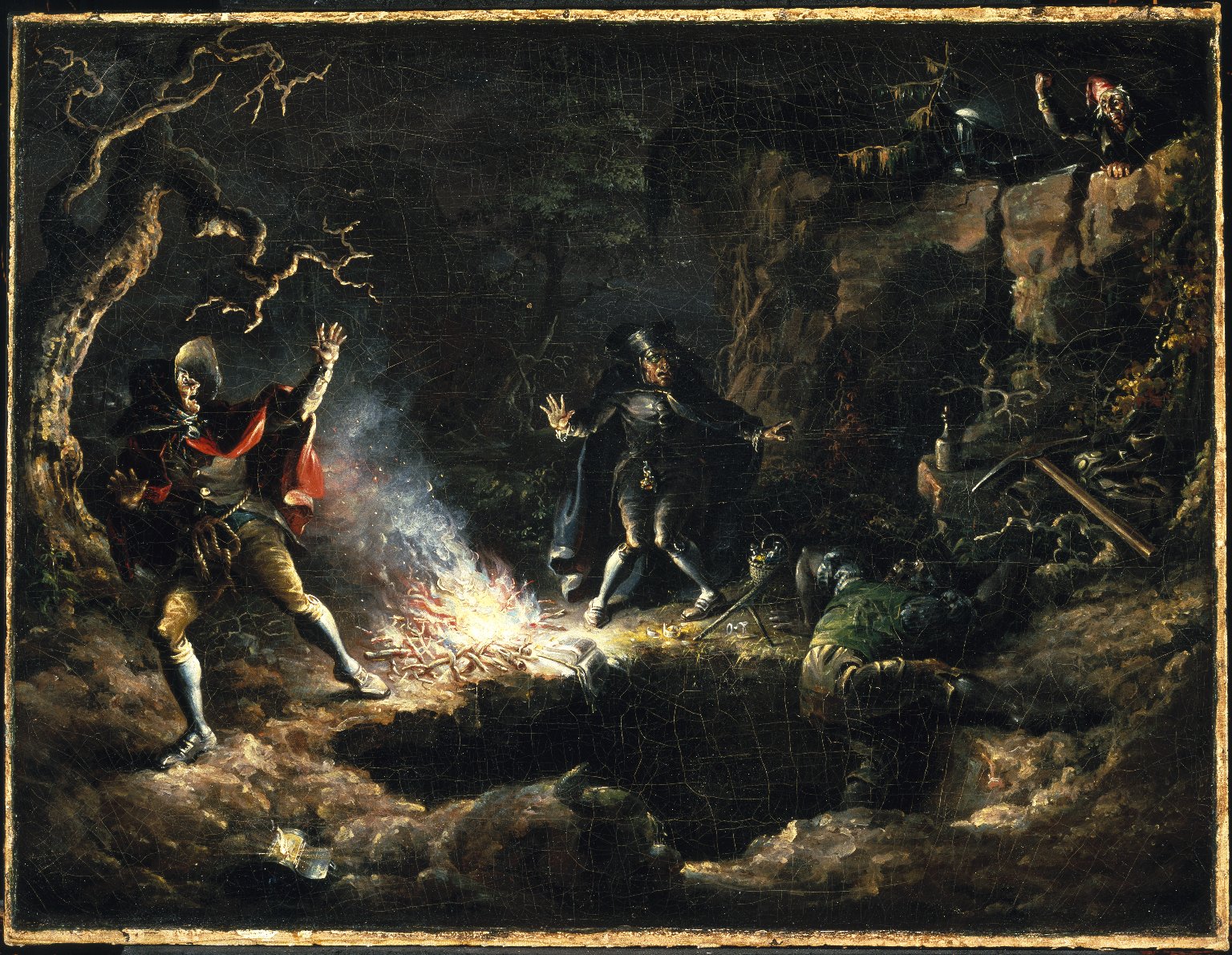
John Quidor (American, 1801–1881). The Money Diggers, 1832. Oil on canvas, 1515/16 × 2015/16 in. (40.5 × 53.2 cm). Brooklyn Museum, Gift of Mr. and Mrs. Alastair Bradley Martin, 48.171. (Photo: Brooklyn Museum, 48.171_SL1.jpg)
Washington Irving (1783–1859) wrote stories about the enchanted world Joseph knew, including several about money diggers. One of Irving’s stories, published in 1824, the year after Moroni first visited Joseph, tells of a nocturnal treasure dig in which a scryer or seer with green glasses and a forked divining rod finds the location of a buried treasure, silently draws a circle around it, and performs ceremonies “to prevent the evil spirits which kept about buried treasure, from doing them any harm.” Then the fisherman, Sam, dug “a considerable hole” while the scryer, “by the aid of his spectacles, read off several forms of conjuration,” and Wolfert Webber “bent anxiously over the pit, watching every stroke of the spade.”
“At length the spade of the fisherman struck upon something that sounded hollow. . . . ‘’Tis a chest,’ said Sam. ‘Full of gold, I’ll warrant it!’ cried Wolfert.”
Just then they heard a sound, looked up, and saw on the rocks above them in a red cap “what appeared to be the grim visage of [a] drowned buccaneer, grinning hideously.” The 1832 painting The Money Diggers depicts this moment. The scryer dropped his divining rod and ran one way, Sam “leaped out of the hole” and ran another way, and “Wolfert made for the water-side.” Each eventually made their way home and told their tales, but “whether any treasure were ever actually buried at that place; whether, if so, it were carried off at night by those who had buried it; or whether it still remains there under the guardianship of gnomes and spirits . . . is all [a] matter of conjecture.”
According to the Joseph Smith Papers, “by 1825 Joseph Smith had a reputation in Manchester and Palmyra, New York, for his activities as a treasure seer, or someone who used a seer stone to locate gold or other valuable objects buried in the earth.” Treasure-seeking culture was real, including the gift of seeing, but the treasures were probably legendary or imaginary. There is no evidence that Joseph or his peers ever found the treasures they sought. So why did people think Joseph could find them?
At twenty years old, in 1826, Joseph Smith stood amid a crowd of curious (and some hostile) onlookers before a justice of the peace in northeastern Pennsylvania, not far from the Susquehanna River. The nephew of his employer, Josiah Stowell, accused Joseph of fraud by leading Stowell to believe he could find buried treasure by looking into a certain stone. According to one account, Joseph
said when he was a lad, he heard of a neighboring girl some three miles from him, who could look into a glass and see anything however hidden from others; that he was seized with a strong desire to see her and her glass; that after much effort he induced his parents to let him visit her. He did so, and was permitted to look in the glass, which was placed in a hat to [e]xclude the light. He was greatly surprised to see but one thing, which was a small stone, a great way off. It soon became luminous, and dazzled his eyes, and after a short time it became as intense as the mid-day sun. He said that the stone was under the roots of a tree or shrub as large as his arm, situated about a mile up a small stream that puts in on the South side of Lake Erie, not far from the New York and Pennsylvania line.
Joseph testified that he had gone and found the stone, washed it, dried it, put it in his hat, “and discovered that time, place and distance were annihilated; that all intervening obstacles were removed, and that he possessed one of the attributes of Deity, an All-Seeing-Eye. He arose with a thankful heart. . . . On the request of the Court, he exhibited the stone. It was about the size of a small hen’s egg.” Joseph Sr. then testified that it was all true, and that both he and Joseph Jr. “were mortified that this wonderful power which God had so miraculously given him should be used only in search of filthy lucre.”
Then Josiah Stowell testified. “He swore that the prisoner possessed all the power he claimed, and declared he could see things fifty feet below the surface of the earth, as plain as the witness could see what was on the Justices’ table, and described very many circumstances to confirm his words.” When the justice questioned, “‘Deacon Stowell, do I understand you as swearing before God, under the solemn oath you have taken, that you believe the prisoner can see by the aid of the stone fifty feet below the surface of the earth, as plainly as you can see what is on my table?’ ‘Do I believe it?’ says Deacon Stowell, ‘do I believe it? no, it is not a matter of belief: I positively know it to be true.’”
Martin Harris also knew that Joseph could see in his stone, and just as certainly as Stowell did. Martin said,
I was at the house of his father in Manchester, two miles south of Palmyra village, and was picking my teeth with a pin while sitting on the bars. The pin caught in my teeth, and dropped from my fingers into shavings and straw. I jumped from the bars and looked for it. Joseph and Northrop Sweet also did the same. We could not find it. I then took Joseph on surprise, and said to him—I said, ‘Take your stone.’ I had never seen it, and did not know that he had it with him. He had it in his pocket. He took it and placed it in his hat—the old white hat—and placed his face in his hat. I watched him closely to see that he did not look [to] one side; he reached out his hand beyond me on the right, and moved a little stick, and there I saw the pin, which he picked up and gave to me. I know he did not look out of the hat until after he had picked up the pin.
In his Manuscript History, excerpted in the Pearl of Great Price, Joseph Smith explained that after the death of his older brother Alvin, which crippled his family’s ability to make cash payments on their farm or finish the construction of their home, Joseph went to work for “an old Gentleman, by the name of Josiah Stoal [Stowell] who lived in Chenango County, State of New York. He had heard something of a silver mine having been opened by the Spaniards in Harmony Susquahanah County, State of Pensylvania, and had previous to my hiring with him been digging in order if possible to discover the mine.” Joseph said that he searched for the silver for nearly a month, along with others, before giving up the quest. “Hence arose the very prevalent story of my having been a money digger,” said Joseph in his history.
Another document to examine “is an agreement allegedly made between two groups of investors” who hired Joseph Smith and others, including Joseph’s father, to share what they might discover “at a certain place in Pennsylvania . . . , supposed to be a valuable mine of either Gold or Silver.” The scholars of the Joseph Smith Papers did excellent source criticism of this document, showing that it “cannot be authenticated.” Though dated 1825, the only known version of the document comes from an April 1880 issue of the antagonistic Salt Lake Daily Tribune newspaper. The hostile article got several details about the document wrong, but the document itself does not discredit Joseph. It is consistent with his history and with his mother’s memoir.
Lucy Mack Smith’s memoir of her family explains why Josiah Stowell recruited Joseph. She echoed Joseph’s story about how his work for Stowell led to later disrepute as a money digger. Unlike Joseph’s account, however, Lucy’s version includes a reason why Stowell valued Joseph’s help. He “came for Joseph,” Lucy says, “having heard, that he was in possession of certain means, by which he could discern things, that could not be seen by the natural eye.”
Evaluating Our Sources of Knowledge
This is explained further in the largest collection of documents relative to Joseph Smith’s treasure seeking. These documents include several controversial statements by neighbors and some acquaintances of the Smith family who believed that Joseph’s ability to discern involved a stone or stones. Many of these statements were gathered in 1833 by a man named Doctor (really, he was named Doctor) Philastus Hurlbut, an excommunicated Latter-day Saint who was antagonistic to Joseph Smith and the Church.
The statements Hurlbut gathered were published by another critic, Eber D. Howe, in Mormonism Unvailed (1834). Scholarly analysts of the statements have made strong arguments for and against their reliability. Making sense of them is a challenge because they are neither all true nor all false, neither informed nor ignorant. Some of the statements are by people who knew Joseph, and others are by people who heard about him. The statements mix factual memories of events or conversations with interpretive memories—the subjective understandings of what the events or conversations meant. The statements mix eyewitness evidence with hearsay, observation with gossip, and it is difficult to discern where one ends and the other begins.
The statements Hurlbut gathered and Howe published are useful for learning what some of Joseph Smith’s former neighbors thought and felt about him in the early 1830s, after the Book of Mormon was published and the Savior’s Church was established. But the documentation is much less reliable for learning the facts of Joseph Smith’s experience in the 1820s, when he was involved, by his own admission, in treasure digging. Joseph did not dispute the fact that he searched for buried treasure using a stone, and his mother tacitly acknowledged it. Joseph Knight, who employed Joseph in 1826 and who converted shortly after the Church was organized, wrote that Joseph “looked in his glass,” meaning his stone. Brigham Young later used the term seer stone to describe the type of object Lucy Mack Smith called “means” and Joseph Knight called a “glass.”
Many people are suspicious about the idea of seeing or discerning with a stone or other material objects endowed with supernatural power. The suspicion is based on a skeptical assumption, not a proven fact, and it is a recent phenomenon, as history goes. In ancient Israel, certain stones were associated with the priestly or prophetic office and considered a means of revelation. The Bible says that Jacob, Moses, and Aaron had powerful rods and that Joseph of Egypt had a cup “whereby indeed he divineth” (Gen. 44:5).
In early modern Europe, there were several magician mathematicians, including Isaac Newton, who sought after or used marvelous stones. John Dee, for example, taught algebra and navigation, sought to commune with angels, and used a translucent stone that has been displayed in the British Museum.
However, by Joseph Smith’s time, Enlightenment rationalism in large parts of Europe and America turned revelatory stones and similar objects into a form of magic, which some elites and many in the developing middle class separated from religion. The word occult, which originally described desirable secret knowledge given only to the initiated, acquired a negative sense and became a weapon to label and thus discredit people who continued to think of “the supernatural as inseparably interwoven with the material world.”
This is the environment in which Doctor Philastus Hurlbut gathered statements from some of Joseph’s former neighbors. The documents were intended to imply “that treasure-seeking was an ignorant superstition whose devotees were either credulous dupes or cunning con-men equally driven by materialistic greed.” But given many neighbors’ Enlightenment-biased view, their interpretation of Joseph’s behavior is subjective. It is not an objective truth that is verifiably the same regardless of what point of view a person chooses. Rather, it is one possible explanation of the fact that Joseph and others could reputedly see in stones and sometimes used that ability to search for buried treasures.
In an age when new revelation of any kind was suspect, revelatory stones were certainly seen as dubious. Though many people in Joseph Smith’s time had adopted skeptical views, he and others continued to live in what one scholar called the shadow of the Enlightenment, meaning that they still inhabited a world like Isaac Newton’s a century and a half earlier: a world in which revelation and magic, God and buried gold coexisted along with calculus, and all made good sense. It was seen as an enchanted world as much as an enlightened world, and no matter how strongly or widely held the opinion to the contrary, it is by no means a proven fact that Enlightenment rationalism represents reality better than a world that includes supernatural forces, divine beings, demons, and marvelous works and wonders. Making occult a bad word does not prove that there are not supernatural forces infusing the material world. It can be hard to see past our own sense of scientific certainty, escape our assumptions about what is possible, and overcome a feeling of superiority that regards people in the past as more primitive and less informed in order to understand the world as Joseph Smith and many of his peers experienced it. This is in part because, as Alan Taylor (a Pulitzer Prize–winning historian of Joseph Smith’s culture) described it, we assume a “rigid insistence that magic and Christianity are polar opposites when in fact they have usually been inseparable and natural allies.” That was true for the respected Presbyterian Josiah Stowell and for the upstanding Methodist Willard Chase.
Chase was one of the people who made a statement for Philastus Hurlbut to explain his claim that Joseph Smith kept a stone that belonged to him. Another neighbor claimed that Willard Chase’s sister Sally could see in the stone. Another said Sally could reputedly “look through [a] stone she had & find money” and added that “Willard Chase use[d] to dig when she found where the money was.” Willard’s own statement never mentions his sister’s reputation as a scryer or his participation in treasure quests. Instead, it casts Willard as informed and intelligent, in contrast to the Smiths, whom he represents as dishonest opportunists. Yet the statement suggests that they knew each other well and that they cooperated with and confided in each other, until they disagreed about the stone or, perhaps, the meaning of Joseph’s discovery of gold plates.
According to Willard Chase’s statement, he employed Joseph and his brother to help him dig a well. “After digging about twenty feet below the surface of the earth,” he said, “we discovered a singularly appearing stone, which excited my curiosity. I brought it to the top of the well, and as we were examining it, Joseph put it into his hat, and then his face into the top of his hat.” According to Willard, Joseph said “that he could see in it.” This curious telling of the events says that Joseph claimed to have “brought the stone from the well; but this is false,” said Willard. “There was no one in the well but myself.”
Willard Chase’s version of this story has him hiring Joseph and his brother to dig a well, but then digging it himself as they watched. It may be that Willard shaped his story to give him rightful claim to the stone while distancing himself from Joseph Smith and what Willard called “the credulous part of the community.” But evidence, including his own statement, shows that Willard Chase believed in supernatural means as well. So did other people in the area. Several of the people who made statements about Joseph’s reputation for being able to discern the location of buried treasure in a stone were involved with him in these adventures and believed in his gift.
Records from the Chenango County courthouse in Norwich, New York, show that a justice of the peace issued an order for a constable to bring Joseph before him, and that the justice ruled on the case of Joseph Smith the “Glass looker.” But these records do not tell what the ruling was. Josiah Stowell, the man who employed Joseph to seek for buried treasure in 1825, testified that Joseph was a legitimate seer. The charges against Joseph were apparently made by one of Stowell’s relatives. A New York law against disorderly conduct at that time forbade people “to discover where lost goods may be found,” assuming that such activity was fraudulent. The law itself and various versions of what took place at the hearing or trial indicate how the world around Joseph Smith was moving from enchanted to enlightened, from supernatural gifts to naturalistic explanations, and how, in that process, Joseph’s gift was subject to different interpretations.
There are five different inconsistent accounts of Joseph’s appearance before the justice of the peace, published anywhere from five to fifty-seven years after the event. Only one of them claims to be the record of an eyewitness, a fellow named William Purple, who wrote that he kept the records for the justice of the peace. The Purple account includes quite a bit of testimony reportedly from Joseph and claims that he was discharged, meaning released without being cleared or condemned.
In 1831, a Christian magazine published the earliest account of Joseph’s 1826 hearing. The article was by a doctor named Abram Benton, who was not at the hearing but learned of it later. He represents the skeptical view, claiming that Joseph was a glass-looker who deceived the gullible and that he was “tried and condemned before a court of Justice” but allowed to escape.
Published in 1835, the next account comes from Oliver Cowdery, who said that he gained his knowledge of the events from Joseph. Commenting “on the private character” of Joseph, Oliver claimed that “some very officious persons complained of him as a disorderly person, and brought him before the authorities of the country; but there being no cause of action he was honorably acquited.”
Two accounts, published in 1873 and 1883 respectively, say they are copies of an actual record that a niece of the justice of the peace later tore from his docket book, but that cannot be verified from known records. The docket book is missing, the pages have not been found, and justices of the peace were not required to make trial transcripts and usually did not. These two accounts disagree on some details, but both say that Joseph was found guilty. Between these accounts, in 1877, William Purple, the only eyewitness, published his version, which says, again, that Joseph was discharged.
The conflicting evidence makes the most sense when we recognize that each of the accounts is a mixture of factual memories and interpretive memories. Factual memories recall verifiable data that does not vary over time or between reporters, such as Joseph Smith appearing before a justice of the peace named Albert Neely in March 1826, charged with disorderly conduct. Interpretive memories are subjective, specific to the rememberer, and prone to vary over time. Imagine that a few friends sat side by side at the same symphony, movie, or sporting event. When they recall the event later, they will share factual memories but have different interpretive ones. Perhaps one friend enjoyed the symphony while another found it boring. One person’s toothache could mar his or her movie experience while friends laugh nonstop. Interpretive memories tell us more about the subjective interpreter than about the facts of the remembered event.
Differences in the several accounts regarding Justice Neely’s ruling are probably examples of interpretive memory. The 1877 account by the eyewitness William Purple is likely accurate about the verdict—a discharge, meaning that Joseph was found neither innocent nor guilty. Oliver Cowdery interpreted the decision as acknowledgment of innocence, while sources unfriendly to Joseph interpreted the event as acknowledgment of guilt. Probably none of these reporters flatly lied or knowingly distorted their story. Rather, each likely reported the event as their interpretive memories perceived it.
Why a discharge? Available records are inconclusive, but it seems likely that there was no evidence presented that Joseph was anything but what he claimed to be. The William Purple account is not friendly to Joseph, but it acknowledges in the end that “as the testimony of Deacon Stowell could not be impeached, the prisoner was discharged.” One of the consistent evidences in most of the accounts is Stowell’s confidence in Joseph as a seer. Three of the accounts that otherwise vary give the same account of Stowell’s testimony, that Joseph Smith could see by supernatural power.
Understanding Joseph’s Motives for Telling His Own Story
Josiah Stowell is an example of an upstanding Christian in Joseph’s time and place who still believed that God’s power infused material objects and was manifest in gifts possessed by seers. At least some members of Stowell’s family represented the newer, more skeptical way of thinking and thus interpreted the same facts differently. A later article in a Christian magazine, for example, described Joseph as “a money-digger and necromancer from his youth.” Those words weaponize a neutral fact by associating treasure seeking with necromancy, a negatively charged word describing conjuring the dead to assist in magic. The article went on to tell readers how to interpret Joseph’s character: “An equal compound of the imposter and the fanatic, and combines all the features of the knave and the dupe.”
This helps us understand why Joseph responded to such reports by telling his own story, “owing to the many reports which have been put in circulation by evil-disposed and designing persons.” In telling his own story, Joseph said he “was verry concious that I had not kept the commandments, and I repented hartily for all my sins and transgression, and humbled myself before Him whose eyes are over all things.” In his history, Joseph confessed that he searched for treasure, mingled with all kinds of society, and frequently fell into foolish errors, but he endowed those autobiographical facts with different meanings than his critics did. Joseph said he “often felt condemned for [his] weakness and imperfections.” As a result, he was repenting when an angel revealed to him that there were actual gold plates containing a gospel, not material treasure, and that Joseph could only get them if his purpose was to glorify God, and if he rejected the temptation “to get the plates for the purpose of getting rich.”
Joseph candidly acknowledged, in both his 1832 history and to Oliver Cowdery, that it took him years and concerted effort to become reoriented. “I had been tempted of the advisary,” he said, “and saught the Plates to obtain riches and kept not the commandme[n]t that I should have an eye single to the Glory of God therefore I was chastened and saught diligently to obtain the plates and obtained them not untill I was twenty one.” For Joseph, and apparently for Moroni, Joseph’s treasure seeking was misguided but not malignantly sinful behavior that Joseph outgrew as he became converted to Jesus Christ and learned from an angel “what the Lord was going to do, and how and in what manner his kingdom was to be conducted in the last days.” Treasure seeking was not the sum of Joseph’s story. It was one obstacle he overcame in the story of becoming a chosen seer.
Reasons to Trust Sources That Say Joseph Could See
Regardless of Joseph’s treasure seeking, many trusted sources claim that he was a seer. His mother wrote that he was known to “discern things, that could not be seen by the natural eye.” His father knew it. Joseph Knight knew it. Martin Harris knew it. Josiah Stowell told a justice of the peace “very many circumstances” that proved to him that Joseph could see in his stone.
Despite his gift, Joseph Smith did not find any buried treasures he had looked for. What is the best interpretation of that fact? Abram Benton gave a hostile interpretation of it in an 1831 Christian magazine article titled “Mormonites.” Benton said Joseph “constantly failed in his pretensions” to find treasures, but “still he had his dupes who put implicit confidence in all his words. In this town, a wealthy farmer, named Josiah Stowell, together with others, spent large sums of money in digging for hidden money, which this Smith pretended he could see, and told them where to dig; but they never found their treasure.” None of the witnesses to Joseph’s gift claimed that Joseph found treasure. Rather, they watched as he saw and found other, more mundane things. That led Stowell to hire Joseph to use his gift to find treasure. But while working for Stowell, Joseph may well have felt conflicted in making money by using his gift to search for a treasure he soon realized did not exist. After “nearly a month” he made it clear to Stowell that they were not going to find a treasure.
Making sense of this past requires us to see that Joseph Smith and hostile commentators created various versions of the story—interpretations that are not the facts themselves but meanings assigned to the facts, meanings we may assume are true but that are not objectively, demonstrably true. It may come as a surprise to some readers that Fawn Brodie and many Latter-day Saint believers share the same interpretation of the facts: that God would not call someone who searched for buried treasure by using a seer stone. Dale Morgan, a well-informed but unbelieving student of early Latter-day Saint history and a confidant of Fawn Brodie, highlighted her flawed interpretation. “Your chain of reasoning looks logical,” he wrote to her, “but it is attended by a string of ifs all along the line (precisely as with the orthodox Mormon reasoning), and the probability of error increases as the chain of reasoning lengthens.”
Fawn Brodie nevertheless adopted the version of the past created by Philastus Hurlbut and Eber Howe, who didn’t unveil “Mormonism” as much as they shaped the way generations have interpreted it. That includes generations of believers, who may not recognize that any discomfort they feel from the prospect of Joseph Smith using a seer stone is not an objective reality. Rather, it is created by assuming a negative interpretation of otherwise neutral facts. The Book of Mormon says, after all, that the Lord would prepare for his servant a stone “which shall shine forth in darkness unto light” (Alma 37:23). Why not, therefore, choose to interpret the fact that Joseph discovered just such a stone or stones positively instead of negatively? Assuming the validity of the Hurlbut and Howe interpretation may cause us to either conclude that Joseph was not a prophet or shut our eyes to the well-attested fact that he used a stone to search for buried treasure. But we do not have to accept the meaning others gave to the facts. We do not have to perceive the past hypothetically, as Fawn Brodie did.
It was her interpretive choice to perceive Joseph’s seeing and treasure seeking as negative. Like many believers, she was, remember, “particularly bothered by the discovery of Smith’s ‘money-digging’ activities” since she assumed “that the Lord would never have permitted [a prophet] to take part in such activity.” That perspective was not based on any verifiable facts. It was based on Brodie’s assumption about the mind of God. It is hypothetical history as compared to well-documented history. After all, a characteristic of some scriptural call narratives is the prophets’ statement of their sinfulness and of being called and qualified by God despite their flaws (see Isa. 6; Jer. 1; Ether 12; and Moses 6). In some of his own revelations from the Lord, Joseph is rebuked and told to repent (see D&C 3, 10, 64). And in his own histories, Joseph confesses his sins and documents his repeated repentance. In Joseph’s interpretation of himself, as with many prophets in scripture, he was a flawed vessel who was called of God and qualified for divine work. Beset by conflicting choices, Joseph steadily if not exclusively chose faith, hope, charity, and an eye single to God’s glory (D&C 4).
Learn the Facts and Then Interpret Them with Faith, Hope, and Charity
We can interpret historical records less hypothetically and more accurately when we deliberately think in this order:
- Discover from primary sources of knowledge what the facts are, meaning the knowledge that is verifiably the same regardless of how one interprets it.
- Then consider various interpretations and judge for ourselves how best to interpret the facts.
Wise and well-informed historians interpret the facts discussed here as part of a past “where treasure-seekers were neither fools nor deceivers, where treasure-seeking was part of an attempt to recapture the simplicity and magical power associated with apostolic Christianity.” Joseph came to think of his ability as “a gift from God.” His family and friends knew of his gift and believed in him. They believed because they knew of his ability to see, and they marveled at it. Josiah Stowell was certain that Joseph could see, as were Martin Harris, Oliver Cowdery, and David Whitmer. These witnesses interpreted Joseph’s past in terms of growth and progress along a path from local seer to biblical-style prophet.
Brigham Young, for instance, believed “that there are thousands in the world who are natural born Seers, but when the Lord selected Joseph Smith to be his . . . mouthpiece upon the earth in this dispensation, he saw that he would be faithful and honor his calling.” Alan Taylor, a prominent non–Latter-day Saint historian, interpreted the facts to mean that Joseph’s “transition from treasure-seeker to Mormon prophet was natural, easy, and incremental.” Richard Bushman, Joseph’s most knowledgeable believing biographer, wrote that Joseph’s ability to see in stones enabled him to “move step by step into his calling.” In his wordy way, Oliver Cowdery judged Joseph “worthy the appelation of a seer and a prophet of the Lord. In this,” he added, “I do not pretend that he is not a man subject to passions like other men, beset with infirmities and encompassed with weaknesses; but if he is, all men were so before him, and a pretence [sic] to the contrary would argue a more than mortal, which would at once destroy the whole system of the religion of the Lord Jesus; for he anciently chose the weak to overcome the strong, the foolish to confound the wise.”
In the 1980s, after a modern document forger named Mark Hofmann proved to be a deceiving murderer, and it was clear that his forgeries were designed to undermine faith in Joseph Smith, Elder Dallin H. Oaks reclaimed the historical way of seeing the past, offering an alternative to the Hurlbut, Howe, and Hofmann interpretations. President Oaks is widely known for his ability to analyze evidence carefully with both spiritual sensitivity and a judicious, highly trained intellect. He even-handedly announced, “Some sources close to Joseph Smith claim that in his youth, during his spiritual immaturity prior to his being entrusted with the Book of Mormon plates, he sometimes used a stone in seeking for treasure. Whether this is so or not, we need to remember that no prophet is free from human frailties, especially before he is called to devote his life to the Lord’s work. Line upon line, young Joseph Smith expanded his faith and understanding and his spiritual gifts matured until he stood with power and stature as the Prophet of the Restoration.”
Was Joseph Smith a money digger? Yes. And when we discern the difference between that neutral fact and hostile interpretations of it, we no longer deny the fact or fear its implications. Joseph responded to the many reports “designed by the authors thereof to militate against” the Savior’s Church. In that situation, he “did not want to make himself a target for attacks that would cripple the work. But neither did he repudiate the stones or deny their powers.” Like Joseph, we get to choose how to make sense of the historical facts, what we believe about God and how God calls prophets, and whether we believe that stones can be endowed with supernatural power to “magnify to the eyes of men” words that could not otherwise be read (Ether 3:23–24).
These are open choices. The facts of history do not force us to conclude either that Joseph was a disingenuous deceiver, as Hurlbut and Howe believed, or that he was endowed with spiritual gifts and called by God to use them, as his family and friends believed. Both of those options are open to people who know the very same facts. The historical facts do not act on us. We act upon them. If we wish, we can choose to be guided in our actions by faith, hope, charity, and an eye single to God’s glory (D&C 4).


