


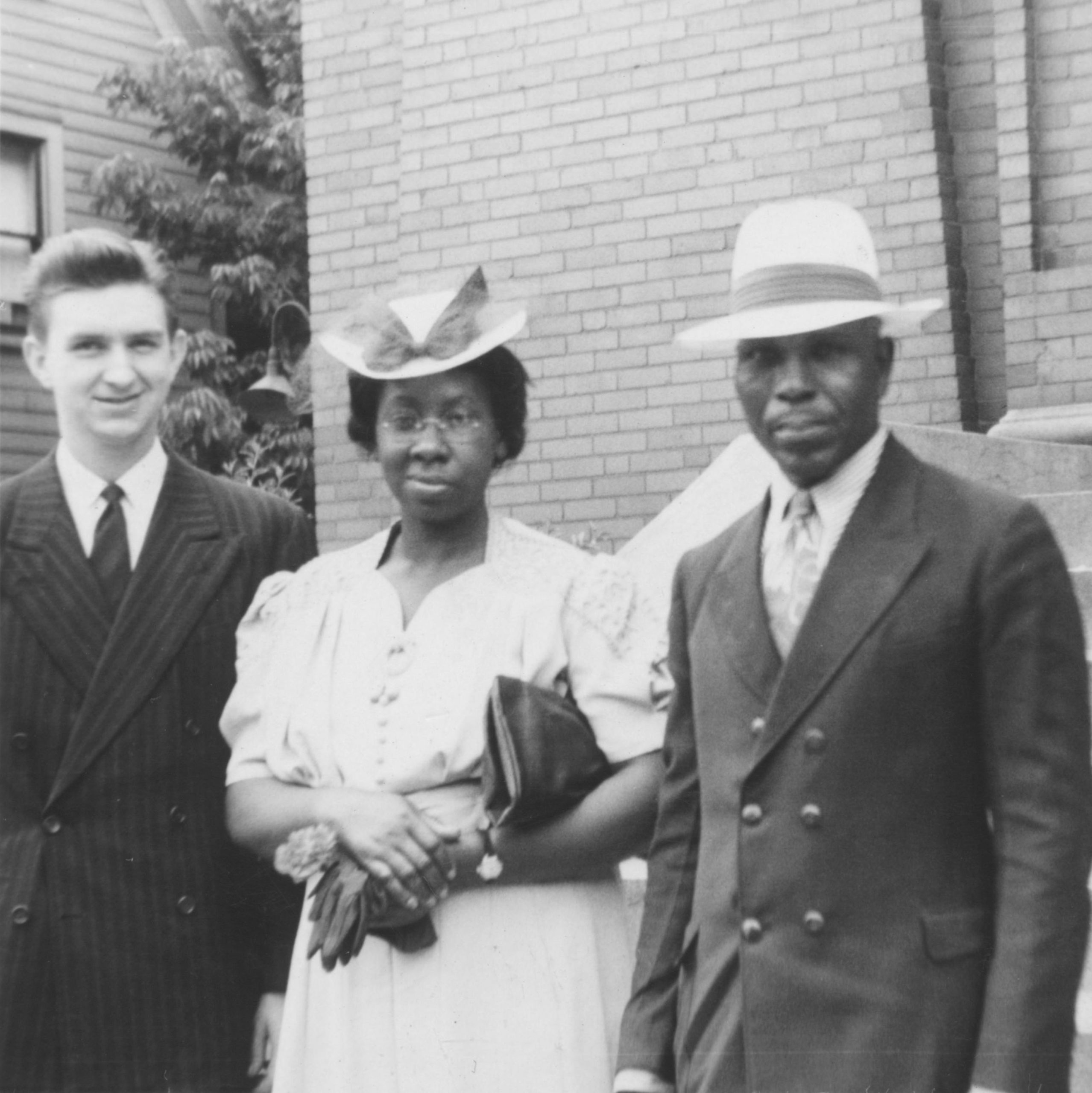
 Len and Mary Hope with Elder Marion Duff Hanks. Courtesy Richard D. Hanks.
Notes
1. This article benefits from the research of Joseph R. Stuart, whose foundational research on Len and Mary Hope can be found in the biographical entries for the couple in the University of Utah’s Century of Black Mormons database (https://exhibits.lib.utah.edu/s/century-of-black-mormons/page/welcome). Additionally, I am grateful for the research and guidance of Jed L. Woodworth, who conducted much of the research on the Hope family for Saints: The Story of the Church of Jesus Christ in the Latter Days, vol. 3, Boldly, Nobly, and Independent, 1893–1955 (Salt Lake City: The Church of Jesus Christ of Latter-day Saints, 2022). Lisa Christensen, Brooke Jurges, and Jed L. Woodworth also contributed to the transcription of the ca. 1952 recording of Len and Mary’s testimonies.
2. Marion D. Hanks, interview by Jessie L. Embry, May 18, 1989, 9–10, MSS OH 1147, Marion D. Hanks Collection, Harold B. Lee Library, Brigham Young University, Provo, Utah; Len Hope, in “Utah Death Certificates, 1904–1965,” Salt Lake City, 1952, image 1869, citing series 81448, Utah State Archives Research Center, Salt Lake City. The death certificate provides the Hopes’ address and a “length of stay” of “8 mo.” at that place, suggesting the Hopes moved to Utah in February 1952, eight months before Len’s September 14 death. Hanks remembers the Hopes’ Utah residence being short-lived: “It was a very brief period. I’m not sure how long they were there. He died in 1952. I know it was a year or two or more after their visit in 1947.” Embry notes, “They were only in the Polk City directory one year, living at that address. They aren’t there in 1951, there in 1952, and then gone by 1953.” Hanks, interview, 16.
3. Stanley L. Fish, Bradley J. Kramer, and Wm. Budge Wallis, History of the Mormon Church in Cincinnati (1830–1985) (Cincinnati: Cincinnati Ohio and Cincinnati Ohio North Stakes, 1997), 58–59, 68; Hanks, interview, 1–3, 7–8, 15–17; “Cincinnati Pair to Attend Conference for First Time,” Deseret News, September 26, 1947, 9.
4. The Marion D. Hanks Collection (MS 31743) in the Church History Library, The Church of Jesus Christ of Latter-day Saints, Salt Lake City (hereafter cited as CHL), catalogues these recordings as MS 31743/14AT0046, MS 31743/ACASS0001, MS 31743/ACASS0028, and MS 31743/ACASS0033 respectively. Hanks, interview, 1–3.
5. Len Hope’s record of membership for The Church of Jesus Christ of Latter-day Saints gives his birth date as October 10, 1895. Record of Members, Southern States Mission, CR 375 8, box 34, folder 1, item 53. The 1920 and 1930 United States Censuses also give 1895 as his birth year. His Selective Service draft registration card, however, lists October 10, 1894, as his birth date. “United States World War I Draft Registration Cards, 1917–1918,” Alabama, Marengo County; A–T, image 2289, Washington, D.C.: National Archives and Registration Administration. Likewise, the 1940 U.S. Census gives 1894 as his birth year. While the 1900 U.S. Census lists no “Len Hope” in the family of Jim and Annie Hope of Marengo County, Alabama, it identifies a “Boots Hope,” born 1894, in the family. If “Boots” was Len’s childhood nickname, then the 1900 census may be good early evidence of an 1894 birth. Complicating the matter is Len’s death certificate, which gives October 11, 1893, as his birth date. “Utah Death Certificates, 1904–1965,” Salt Lake City, 1952, image 1869; Utah State Archives Research Center, Salt Lake City.
6. Jim Hope and Annie Hope, in “United States Census, 1900,” Alabama, Marengo, ED 73 Precinct 13 Hampden, image 20.
7. “Len Hope’s testimony, undated,” audio recording, Marion D. Hanks Collection, CHL; Len Hope, in “Alabama, World War I Service Cards, 1917–1919, Alabama Department of History and Archives, Montgomery; Len Hope, Record of Member, Southern States Mission, CR 375 8, box 34, folder 1, item 53.
8. Len Hope and Mary Pugh, January 1920, “Alabama County Marriages, 1809–1950,” database with images, FamilySearch, https://familysearch.org/ark:/61903/1:1:Q2DQ-RS22 : 19 February 2021, citing Wilcox, Alabama, United States, County Probate Courts, Alabama, Family History Library (FHL) microfilm 1,418,507.
9. Mary Hope, Record of Member, The Church of Jesus Christ of Latter-day Saints, CR 375 8, box 34, folder 1, item 264; Ben and Mahala Pugh Family, “United States Census, 1910,” Alabama, Wilcox, Clifton, ED 148, image 8 (Washington, D.C.: National Archives and Records Administration, n.d.). Note that Mary’s Record of Member entry identifies her parents as “Bean” and “Mahalie.”
10. “Testimony of Len R. Hope and Mary Hope, 1938,” [3], CHL; Mary Hope, Record of Member. Mary was baptized by Elder Wm. O. Clouse and confirmed by Elder Sterling W. Sill, future member of the First Council of Seventy.
11. “Testimony of Len R. Hope and Mary Hope, 1938,” [3]; Cincinnati Branch, Record of Members and Children, 1930–1942, no. 48–52, 197, 214, 258, LR 1734 23, CHL.
12. For more about the Great Migration, see Isabel Wilkerson, The Warmth of Other Suns: The Epic Story of America’s Great Migration (New York: Vintage, 2010); James N. Gregory, The Southern Diaspora: How the Great Migrations of Black and White Southerners Transformed America (Chapel Hill: University of North Carolina Press, 2005); Beverly A. Bunch-Lyons, Contested Terrain: African-American Women Migrate from the South to Cincinnati, Ohio, 1900–1950 (New York: Routledge, 2002); Alferdteen Harrison, ed., Black Exodus: The Great Migration from the American South (Jackson: University Press of Mississippi, 1991).
13. Len Hope Sr. and Mary Hope, Record of Members, South Ohio District, CR 375 8, box 5008, folder 1, item 228, Ohio State, Part 2, CHL; Marion D. Hanks, oral history interview by Jessie L. Embry, May 18, 1989, 12, CHL.
14. Joseph R. Stuart, “Len Hope,” Century of Black Mormons, J. Willard Marriott Library, University of Utah, accessed January 10, 2023, https://exhibits.lib.utah.edu/s/century-of-black-mormons/page/hope-len; “Len Hope,” Salt Lake Tribune, September 15, 1952, 15. A 1940 city directory also identifies Len Hope as a “fctywkr” or factory worker. Williams’ Hamilton County (Hamilton County, Ohio) Directory 1940 (Cincinnati: Williams Directory Co., 1939), 363. Marion D. Hanks remembered Len Hope working “in a fiber glass making factory in the area.” Hanks, interview, 1.
15. See Petersen, “Race Problems,” 17. According to Petersen, Len once declared, “I paid my tithing and during that whole depression, I didn’t lose one day’s work. Sometimes I didn’t make much money on that day, and I did have to go out into the hills and get berries, but I always had an income.”
16. Williams’ Cincinnati (Hamilton County, Ohio) Directory 1939 (Cincinnati: Williams Directory Co., 1938), 551; Williams’ Cincinnati (Hamilton County, Ohio) Directory 1940; see also Marion Duffin, Journal, October 30, 1936, CHL.
17. For more on race relations and the Black community in nineteenth-century Cincinnati, see Nikki Marie Taylor, Frontiers of Freedom: Cincinnati’s Black Community, 1802–1868 (Athens: Ohio University Press, 2005).
18. Robert B. Fairbanks, “Cincinnati Blacks and the Irony of Low-Income Housing Reform, 1900–1950,” in Race and the City: Work, Community, and Protest in Cincinnati, 1820–1970, ed. Henry Louis Taylor Jr. (Urbana: University of Illinois Press, 1993), 193.
19. Bunch-Lyons, Contested Terrain, 90–91; “Go to Church Tomorrow,” Cincinnati Enquirer, March 15, 1930, 10.
20. “Race and the Priesthood,” Church History Essays, The Church of Jesus Christ of Latter-day Saints, accessed December 29, 2022, https://www.churchofjesuschrist.org/study/manual/gospel-topics-essays/race-and-the-priesthood?lang=eng.
21. “Racial Segregation,” Church History Essays, The Church of Jesus Christ of Latter-day Saints, accessed December 29, 2022, https://www.churchofjesuschrist.org/study/history/topics/racial-segregation?lang=eng.
22. Hanks, interview, 2. Mildred Catherine Bang Cannon, whose grandparents and parents were some of the earliest members of the Cincinnati Branch, remembered the Hopes coming to Church for district conferences and other important meetings. “People voted not to have them,” she recalled. “They could come to conference when a General Authority came.” Interview by Jed Woodworth, January 15, 2021, 1, CHL.
23. Henry Layton to Richard Layton and Annie Horn Layton, March 3, 1931, CHL. In his recollection of the Hopes’ experience in Cincinnati, Marion D. Hanks noted that some members of the branch had no “trepidation or reticence” about the Hopes attending regular church meetings. However, those who opposed integrated meetings won out. “It was primarily the old guard,” Hanks recalled. “Some of them had been in the Church a long time and fought a long battle. They were not about to lose their own esteem or place in the neighbor’s eyes by having black people come to Church.” Hanks, interview, 17.
24. Duffin, Journal, December 1, 1935.
25. Petersen, “Race Problems,” 16.
26. Lula Bell B. Blackham, “Cincinnati Years, 1948–1952,” 7, CHL.
27. Jonathan Stephenson, “‘I Cries Inside’: A Short Biography of Len, Sr. and Mary Hope,” [10], CHL. Although Charles V. Anderson attended cottage meetings regularly at the Hopes’ home, he made no mention of the meetings in his short memoir or his life in Cincinnati. He does, however, allude to the Hopes and their devotion to the Church: “Cincinnati has a colored population of 50,000. Some of them are quite wealthy. They are members of various churches, but have their own places of worship, fraternal societies, etc. The Latter-day Saints have only one [Black] family belonging to their Church. They are very devout, and live exemplary lives. They own their neat little home, and are very industrious. One of their girls is quite gifted musically.” Charles V. Anderson, Twenty-Three Years in Cincinnati: A Six Months’ Visit to the Old Mission Field (Salt Lake City: n.p, n.d.), 17, CHL.
28. Stephenson, “‘I Cries Inside’” [10]. Evidence suggests that the Cincinnati Branch had somewhat eased its restriction on the Hopes’ Church attendance by 1951. Abner L. Howell, an African American Latter-day Saint from Salt Lake City, visited the Hopes in the summer of 1951. He recalled that the Hopes could “come to church once a month, on fast Sunday,” Kate B. Carter, The Story of the Negro Pioneer (Salt Lake City: Daughters of Utah Pioneers, 1965), 59. Marion D. Hanks likewise believed “the branch . . . was treating them more courteously” by the time they moved to Utah in 1952. Hanks, interview, 9. Still, there is no evidence that the branch ever fully rescinded its restriction on the Hopes.
29. Hanks, interview, 6.
30. Blackham, “Cincinnati Years,” 7.
31. See Hanks, interview, 14.
32. See, for instance, Inez Gibson, Journal, July 12, 1930; August 6, 1930; November 23, 1930; July 27, 1931; November 28, 1931; January 16, 1932; February 20, 1932; March 26, 1932; April 30, 1932; Essie Holt, Journal, July 27, 1931; September 2, 1931; October 5, 1931; CHL.
33. Ronald Gowers, Journal, November 15, 1934, CHL.
34. Holt, Journal, September 2, 1931.
35. Fred Croshaw, Journal, April 30, 1932, CHL.
36. Crowshaw, Journal, February 4, 1933.
37. Crowshaw, Journal, December 27, 1932.
38. Duffin, Journal, January 5, 1936.
39. Blackham, “Cincinnati Years,” 7.
40. Gibson, Journal, July 12 and August 5, 1930.
41. Hanks, interview, 6.
42. Crowshaw, Journal, April 30, 1932.
43. Opal Litster, Journal, September 17, 1932, CHL.
44. Duffin, Journal, January 5, 1936.
45. Cannon, interview, January 15, 2001, 1.
46. Karl R. Lyman, As I Saw It (Orem, Utah, n.p., 1972), 74, CHL.
47. Joseph Hancock to Gloria Gunn, December 2, 1949, CHL.
48. Joseph Hancock to Gloria Gunn, December 31, 1949, CHL.
49. The typescript was donated to the Church History Library by Judith LaMontagne.
50. “Testimony of Len R. Hope and Mary Hope, 1938,” 1–[2].
51. “Testimony of Len R. Hope and Mary Hope, 1938,” [3]. What Mary meant by “I also hope that we are standing separated from our race, may stand steadfeast [sic] and unmoveable [sic] before our God” is unclear because the statement seems to be missing at least one word. There is evidence that Len and Mary Hope were criticized by the local Black community for their membership in the Church. Lula Belle Blackham recalled that “I once heard [Len] say that his black friends chided him for belonging to that ‘white church’ where he couldn’t hold the priesthood and where the white members didn’t want him to come.” Blackham, “Cincinnati Years,” 7. With this in mind, one possible rendering could be “I also hope that we [who] are standing separated from our race,” a recognition that the religious path she and Len had taken had removed them from the Black church and the community it fostered. Her hope that her family may be steadfast and immovable is, therefore, an expression of faith that they might remain true to the path they have taken, despite persecution and social repercussions. Another possible rendering, however, is “I also hope that [because] we are standing separated from our race, [we] may stand,” which is more in line with Len’s apparent willingness to “let any man strip him literally of his black skin if he could only hold the priesthood.” Unfortunately, all known sources related to the Hopes reveal little about their relationship to or feelings about the broader Black community. Blackham’s recollection, cited above, indicates that they had Black friends, and contemporary sources confirm it. See Gibson, Journal, November 23, 1930; Cincinnati Branch, Minutes, October 5, 1941. Note the Gibson source does not specify the race of the Hopes’ friends.
52. Fish, Kramer, and Wallis, History of the Mormon Church in Cincinnati, 58–59, 76.
53. Hanks, interview, 15.
54. A partial, imprecise transcription of Len’s testimony from this recording can be found in “Early Black Pioneers: Building the Kingdom through Faith,” LDS Living (July/August 2005): 59–61.
55. According to Hanks, Len Hope’s lungs “were destroyed” after years of breathing in particles at the factory where he worked, leaving him with “a form of almost miner’s black lung disease.” Hanks, interview, 6.
56. Audio recording can be found at https://catalog.churchofjesuschrist.org/assets/72c48317-499c-4223-9b9d-4df6b6ecc585/0/0.
57. The recording begins midsentence, perhaps suggesting that it was an impromptu rather than a planned recording. But since the recording is a copy, it is also possible that the original recording contained a full testimony from Mary, which was then lost when the copy was made.
58. A reference to Jonathan Edwards’s 1741 sermon “Sinners in the Hands of an Angry God.” Edwards said, “All your righteousness, would have no more influence to uphold you and keep you out of hell, than a spider’s web would have to stop a falling rock.” See Jonathan Edwards, “Sinners in the Hands of an Angry God,” in Sermons and Discourses, 1739–1742, Works of Jonathan Edwards, vol. 22, eds. Harry S. Stout, Nathan O. Hatch, and Kyle P. Farley (New Haven, Conn: Yale University Press, 2003), 410.
59. Also called the “anxious seat,” the “mourner’s bench” was a bench or a series of benches usually placed at the front of some evangelical churches or revivals where penitent Christians and the unconverted would sit or kneel to publicly pray, confess sins or guilt, contemplate their spiritual well-being, and seek communion with God and his Spirit. See Randall Balmer, Encyclopedia of Evangelicalism (Waco, Tex.: Baylor University Press, 2004), 29–30.
60. Possibly “ourselves.”
61. Possibly “after all that.”
62. An allusion to John 14:26: “But the Comforter, which is the Holy Ghost, whom the Father will send in my name, he shall teach you all things, and bring all things to your remembrance, whatsoever I have said unto you.”
63. Possibly “it.”
64. “Death” here may allude to his covenant with God “to neither eat nor drink until I receive the gift of the Holy Ghost and die.” The idea seems to be that Hope could picture himself walking down the road on the brink of death-by-fasting.
65. Hope apparently lived with his brother at this time (see later reference to “brother’s home”). He seems to be saying here that he told his brother “some sort of fairy tale” to account for his absence during the night.
66. In 1913, Hope would have been eighteen or nineteen years old.
67. “I think it was the ‘Plan of Salvation.’” “Testimony of Bro. Len R. Hope,” [2]. The Plan of Salvation, a twenty-four-page Latter-day Saint missionary tract by John Hamilton Morgan (1842–1894), was published in 1887 by the Juvenile Instructor Office, Salt Lake City. The tract was reprinted and circulated many times over the next century.
68. According to the 1900 U.S. Census, Len Hope had three sisters: Eliza (b. 1882), Minnie (b. 1883), and Susie (b. 1890).
69. A possible allusion to Acts 8:18–19: “And when Simon saw that through laying on of the apostles’ hands the Holy Ghost was given, he offered them money, saying, Give me also this power on whomsoever I lay hands, he may receive the Holy Ghost.” See also Doctrine and Covenants 49:14: “And whoso doeth this shall receive the gift of the Holy Ghost, by the laying on of the hands of the elders of the church.”
70. An allusion to Ephesians 4:14: “That we henceforth be no more children, tossed to and fro, and carried about with every wind of doctrine, by the sleight of men, and cunning craftiness, whereby they lie in wait to deceive.”
71. “So I went back home and sat down and ordered the Book of Mormon, The Pearl of Great Price, and the Doctrine & Covenants, and other books and read them.” “Testimony of Bro. Len R. Hope,” [2]. Hanks remembers Len Hope being studious: “He would speak, and he knew the gospel very well. He could quote by the armlength from the standard works. He studied all the time. After he retired, they [that is, Len and Mary] just spent all their time studying the gospel.” Hanks, interview, 17.
72. Hope registered for the draft in Marengo County, Alabama, on June 5, 1917. He reported for “special mechanical training for military service” at Tuskegee Institute in Tuskegee, Alabama, on July 15, 1918. He then shipped out from Hoboken, New Jersey, aboard the USS Leviathan with the Camp Jackson Automatic Replacement Draft Battery 11th Field Artillery (Colored) on September 29, 1918. He was honorably discharged from military service on March 19, 1919. Len Hope, in “United States, Veterans Administration Master Index, 1917–1940,” image 2079 (St. Louis: National Archives and Records Administration, 1985).
73. “So being protected by the hands of the Lord serving on the firing lines I barely escaped death.” “Testimony of Bro. Len R. Hope,” [2].
74. According to his Record of Member, Hope was baptized in Magnolia, Alabama, on June 22, 1919, by John M. Tolbert and confirmed by Horace J. Knowlton.
75. Possibly “related.”
76. That is, the Holy Ghost.
77. An allusion to Matthew 10:16: “Behold, I send you forth as sheep in the midst of wolves: be ye therefore wise as serpents, and harmless as doves.” Hope may also have had Proverbs 28:1 in mind: “The wicked flee when no man pursueth: but the righteous are bold as a lion.” The phrase “humble as a lamb” does not appear in the King James Bible or other Latter-day Saint scriptures.
78. Possibly “haven’t had.”
79. “So in a few days a band of white men came to my brothers house with rifles and shot guns so they called me saying, ‘We just want to talk to you.[’] So I went out and they ask me, ‘Why did you join the whites.’ I said, ‘No, I was investigating long before I went to war and I found it was the only true Church on earth that is why I joined it’, ‘We want you to go and have your name scratched off the record if not we will hang you up to a limb and shoot you full of holes.’” “Testimony of Bro. Len R. Hope,” [2].
80. Possibly “was.”
81. “I had another vision or dream that the Elders work had been recognized in heaven and my sins had been forgotiven and my name was written in heaven.” “Testimony of Bro. Len R. Hope,” [2].
82. “I rehearsed to the L.D.S. my troubles, so thoes [sic] beautiful smiles they gave me not only put sunshine thei into their souls but mine also, so they said ‘Brother Hope we could not scratch your name off if we tried to, for your name is in Salt Lake City and also written in Heaven.[’]” “Testimony of Bro. Len R. Hope,” [2].
83. David O. McKay became President of The Church of Jesus Christ of Latter-day Saints on April 9, 1951.