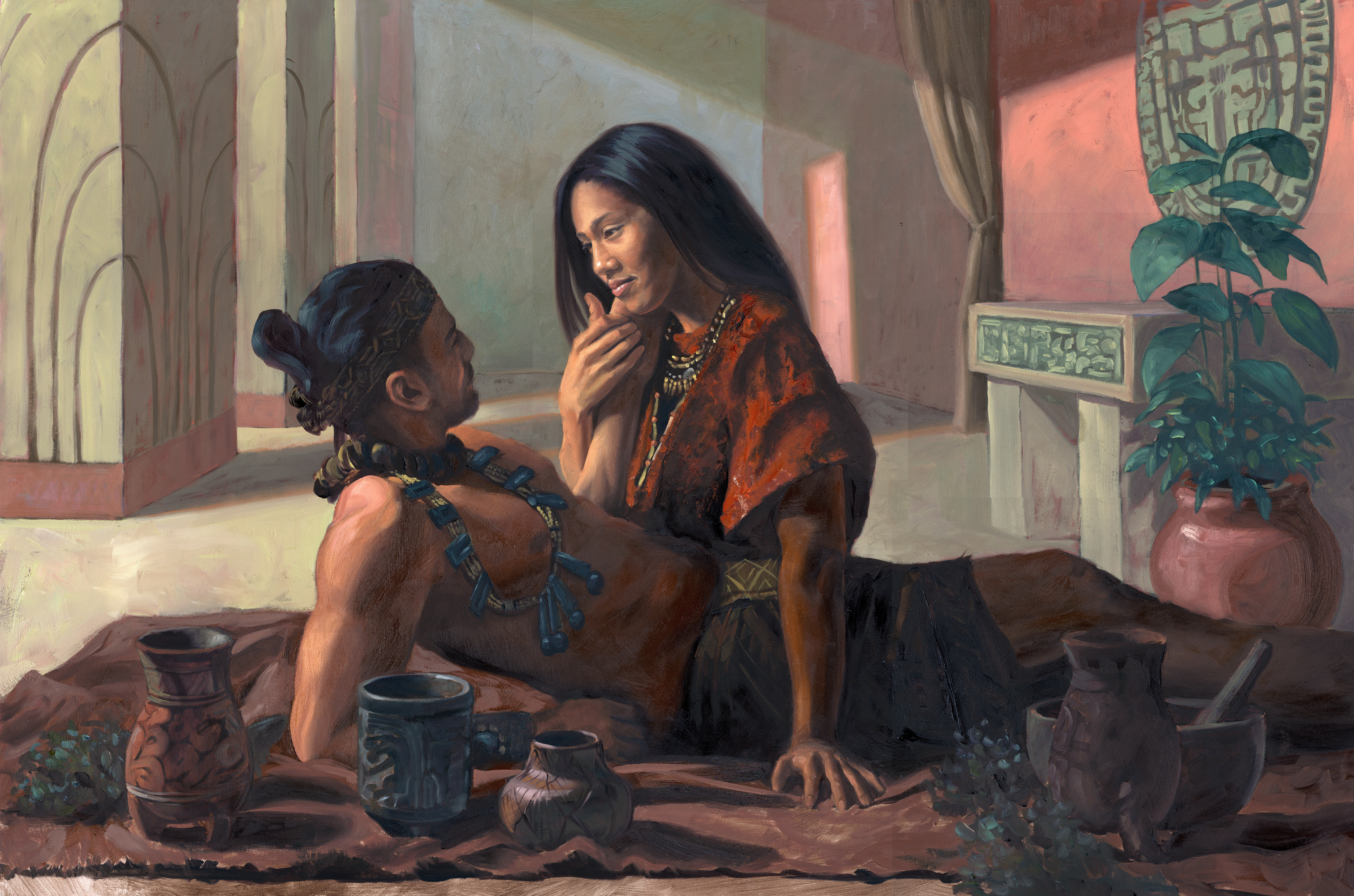
Lamoni’s Queen—“He Stretched Forth His Hand unto the Woman” by James H. Fullmer. Used by permission.
A few years ago, I was talking with some friends about the Book of Mormon. Actually, if you know me much at all, then you know that those last five words are unnecessary. Of course I was talking about the Book of Mormon. My children have been known to complain that the Book of Mormon is all I talk about. But let’s continue the story: One of my friends indicated that we “cannot read the Book of Mormon down to the word level.” She insisted that it was just not possible to read it “as if individual words are meaningful.”
I listened until she paused. Then I said, “That has not been my experience.”
My friend explained how she thought the translation process worked, and why the authoritative people supported the theory she was advocating. She ended by restating her original opinion that “you simply cannot read down to the word level.”
As mildly as I could, I restated my original response, “That has not been my experience.”
When my friend began to explain again—this time with emphatic gestures and vigorous diction—I figured it was time to slip away. I could see she was not suddenly going to ask, “And, Kylie, what has your experience been with the Book of Mormon?” Ironically, I find her assessment of translation theories to be fairly persuasive; her ideas make sense. Nevertheless, I cannot say, “I am convinced! My personal experience is wrong!” That is because my study of the Book of Mormon has convinced me—time and time again—of the opposite: Not only can I study down to the word level, I should.
I believe that I praise God and his son Jesus Christ, who is named the Word,1 by reading as carefully and attentively as I can. Far from falling apart under such scrutiny, the Book of Mormon has instead flourished in amazing and wonderful ways. That is my experience. And that is how I came to my (self-assigned) challenge in this speech.2 I have two aims: (1) to discuss faith by explaining what I have learned from reading the story of King Lamoni’s wife, and (2) to show you how careful reading brought me to that understanding of faith. By the end, I hope you will note not only the content (faith) but also the process by which I reached this content. I hope you will notice that this discussion of faith is the byproduct of “reading small”; that is to say, I think there is much to learn about faith by reading slowly and carefully, by (in the words of my friend) “reading down to the word level.” One of the Book of Mormon’s purposes is to “show” its messages to the intended audiences (title page). As most any first-year writing student can explain, it is a very different thing to show rather than to tell. Thus, my plan is to tell you about faith and to show you how to read at a word level.
Exceeding Faith
In the story of King Lamoni, Ammon praises the queen’s “exceeding faith,” claiming that “there has not been such great faith among all the people of the Nephites” (Alma 19:10). Does anyone else find this statement confusing? The source is Ammon! The Ammon who sees angels, who leads a missionary expedition to the land of enemies and bitter dissenters, and who fights sheep-stealing brigands single-handedly. Is the queen’s “exceeding faith” merely another example of Ammon’s enthusiasm?3 Is “exceeding faith” an appropriate way to address the sorrow (and most likely the denial) overwhelming a recent widow?
If faith is the question, most members of The Church of Jesus Christ of Latter-day Saints know where to find the answer: Alma 32. That chapter is Alma’s famous sermon to the Zoramites about faith and the metaphoric planting of seeds. If the seeds sprout, the metaphor continues with the tending of the seedling until it grows into a tree. This growth process is what Alma uses to explain his idea that “faith is not to have a perfect knowledge of things.” Lacking perfect knowledge leaves people in a position to “hope for things which are not seen, which are true” (Alma 32:21). When Ammon says the queen has faith, what is he saying? What does the queen’s faith have to do with Alma’s words? Does wishing one’s husband is alive relate to planting seeds and seed growth? Is faith a seed that the queen needs to plant? Or is faith the work of planting? What is the difference between the queen’s faith and a “perfect knowledge of things” (Alma 32:2)? What things? Any things? Why does Alma say that faith is “not to have a perfect knowledge” rather than simply saying “faith is not perfect knowledge”? And then he says that “if ye have faith, ye hope for things”? Is “hoping for things” equated with faith? Or is it an outgrowth of having faith? And there are those things again. Why things? This definition may not be as helpful as we thought.
Even a quick perusal of Alma 32:21 demonstrates why this definition confuses some modern readers, just as it confused Alma’s ancient listeners. Alma’s direct audience in the Book of Mormon wondered “how they should plant the seed, or the word of which he had spoken” (Alma 33:1). Do readers feel similarly? What does Alma’s definition of faith mean, and what does it have to do with the queen and her faith?
Alma’s definition and Ammon’s comment to the queen need something more if they are going to work together and help us understand faith. While Ammon’s comment to the queen is embedded in Alma 19, the whole story spreads beyond a single chapter to involve modern-day chapters Alma 17–20 (original chapter Alma XII).4 It is within Alma 18:42 and 18:43 that we find a tiny, two-word phrase, as if. This tiny phrase seems to be the missing element. When Alma’s definition is connected to as if, and also to this Lamanite queen’s conversion narrative, we find a faith that is active, rational, agentive, and relational—and that faith involves a deliberate choice to act as if. Readers who do not notice as if are unlikely to see that what Alma calls faith defines precisely what is going on in the queen’s story. If readers will combine as if, the story of the queen, and Alma’s definition of faith, they will see that the three inter-define each other, working together to explain faith better than any one of them does alone. Together, they explain a practical, lived, as if faith—and that faith has some surprising implications.
The deliberate choice to act as if allows what is hoped for to become—or to remain—real. It explains why more faith will not make more things happen more quickly, why a fleeting thought of doubt has little impact on faith, and why, contrary to what many assume, disbelief—not faith—can be a self-fulfilling prophecy with a predictable outcome.
Definitions and Beginnings
The phrase “as if”5 is used fifty times in the Book of Mormon, and despite its small size, it can carry a heavy load. For example, the phrase can be used for exclamatory statements of disbelief. Some of us may be thinking of Alicia Silverstone’s use in the movie Clueless,6while a few others may be thinking of the use found in Isaiah 10:15. (Is this the first time that Clueless and Isaiah have been used in the same sentence?) As if can be used with intent to deceive (see Alma 56:30) or as a way for an honest narrator to explain what another character thinks or feels (see 1 Ne. 8:25).7 It can indicate an interrupted action (see 1 Ne. 11:12) or be a way to heighten the dramatic (see 3 Ne. 8:6).8 There are other phrases, such as as though, that work similarly.9 In this story of King Lamoni’s wife (Alma 17–20), as if works as a type of paranarrative communication. It does so by sharing something with readers that is beyond the scope of the story.10
As and if are excellent words. Separated, as signifies a comparison or metaphoric statement, while if hints at a hypothetical or a consequential phrase (an if-then type of statement). When those two elements are combined, the result is much more potent than the sum of their parts. The combination creates an unreality, or, in this situation, a statement that should “not be taken factually.”11 While all that sounds complicated, it is actually intuitive. For example, Moroni addresses future readers in Mormon 8:35, stating, “I speak unto you as if ye were present, and yet ye are not” (emphasis added). Moroni understands as if. He is suggesting that if his future readers were present, then he would speak as he is speaking regarding the topic he is speaking about. He is certain that if future readers were a visible, tangible audience sitting right in front of him, he would call them “pollutions” and “hypocrites” and tell them that they “adorn [them]selves with that which hath no life” while forgetting to serve or help their neighbors in need (Morm. 8:38–39). This is the topic about which he would speak and the hostile style in which he would address them. But his future readers are not present and will never be present to hear Moroni speak in his present. It is impossible. Modern readers should pause and understand: Something unreal (you and I and other modern readers being Moroni’s real, in-person audience) impacted something that is absolutely real (the words of Mormon 8). A world in which as if is used is a world in which the unreal, the hypothetical, and the conditional can impact—and change or alter—the real world.
These tiny words—as and if—play out in the same manner in the queen’s story. Ammon teaches her husband, King Lamoni, who offers a repentant prayer and then falls “unto the earth, as if he were dead” (Alma 18:42). The servants take the king’s limp body to the queen and “he lay as if he were dead for the space of two days and two nights” while his family mourns his death (18:43). The question of faith arises when the queen begins to doubt whether her husband is dead. She does not know that he is only as if dead, but something makes her wonder if he is dead.
Others around her presume he is dead. Why they believe the King is dead is hidden within the use of as if. There is a condition or hypothetical possibility implied by the if.If a person dies, then he or she will fall to the earth. The metaphoric aspect—the as—suggests that King Lamoni looks as someone looks when they die. Combining those two elements creates something that is unreal: King Lamoni falls to the earth like he is dead, but he is not. He certainly appears to be dead. Lots of people think he is dead. He lays “as if he were dead for the space of two days and two nights” (Alma 18:43), a time frame that readers should notice. But no matter how dead he appears on those two days and two nights, he is not.
Despite appearances, King Lamoni is only as if dead, not actually dead—something that the queen must wait until Alma 19:12 to discover. Readers, on the other hand, have known this since Alma 18:42, the verse describing King Lamoni’s as if death. When this verse says the king “fell unto the earth, as if he were dead,” the reading audience understands that the king is still alive. Readers who move too quickly may miss just how significant this moment is. The discrepancy between what readers know and what the people in the story know is as vast as the difference between life and death. For thirteen long verses, modern audience members are reading a different story than the queen is living.
Despite the fact that both the queen and the readers are moving through the exact same events—the queen as she lives them and the readers as they read the text—they are not facing the same conflict from the same point of view. They are not even facing the same conflict from different points of view. The queen’s concern is whether the king is alive. Modern readers wonder what the queen will do with her husband’s supposedly dead body. The queen wonders if there is room for hope, despite appearances. The queen certainly wants to know what she should do, but that question will take care of itself if she can figure out whether to believe what her eyes see and what her nose does not smell. Readers do not care about the queen’s question because it was answered before they thought to ask it. The queen does not have the answer to the readers’ question because she has no idea they are in her future. She is just trying to get through this tragedy. She gathers the sons and daughters of the king and they “[mourn] over him, after the manner of the Lamanites, greatly lamenting his loss” (Alma 18:43). And yet, she begins to wonder if hope for a different outcome is possible. The queen wonders if her husband is dead or alive, if there is room for hope. Readers wait anxiously, wondering what the outcome might be.
Why the Queen Needs Faith
Lamoni’s wife knows her husband looks dead, and yet, for some reason, she begins to doubt what her eyes see. She calls for Ammon, believing he may be a “prophet of a holy God,” a God who gives him “power to do many mighty works” (Alma 19:4). Ammon tells the queen that her husband is “not dead” and that she should “bury him not” because “on the morrow he shall rise again” (Alma 19:8).
What should the queen do? From the reader’s perspective, the queen’s most rational choice is obvious: wait for a few more days. But waiting a few days is not as simple as it seems. There are many reasons to suspect that that advice will not be received well in this fractured society. From a practical point of view, bodies decompose. They begin to smell, a reality that is upsetting some people already. This society—like many others—may be one in which practical concerns are supported by social or religious traditions. Fears about disease and cleanliness may give rise to the tradition that those who have passed away be buried quickly, even the same day as the death.12 If this society still has remnants of Israelite traditions, then they believe that “to be unburied [is] the ultimate disgrace.”13 Moreover, they also believe that any who touch a dead body are rendered unclean for seven days (Num. 19:11). If the queen disallows the burial, her actions could be interpreted as dishonoring her husband, violating Mosaic law, instigating a health hazard, and creating a situation that causes many people to become ritually impure.
The queen seems aware of the fractures and instability in her society. Before she sends servants to fetch Ammon, she has already “heard of the fame of Ammon” (Alma 19:2), talked to “the servants of [her] husband” (Alma 19:4), and heard what “some say” as well as what “others say” about her husband’s body (Alma 19:5). Likely, she is aware that these people are quick to assume evil has come upon them and to blame someone for that evil. Some ascribe evil to King Lamoni because he “slew his servants who had had their flocks scattered” (Alma 19:20), while others believe evil came upon them because King Lamoni “suffered that the Nephite should remain in the land” (Alma 19:19). The group of Lamanites who “delighted in the destruction of their brethren” and purposefully scattered flocks with that intent (Alma 17:35) were also “exceedingly angry with Ammon” for fighting back (Alma 19:22). Between weeping and scared servants, bloodthirsty Lamanite outlaws, and those who blame the king for various evils, this situation is wildly unpredictable. The explosive political environment, hostile populace, and general uncertainty at a time of grief and mourning make this situation complex and even volatile. Any choice is going to offend some, but aligning with the Nephite is sure to provoke many. This is the situation facing the queen, and it seems almost impossible to untangle.
The queen’s situation is politically perilous and perhaps even physically dangerous. But readers may overlook it all, not realizing that two tiny words, as if, convey information that changes the story for them. Does anyone inside the story understand that reality and unreality are twisting together and tangling the plot? Readers do not know why King Lamoni collapsed, and the people inside the story are unaware that there is a need to ask. Cause and effect sequencing are not working correctly in this plot. The cause—the death of King Lamoni—is not real. It did not happen. But only readers (and Ammon) seem to know that. Oddly, an unreal cause is about to break into reality. King Lamoni is not dead, which should lead this story to a happy ending: a non-burial for a non-dead king. But if those who want to bury the king actually do so, they will leave this story with a very unhappy ending: a real burial for a non-dead king.
What should be done? In Alma’s theology of Alma 32, the definition of faith leads to a metaphor of planting seeds and growing a tree. The fulfillment of faith is a mature tree of life that produces fruit, which fills one in such a way “that ye hunger not, neither shall ye thirst” (Alma 32:42). Having faith is acting in a manner that “[looks] forward . . . to the fruit” (Alma 32:40), namely by planting, tending, and nourishing the seed. Alma tells readers that planting “a true seed, or a good seed” means “not cast[ing] it out by [their] unbelief” (Alma 32:28). Besides equating true with good, Alma says that knowledge of the goodness of the seed is “real” and argues that it is real “because it is light” and is also “discernible” (Alma 32:35), intimating that these words are near synonyms.
In the high-pressure circumstances surrounding Lamoni’s as if death, the queen has a big problem: She does “not . . . have a perfect knowledge of things,” even very important things, such as whether her husband is dead or alive. If she knew what was real or true, she could make her decision easily: If the king is dead, she should bury him. If the king is not dead, she should not. But in this situation, what is real or true cannot be discerned. Lacking perfect knowledge leaves the queen with a choice and with the consequences of that choice. The queen can allow the servants to “take his body and lay it in a sepulchre” (Alma 19:1). If he is dead, this action will not change anything. But what if he is only as if dead? Burying him alive will cause his actual death.
This is critical for readers to understand. Burying the king’s body has one, guaranteed outcome: death.14
Queen (Lamoni) and Alma’s As If Faith Model
Perfect Knowledge
Queen’s Choices
Consequences
The king is dead.
→
Bury him!
→
The king is dead.
The king is as if dead.
→
Do not bury him!
↗
The king may be dead.
↘
The king may be as if dead.
Alma’s definition of faith describes the queen’s situation. Readers understand that the queen is willing to “hope” her husband is alive, even though she has “not seen” that reality. The queen’s hope is what informs the decisions she must make. The queen “[has] had no witness save [Ammon’s] word, and the word of [the] servants,” but she tells Ammon that she will “believe that it shall be according as thou hast said” (Alma 19:9). Of course, she has her sensory perceptions, and it seems that those perceptions are what cause her to question Lamoni’s death, but she does not rely wholly upon her eyes or her nose. Instead, she is willing to risk faith in Ammon’s word. This is what Ammon declares is “great faith” (Alma 19:10), and it is according to Alma’s definition. The queen states her faith in terms of believing what Ammon says, and then acting in faith when she chooses to not bury her husband but, instead, to “[watch] over the bed of her husband, from that time even until that time on the morrow which Ammon had appointed that he should rise” (Alma 19:11).
Fortunately for the king, the queen believes what Ammon says. The queen’s belief in Ammon’s words allows time for her husband to recover, and thus the queen’s faith “saves” the king’s life—sort of. At least, her belief halts those who are sure that Lamoni’s body “stinketh, and that he ought to be placed in the sepulchre” (Alma 19:5). The queen is determined to wait and watch (Alma 19:11), which halts the burial and the king’s possible death. It is the queen’s belief and her actions that save Lamoni. She does not raise him from the dead, but she does save him from being killed. She acts as if what Ammon says is real is real, and that is what allows her husband’s life to be spared.
Implication 1: Faith Is Choice and Action, Not (or Not Only) Patience, Thinking, or Feeling
This story might make faith seem synonymous with patience. Confusing patience and faith can occur because, depending on the situation, the action required of faith may be the action of patience. The Book of Mormon recognizes the connection. For example, Alma’s people learn that “the Lord seeth fit to chasten his people; yea, he trieth their patience and their faith” (Mosiah 23:21). In his sermon to the Zoramites, Alma’s son, Alma, says—three times in three consecutive verses—that nurturing the seed requires “patience,” “diligence,” and “faith” (Alma 32:41, 42, 43). Patience is near and connected to faith, but despite similarities, faith and patience are not the same. Even the connection between patience and faith inherently recognizes that both words are needed because they are not so similar that only one word is needed.
Moreover, in other situations, the action of faith is not simply waiting, no matter how it may appear in the queen’s story. Indeed, even in the queen’s story, her faithful action is not merely passive and patient. She could sit and wish that what she wants will happen. But patience alone is not her best option. If the queen does not talk to Ammon, does not choose to believe him, does not communicate what she wants, and does not sit beside her husband, then her hoped-for outcome has a dismal chance of success. Those people who are more motivated will decide to do what they think ought to be done, and that means that the body of King Lamoni will most likely be buried in the sepulcher by the third day. If the queen simply waits, her husband will end up as dead as some assumed he already was.
Combining the queen’s story with Alma’s explanations suggests that faith is choice with action. The queen makes a tough decision in an unpredictable situation and then ensures that her faithful decision is given the time needed to manifest what is real or true. The queen stays beside her husband all night, watching the man she loves, but possibly “watching” to protect, as well. Patience was a characteristic of her faith—her choice to act as if.
We could consider another as if situation and see that faith requires action. For example, consider this less religious but realistic event from my own life: I grew up in Wyoming, and my family hunted wild game. Hunting was never my favorite thing to do, so after I was married, I decided to send my husband to participate in the hunt. My husband agreed to go—not because he loved hunting, but because he wanted to get to know his new in-laws. My mother thought that was a marvelous idea, which is how and why my husband and my mom spent a few days together in the mountains of Wyoming, traipsing up and down trails and through meadows, fording streams and riding horses—chatting the entire time about the gospel, life, growing up, family, and whatever else suited them. My father was not amused. He tried to shush them, explaining time after time that their chatter made the hunt pointless. Hunting requires people to act as if. There may or may not be animals present in the next thicket of trees or in the valley just over that next hill. But—as my dad tried to reiterate—if people value finding wild game, they must behave as if the animals are there. If they behave otherwise, then the animals will not be there. The skittish wild game will be frightened by the sound or smell of people, and the animals will slip away into the forest. Intriguingly, that occurs not because wild game is imaginary but because loud people act in a manner that alters or changes their ability to find what is real.
In a similar manner and for some of the same reasons, faith is not simply thinking. It is also not a magical power, an intense cognitive focus, an absence of doubt, or an emotional connection with deity. The relationship between belief and action is not something explored in great detail in the queen’s situation. But it seems that once she has settled on her faithful and active commitment to non-burial, her thoughts and doubts will not matter. A random stray thought or a feeling of creeping doubt does not change what is real. The queen must believe enough to act, but forcing herself to pray harder or believe stronger will not make what is real somehow more real. Whether she sings hymns all night, recites scripture, or sits beside her husband simply holding his hand, it will not make Lamoni more—or less—alive. She may think about her fears—for her children, her people, and everyone in this fractious society. As long as she remains committed to her chosen course of action, Lamoni will rise when he rises. The queen’s thoughts do not alter that reality—at least they do not until those thoughts become powerful enough to convince her to change how she is behaving.
Implication 2: Disbelief Is Predictable, but It Hides Reality and Creates Tragedy
Ironically, it is disbelief or lack of faith that has the power to change reality in predictable and yet devastating ways. An unwillingness to believe that King Lamoni is only as if dead ensures the worst outcome. King Lamoni will be dead after he is buried, even if he was not dead before. In this situation, disbelief will create the tragedy that the queen and her children are lamenting. If the queen rejects what Ammon has told her, she will alter what is real, run roughshod over what was true, and fulfill her own worst nightmare. Her disbelief could very well cause the situation she desperately hopes is not real.
It is in this manner that disbelief creates a situation in which an unbeliever may never know what is real. In this Book of Mormon scenario, King Lamoni’s wife makes the faithful choice not to bury him. But if she had lacked faith in Ammon’s words, if she had buried her husband, then how could she ever know with certainty that King Lamoni was dead when he was buried? The king may have been alive or dead, but doubt hides what is real. The queen’s story demonstrates that a lack of faith distorts and hides what is true, even as it changes and ruins what could have been real. It takes fear of the unknown and exchanges it for predictability and tragedy.
Implication 3: Faith Is Relational
Once Ammon gives his message to the queen, he fades into the background, leaving the queen momentarily in the spotlight. But Ammon’s perspective is unique: When he “went in to see the king according as the queen had desired him,” he “knew that [the king] was not dead” (Alma 19:7, emphasis added). Ammon also “perceive[s] the thoughts of the king” (Alma 18:16), has “a portion of that Spirit dwell[ing] in [him],” and has the “knowledge, and also power” of God (Alma 18:35). Ammon seems to have an almost godlike perspective. Nevertheless, he is “overpowered with joy” (Alma 19:14) when he sees the queen’s choice and the result. Is he surprised? Despite knowing what is real, Ammon did not know what King Lamoni’s wife was going to do. Even with his amazing point of view, Ammon also lives by faith, acting as if the queen will believe, hoping that this woman he barely knows will preserve the life of his friend. When she does, he is overjoyed.
It seems that Alma’s faith has a hidden aspect: It is relational. When the queen acts as if her husband is alive, she is risking trust in Ammon and his God. That is inherently unpredictable. Trusting in a person means being vulnerable. It is opening oneself up to being hurt or betrayed or let down. Can the queen stand to do it? What if she believes Ammon and then learns that her husband really is dead? She would then have to suffer through the shock and lamenting of those first few days all over again. Faith is not easy. There is no guarantee. But in these stories, faith is not irrational wishful thinking, either. It is a deliberate choice to trust a person and make decisions based on a relationship.
Disbelief, or refusing to believe as if, is typically described in terms of cognitive thought. But in these stories, the lack of belief seems to have more to do with distrust. In the as if story about King Lamoni’s father, the queen of all the Lamanites rushes to her husband who—like his son—has collapsed on the ground and appears to be dead. The queen “saw him lay as if he were dead, and also Aaron and his brethren standing as though they had been the cause of his fall” (Alma 22:19). This queen clearly believes what she sees with her own eyes and is willing to act quickly upon her own perceptions. In the story of King Lamoni’s father and mother, disbelief relies on one’s self and often on one’s own perceptions, rather than on relationships and trust. Disbelief is predictable, which can make it seem safe. But the price for that safety is high: Disbelief leads to certain tragedy and certain pain.
Implication 4: Faith Is Not About the Outcome
Many want certainty of outcome, and we want it so much that we tend to work backwards. We assume that someone has faith if the outcome is positive. But if faith is acting as if, then it is not dependent on outcome. Faith is the belief-inspiredaction. It is the act of being faithful that deserves praise. The outcome is not our business. We do not decide what is real or true in these types of situations—God does. In fact, not only do we not know what is real or true, but, according to Alma, at first we “cannot know” (Alma 32:26, emphasis added). God “desireth . . . that ye should believe, yea, even on his word” (Alma 32:22). We do not know, we cannot know, and God—in his mercy—wants it that way. Alma explains why in his honest, straightforward way: “How much more cursed is he that knoweth the will of God and doeth it not, than he that only believeth, or only hath cause to believe, and falleth into transgression?” (Alma 32:19).
Nowhere in Alma’s pithy, one-verse definition (Alma 32:21) of faith is there anything indicating that people are responsible for the result of their initial faithful action. Alma begs the Zoramites to plant a seed. That is the faithful action he hopes they will perform. Yet he recognizes that acting in faith to plant a seed does not guarantee the conclusion. Alma explains that “if a seed groweth, it is good, but if it groweth not, behold it is not good and therefore it is cast away” (Alma 32:32). The Zoramite responsibility at the beginning is simple: plant a seed. Whether that seed is “good” or “bad” is not up to them. Notably, when the seed grows, they learn the seed is good and that their knowledge is “perfect” about that particular seed. But they still need faith. Acting in faith becomes the action of nourishing that small seedling.
In a similar manner, the young queen acted faithfully when she extended trust in Ammon’s words, not knowing what was true and yet believing enough in Ammon’s words and trusting enough in Ammon that she acted. Regardless of how this faith-filled story concludes, the queen’s actions remain faithful. Even if the action of faith uncovers a different reality than what the queen hoped for, even if the action of faith determines that the “seed” is “not good” and should be “cast away” (Alma 32:32) or that the king is dead and ought to be buried after all, the queen acted in faith. Her choices allowed what was true to manifest itself, to become “discernible” (Alma 32:35). Her responsibility was to act faithfully. It was not her job to somehow force her husband to not be in his death-like state.
Faith is difficult, and any person—even a queen with exceeding faith—may doubt. But faithful action is strong. Some people may worry that they will sabotage what they want most if they wonder or question. What if a thought of doubt flits across the stage of the mind? In Alma’s faith model, a random stray thought does not unplant a seed, nor does a moment of questioning move a king’s body from his bed to a sepulchre. Thoughts and beliefs absolutely matter. But until thoughts rise to the level of action, they do not change the outcome of prior faithful actions.
Implication 5: As If Faith Seems to Be Transferable to Other Situations
Is Alma’s definition of faith as understood through the as if decision-making process transferable to other faith-necessitating situations? Perhaps. In the last chapter of the Book of Mormon, Moroni exhorts readers to ask “if these things are not true” (Moro. 10:4, emphasis added). This phrasing is why many pray to know if the Book of Mormon is true and then wait for a witness from the Holy Ghost to know.
I have nothing against that process. I have no reason to doubt the experiences of others. It just did not work for me. I prayed and prayed and prayed—on multiple occasions, for various lengths of time, in my closet, at the church, outside in nature. I never felt like I received an answer—at least not in the way that other people do. One of my sisters noted the not phrasing years ago and asked me, “Is God really sitting in his heaven not answering heartfelt prayers because of a slight wording issue?”
My answer then and now is “I really don’t know.”
But I do know that Alma says that “faith is not to have a perfect knowledge of things” (Alma 32:21). And I also know that Alma says that “there are many who say: If thou wilt show unto us a sign from heaven, then we shall know of a surety; then we shall believe” (Alma 32:17). I am afraid that was exactly what I wanted God to do for me. I wanted to know the Book of Mormon was true so that then I could believe. I wanted proof of the real and the true before I committed. I wanted to see and to know beforehand so that I would not be disappointed. But that is not how faith works, at least not according to Alma.
I should warn you that I might be wrong. I guess I should have told you that in the beginning, right? When Moroni tells readers to ask if these things are not true, he might be using this phrasing rhetorically, as if he were exclaiming, “How could these things not be true!”15 Another scholar suggests that this phrasing could be a “negative if-clause” which “implies that these things are indeed true.”16
But what if Moroni meant exactly what he said?
What would it look like to see Moroni’s proposition in light of Alma’s as if model of faith? Moroni suggests we ask God if the Book of Mormon is not true. Like the queen, we are stuck in the middle, without a “perfect knowledge” regarding this book. Perhaps we should strip away the clutter and consider where that leaves us. If God did not mercifully bring this book into your life and into mine, what should we do? If this is not a book from God, a reasonable reaction might be to throw it in the trash can or the recycling bin and move on. (Actually, please do not throw it in the trash. Just bring it to me. I’ll take care of it for you.) Why would you waste so much time and effort on something that is not true? But—similar to the queen’s decision—this comes with a warning: If you throw it in the trash, the Book of Mormon becomes trash to you. The book will be dead to you. That is all it can be. The result is predictable, guaranteed, and secure—but at what price?
Are you willing to risk faith instead? Faith is not an assurance of result. Faith is choosing to believe that the Book of Mormon is not “not true.” What then? If the Book is not “not true,” then plant a seed or two. Maybe try watering the seed. How about putting it outside in the proper amount of sunlight and giving it the appropriate nutrients? What does Alma’s seed metaphor mean about the Book of Mormon? Well, first, because this is metaphoric or symbolic language, we should not take it literally. In other words, do not plant your Book of Mormon in your front planters. That will just turn your book into a soggy mess.
The metaphor means we should try out the word of God. We should try it out because we have learned that the book is not not true. If that critical question is answered, then we should try to learn from the queen. We can act in faith, which means making a choice and acting as if. It means reading your scriptures, studying and gaining insight, trying to understand this book, and then living by the teachings and principles you are inspired to understand.
Alma’s metaphoric experiment does not grow a bean plant. That makes me a little sad. I believed my faith could grow into edible, healthy food within a few short months, a vivid object lesson emblazoned in my heart and mind by multiple Primary lessons and their soil-filled Dixie cups. I loved the little white bean seeds that peeked out of the dark soil. But somehow, we missed an important point: Alma’s seed becomes a tree—a tree of life (see Alma 32:40). Faith in Alma’s metaphor leads to life. How long does it take to grow a tree of life? I do not know. But I do know that growing trees requires some amount of time and patience and faith. What this means is that for some of us, the truth of the Book of Mormon is discovered as we live life. As we read the Book of Mormon and try out its principles, we will discover whether the Book of Mormon is “true” or “good” or “light” or “real” (Alma 32:31, 35). This option is uncertain. It is not perfect knowledge. The Book of Mormon may still end up being something other than true, but at least there is the opportunity to discover that reality. Acting as if the Book of Mormon is true means planting a seed and experimenting. Will the seed grow into a tree? Maybe. Maybe not.
Of course, as the queen’s story demonstrates, there is another way. You could not plant a seed. But be aware that not planting leads to one sure outcome: There will not be a tree. Planting a seed is the only possible way to learn if a tree will grow.
Implication 6: Faith and Truth? Faithful and True?
King Lamoni’s father and mother face an almost identical situation. Unlike his son, who seems to spontaneously erupt into prayer, King Lamoni’s father must be taught by Aaron. Aaron tells the king to pray “in faith, believing that ye shall receive” (Alma 22:16), a definition of faith that does not sound like Alma’s choice-and-action kind of faith. How is King Lamoni’s father supposed to marshal his mind and his thoughts into order and then shove everything into a container of belief and make it fit? How is he supposed to pound his heart, his hot temper, and his other emotions into submission? How can he make them bow to a God he knows little about? Is Aaron telling readers a secret about how to squeeze belief out of unbelief?
King Lamoni’s father may not know the answer to these questions. I doubt he does because he seems to blithely ignore Aaron’s instructions. Instead of believing in God and believing that he will receive, this king “bow[s] down before the Lord upon his knees” and offers a breathtakingly honest prayer. He says, “O God, Aaron hath told me that there is a God; and if there is a God, and if thou art God, wilt thou make thyself known unto me?” (Alma 22:18). We could quibble about some minimal level of faith necessary to say the prayer at all, but, regardless, the prayer is shockingly faithless—at least it is, if faith means the type of firm belief in God that Aaron describes. King Lamoni’s father does not focus intently on Jesus, he does not mindfully block out stray thoughts of doubt, and he does not step back and wait patiently to see what happens. Instead, he fully admits that he does not know if God exists. And, rather than hypocritically pretending to believe in a God that he does not believe in, King Lamoni’s father prays truth because he is true. This king of the Lamanites prays effortlessly. He prays without an ounce of showmanship or insincerity. Rather than praying the “right” way in front of Aaron and then wondering whether he really believes or not, he prays what is real or true to him. He is utterly congruent.
For King Lamoni’s father, acting as if is not knowing what God will do or even knowing that there is a God. It is not knowing if the Book of Mormon is not true or true or not not true. Acting as if is knowing himself. He binds himself with the surety of someone who has scoured his soul. He knows the depths of his own sinful nature and is unflinchingly honest with himself about that nature. When he prays, he offers to give away all his sins—the ones he secretly enjoys, the ones he is ashamed of, the ones he did not even know were sins until Aaron started expounding the scriptures. From the depths of his well-searched, magnificently honest soul, King Lamoni’s father prays to a God who may or may not exist and who, even if he does exist, may or may not be Aaron’s God. Nevertheless, for the chance to know this God, for the chance “to be raised from the dead” and “be saved,” King Lamoni’s father “will give away all [his] sins” (Alma 22:18). How can he promise such a thing? He knows who he is and what he is. He knows what it means for him to be true.
Conclusion
The story of King Lamoni can create confusion when readers are told that the queen has such amazing faith. If they overlook as if, misunderstand its power, and misjudge who is saying it to whom, they will know the king is not dead but feel unsure about why the queen has exceeding faith. The queen cares immensely about whether her husband is dead or as if dead, but she does not know which he is, and she does not have access to the words that make King Lamoni’s state clear. The queen’s grief at Lamoni’s passing (Alma 18:43), her refusal to leave his side (Alma 19:11), and their mutual joy at his revival (Alma 19:13) make this the most loving husband-wife relationship in the Book of Mormon. Indeed, even before he was fully standing, King Lamoni “stretched forth his hand unto” his beloved wife, praising God and this woman of exceeding faith (Alma 19:12). He testifies of Jesus Christ, swearing on the life of his beloved that he has “seen [his] Redeemer,” and that this Redeemer shall “redeem all” (Alma 19:13). This is the moment the queen had hoped for, the moment in which she “reaped the rewards of [her] faith, and [her] diligence, and patience, and long-suffering, [and] waiting” (Alma 32:43). This is a good and glorious end. It is a miracle.
But those of us who read a different story for thirteen verses need a different miracle. We cannot let the outcome be mistaken for the message. Our miracle is the process and the story.
We need to believe as if we were the queen of the Lamanites. We are not her. We will never be her. Despite extreme pressures from within and without, she chose to believe Ammon. We can too. Despite what is obvious to her eyes, she acts with faith. We can too. Her faith is evident in her actions. We see her watching and waiting beside the body of the man she adored. She watched all night for signs of life. I imagine that each minute felt as if it were an eternity.
Ammon has a word for what the queen is doing. He calls it faith. So does Alma. And so do I.
There are plenty of words in plenty of books. I like lots of them. I love some of them. But the words of the Book of Mormon are not just words. That is why I read the Book of Mormon as if words matter. I have no guarantee that they do. But I am not as worried about that as much as I used to be. If I want certainty, I know where it is. But I do not think I want it anymore. If I understand what Alma is saying, then I am willing to walk through uncertainty, wait in the discomfort of vulnerability, and attempt the risky way. I find that I want to believe. I want faith. I want to plant little words, even if they are as tiny as mustard seeds. And I have. Time and time again, I have planted the words, studying as if the words do more than tell a story about a tree. I study as if the words are good, true, real, and alive. In my experience, they are. I love the slow work of nourishing my soul with the small and simple words of God. In these words, I find life.
Kylie Turley has thoroughly enjoyed teaching classes such as the Literature of the LDS People, the Book of Mormon, and various writing and rhetoric courses at BYU for nearly thirty years.
2. This essay was originally a lecture given on November 1, 2024, as part of the Wonder of Scripture lecture series sponsored by the Neal A. Maxwell Institute for Religious Scholarship and held at Brigham Young University.
3. Examples of Ammon’s expressive, exaggerated language: “I desire to dwell among this people . . . perhaps until the day I die” (Alma 17:23); “I know that I am nothing” (Alma 26:12); “I cannot say the smallest part which I feel” (Alma 26:16).
4. The Book of Mormon had different chapter breaks when it was first published. The “original” chapter breaks are more narrative-based and tend to be longer than modern stories. When I refer to the “queen’s conversion narrative,” I am referring to modern day chapters Alma 17–20. It is within Alma 18 that we find as if used twice.
5. Hans Vaihinger’s 1911 work, The Philosophy of “As If” is considered one of the foundational texts regarding this phrase. See H. Vaihinger, The Philosophy of “As If”: ASystem of the Theoretical, Practical and Religious Fictions of Mankind, trans. C. K. Ogden (Routledge & Kegan Paul, 1924). See also Hans Vaihinger, The Philosophy of “As If,” 2nd ed. (Routledge Classics, 2021).
6.Clueless, directed by Amy Heckerling (Paramount Pictures, 1995).
7. See Gary Yamasaki, Perspective Criticism: Point of View and Evaluative Guidance in Biblical Narrative (Cascade Books, 2012).
8. See Louis Jacobs, “The ‘As If’ Concept,” European Judaism: AJournal for the New Europe 6, no. 1 (1971/72): 44–49.
9. The Book of Mormon writers often differentiated between as if and as though, reserving as if for narrative and as though for doctrinal issues and for time references concerning Christ. Oddly, that relatively stable consistency is not maintained through the extraordinarily similar stories of King Lamoni and the (young) queen as compared to King Lamoni’s father and the (older) queen of all the land. See María José López-Couso and Belén Méndez-Naya, “On the Use of As If, As Though, and Like in Present-Day English Complementation Structures,” Journal of English Linguistics 40, no. 2 (2012): 172–95, https://doi.org/10.1177/0075424211418976.
10. See Ralph Müller and Tobias Lambrecht, “‘As if’: Mapping the Empathic Eloquent Narrator through Literary History,” Language and Literature 22, no. 3, 175–90, https://doi.org/10.1177/0963947013489236.
11. Douglas Biber, Stig Johansson, Geoffrey Leech, Susan Conrad, and Edward Finegan, Longman Grammar of Spoken and Written English (Pearson, 1999), 840, quoted in Laurel J. Brinton, “The Extremes of Insubordination: Exclamatory As If!” Journal of English Linguistics 42, no. 2 (2014): 98.
12. See Deuteronomy 21:23, which insinuates that people—or, at least, criminals—should be buried on the same day that they die. Jon Davies explains that the Mishnah reaffirms the practice of same-day burial, although the grave remained open for three days to ensure that the death had actually taken place. See Jon Davies, Death, Burial and Rebirth in the Religions of Antiquity (Routledge, 1999), 102.
14. This chart may introduce concerns about binary choices and either-or logic. Close reading points out that there are significantly more factors influencing the queen, but Alma (or Ammon or Mormon) is most interested in a discussion of faith. The author seems to present the queen’s choices in this manner to highlight faith. Even though the queen’s choices are presented as either burying the king or not, those choices do not lead to only two predictable outcomes, even in this simplified model. As discussed, there are clearly multiple factors influencing the queen and her decision making, but the simplification presented by the author is a helpful way to clear away the clutter and focus on faith.
16. Royal Skousen, Analysis of Textual Variants of the Book of Mormon, 2nd ed.,vol. 6, 3 Nephi 8–Moroni 10, The Critical Text of the Book of Mormon 4 (The Foundation for Ancient Researchand Mormon Studies; BYU Studies, 2009), 4092.