


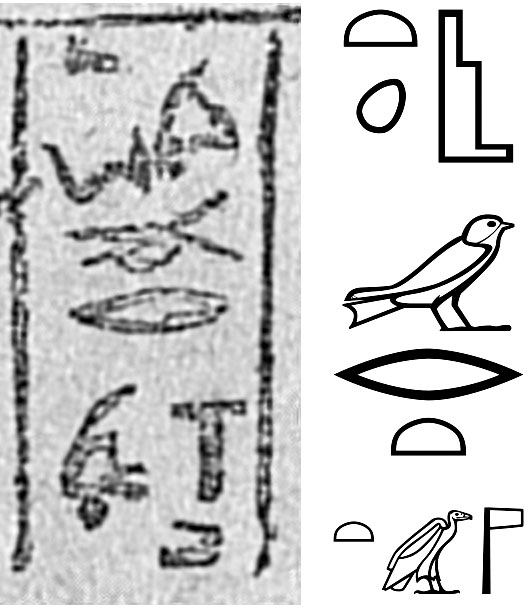
 Figure 47. A side-by-side comparison of the hieroglyphs that appear next to figure 2 in Facsimile 3 in the May 16, 1842, issue of the Times and Seasons (left) and the reconstructed hieroglyphs by Rhodes (2002), 24 (right). Image of Facsimile 3 © Intellectual Reserve, Inc. Courtesy Church History Library, The Church of Jesus Christ of Latter-day Saints.
Notes
1. For instance, Hedlock positioned figure 3 in Facsimile 1 behind figures 2 and 4, whereas in the original illustration figure 3 is positioned between figures 2 and 4.
2. Thus, William Flinders Petrie, “The inscriptions are far too badly copied to be able to read them,” and John Peters, “The hieroglyphics which should describe the scenes, however, are merely illegible scratches, the imitator not having the skill or intelligence to copy such a script.” F. S. Spalding, Joseph Smith, Jr., as a Translator (Salt Lake City: Arrow Press, [1912]), 24, 28. Compare the comments in Klaus Baer, “The Breathing Permit of Hôr: A Translation of the Apparent Source of the Book of Abraham,” Dialogue: A Journal of Mormon Thought 3, no. 3 (Fall 1968): 127 nn. 109–10.
3. Quinten Zehn Barney, “The Neglected Facsimile: An Examination and Comparative Study of Facsimile No. 3 of The Book of Abraham” (master’s thesis, Brigham Young University, 2019), 26.
4. Robert K. Ritner, The Joseph Smith Egyptian Papyri: A Complete Edition, P. JS 1–4 and the Hypocephalus of Sheshonq (Salt Lake City: Smith-Pettit Foundation, 2011), 139; Michael D. Rhodes, The Hor Book of Breathings: A Translation and Commentary, Studies in the Book of Abraham 2, ed. John Gee (Provo, Utah: Foundation for Ancient Research and Mormon Studies, 2002), 25.
5. “A Fac-simile from the Book of Abraham. No. 3,” Times and Seasons 3, no. 14 (May 16, 1842): 783; Rhodes, Hor Book of Breathings, 24.
6. As one Egyptologist has recognized, this can be “a dangerous procedure when one is trying to use the names to prove something.” Baer, “Breathing Permit of Hôr,” 127 n. 110.
7. See the discussion in Barney, “Neglected Facsimile,” 63–88.
8. Hugh Nibley, Abraham in Egypt, 2nd ed., ed. Gary P. Gillum, The Collected Works of Hugh Nibley 14 (Salt Lake City: Deseret Book; Provo, Utah: Foundation for Ancient Research and Mormon Studies at Brigham Young University, 2000), 425–32.
9. Geraldine Pinch, Handbook of Egyptian Mythology, Handbooks of World Mythology (Santa Barbara, Calif.: ABC-CLIO, 2002), 149; compare L. Kákosy, “Isis Regina,” in Studia Aegyptiaca I: Recueil d’études dédiées à Vilmos Wessetzky à l’occasion de son 65e anniversaire, ed. L. Kákosy and E. Gaál (Budapest: Éötvös Loránd Tudományegyetem, 1974), 221–30.
10. R. E. Witt, Isis in the Ancient World (Baltimore: Johns Hopkins University Press, 1971); Barbara S. Lesko, The Great Goddesses of Egypt (Norman: University of Oklahoma Press, 1999), 155–202.
11. The Egyptian word translated here is feminine.
12. Christian Leitz, ed., Lexikon der ägyptischen Götter und Götterbezeichnungen, 8 vols. (Leuven, Belg.: Peeters, 2002), 3:40; 8:29.
13. Leitz, Lexikon der ägyptischen Götter und Götterbezeichnungen, 5:551; 8:30.
14. Leitz, Lexikon der ägyptischen Götter und Götterbezeichnungen, 5:545–46; 8:30.
15. Leitz, Lexikon der ägyptischen Götter und Götterbezeichnungen, 3:40; 88:30.
16. Leitz, Lexikon der ägyptischen Götter und Götterbezeichnungen, 4:347; 8:30.
17. Leitz, Lexikon der ägyptischen Götter und Götterbezeichnungen, 5:543–44; 8:30.
18. Leitz, Lexikon der ägyptischen Götter und Götterbezeichnungen, 4:348; 8:30.
19. Leitz, Lexikon der ägyptischen Götter und Götterbezeichnungen, 5:544; 8:30.
20. Leitz, Lexikon der ägyptischen Götter und Götterbezeichnungen, 5:542; 8:30.
21. Leitz, Lexikon der ägyptischen Götter und Götterbezeichnungen, 4:348; 8:30.
22. “Als mutmaßliche Verkörperung des ‚Thronsitzes‘ ist sie dem Königtum und damit dem politischen Aspekt göttlichen Wesens sogar in besonderer Weise verbunden; ihre Rolle als Mutter des Horus und Schwester-Gattin des Osiris bindet sie denn ja auch aufs engste in das ägyptische Königtum ein, in dem der lebende König Horus verkörpert . . . eingeht.” Siegfried Morenz, “Vorträge und Referate (Ausführliche Fassung) Ägyptische Nationalreligion und sogenannte Isismission,” Zeitschrift der Deutschen Morgenländischen Gesellschaft 111, no. 2 (1961): 434, translation ours. Compare Jan Bergman, “Isis” in Lexikon der Ägyptologie, ed. Wolfgang Helck and Eberhard Otto (Wiesbaden, Ger.: Harrassowitz, 1980), 3:186–87.
23. Nibley, Abraham in Egypt, 429.