Breath of Life (From the Dust) by J. Kirk Richards; 2011; 80 × 98″; oil, acrylic, and dirt on linen; private collection. Courtesy J. Kirk Richards.
Members of The Church of Jesus Christ of Latter-day Saints have a unique and beautiful theology regarding the body. Many Christian religions share teachings such as “people are made in the image of God, that the body is a gift from God or a temple of God, and that God is loving and forgiving and merciful—presumably regardless of one’s appearance or weight.”1 For many religions, including The Church of Jesus Christ of Latter-day Saints, the body is essential to progression and development throughout life. Members of the Church have additional beliefs, such as being created in the image of embodied divine parentage (namely, in the image and likeness of God) and that individuals will one day be resurrected with a perfect body. These beliefs may embolden and protect some members from forming negative body esteem. Indeed, female members of the Church generally experience greater body satisfaction compared to those who are not of the faith.2
In contemporary society, many people have a complicated relationship with their body, with many individuals wishing they looked different. In fact, in the 1980s, body dissatisfaction was so pervasive among women in the United States, it was deemed “normative discontent”;3 meaning, it was typical for individuals to struggle with body image.4 Members of the Church of Jesus Christ are unfortunately not exempt from this experience. Though some of their beliefs may help relieve some of the worldly pressures of unhealthy weight loss or unhealthy body modifications, those striving for a misconceived and misunderstood notion of perfection may still feel dissatisfaction with their body and self.5 While religious affiliation alone does not protect one from forming a negative body image, how doctrines are taught and how highly they are valued by an individual (for example, religious salience) influence the extent to which religion plays a part in the formation of one’s body image and esteem.
Despite divine and empowering teachings, members of the Church are still surrounded by the many messages of the world. It may often feel like an uphill battle as popular media intensifies a makeover culture and shows the many ways one could change their body, eating habits, or exercise habits to conform to “the thin ideal” and other contextual trends for bodies.6 Messages indicating the necessity of altering one’s body to meet painfully high standards may often leave members of the Church grappling with the contradictory religious and cultural expectations. A religion’s doctrine may teach body acceptance while the same religion’s culture may foster body perfection and comparison.7
Religious Factors
Though, generally, religion can be viewed as a protective factor in helping an individual develop a healthy body image,8 taking a more nuanced look at religious influences reveals that there are potentially both protective and risk factors involved—even within the same religious tradition.9 Individuals within the Church of Jesus Christ are taught to love and respect their bodies from a young age. However, despite the fact that members of the Church generally have greater body satisfaction compared to individuals who aren’t members,10 one study conducted with only members of the Church within the United States found that 14% of members had received cosmetic surgery and 20% had received cosmetic enhancement.11 Though cosmetic surgery does not necessarily indicate body dissatisfaction, studies show mixed results on whether it actually improves self-esteem.12 Therefore, while Church members generally may have higher body satisfaction, there are still a significant percentage of members who struggle to accept their appearance or body as is.
It is becoming increasingly apparent that religiosity does not exempt individuals from the influences and pressures of body ideals in a person’s surrounding culture. The amount of pressure an individual feels to acquire or keep a specific body ideal often corresponds to risk factors such as body dissatisfaction from social comparison and engaging in disordered eating.13 Notwithstanding the Church’s pro-body teachings, such as “the body is . . . a sacred gift from God,”14 that members should “be more accepting of . . . [their] body shape,” and that “there is no universal optimim size,”15 many members still feel pressured by cultural body ideals, especially when misinterpreting the need for self-discipline and perfection regarding one’s body.16 Recent studies illustrate that youth and young adult members of the Church may be lower in high toxic perfectionism compared to those who have never been part of a religion, which could act as a protective factor in helping members form a more positive body image.17
Given these many influences and pressures, the purpose of the current study was to investigate which aspects of religiosity (including beliefs, practices, and culture) are most impactful in predicting body esteem among members of The Church of Jesus Christ of Latter-day Saints.18 This was done through a mixed-method sequential exploratory design, starting with a qualitative study followed by a quantitative study, to draw a more holistic picture of how religion may be associated with body esteem.
Methods
Qualitative Study
Sample. Qualitative interviews were conducted between March and July 2020. Participants included 111 individuals (75% female) who were active members of The Church of Jesus Christ of Latter-day Saints. Participants were recruited through digital flyers on social media (Instagram and Facebook) and by word of mouth through members of the research team. Participants qualified if they (a) were currently an active member of The Church of Jesus Christ of Latter-day Saints, (b) lived in the United States, and (c) did not currently meet the criteria for a diagnosable eating disorder. Seventeen participants were not included in the sample because they currently met the criteria for a diagnosable eating disorder, which was assessed using a series of questions with a 100% sensitivity rate for detecting an eating disorder.19 However, eight female participants were included who had suffered from an eating disorder at some time prior but no longer met criteria for a diagnosable eating disorder. To increase diversity in the sample, quotas were set based on age [18–29 (n = 51; 46%); 30–49 (n = 29; 26%); 50+ (n = 31; 28%)] and the geographic location where participants spent their adolescent years [Utah (n = 38; 34%); United States but outside of Utah: “Broad U.S.” (n = 40; 36%); and outside of the United States: “International” (n = 33; 30%)]. Regarding race/ethnicity, 84% of the sample reported as White, 8% Hispanic, 4% Asian, 3% multiethnic, and 1% unknown.
Procedure and questions. Interviews were semistructured and included questions regarding personal religiosity, body esteem, religious beliefs and practices, and Church culture. This study was approved by the authors’ Institutional Review Board (IRB), and each participant was asked to take an initial survey to prove eligibility for the study and to provide consent. Due to how vulnerable the topic of body esteem and religion can be, each interview was conducted via Zoom with one participant at a time and two research assistants (who were also members of The Church of Jesus Christ of Latter-day Saints).
Questions included the following:
1. How does Church doctrine influence how you feel about your body? (By doctrine, we mean our core beliefs, such as eternal families, the Atonement of Jesus Christ, or heavenly parents.)
2. How do specific Church practices (for example, Word of Wisdom, modesty) influence your body esteem positively and/or negatively?
3. How do you feel Church culture might have impacted the positive and/or negative way you feel about your body? (By culture, we mean perceived expectations or attitudes found within the Church.)
3a. Church culture sometimes changes based on location. How do you feel the places you’ve lived, including the [congregations] you’ve been in, impacted the way you feel about your body?
Interviews lasted between 25 and 100 minutes with an average time of 53 minutes. Each interview was recorded, transcribed, and reviewed by the interviewer. Data was stored on a secure cloud file that only research personnel had access to. Participants received a forty-dollar Amazon gift card and resources pertaining to healthy body image at the conclusion of the interview. All participants’ names were replaced with pseudonyms.
Analyses and coding. Using qualitative grounded theory, codes and categories were created from the transcribed interviews.20 Analysis of the interviews consisted of two stages. The first stage, initial coding, involved six trained research assistants who coded two transcriptions using NVIVO 12 to find consensus identifying overarching themes. Once 100% consensus was found (which is higher than the recommended 80%21), the 111 interviews were split up among the six coders. Each coded an average of eighteen transcripts following the agreed upon categories. Three main categories emerged: beliefs, practices, and Church culture. To ensure that there was no drifting and that themes emerged from participant data and not from the researchers’ preconceived beliefs, a qualitative code book was created.
In the second stage of analysis, four additional coders were added and used selective coding to identify the main overarching themes from stage one. Based off our research questions, coders examined subthemes within the three categories. All coders met frequently throughout the process to discuss theme development and assure rigor and validity.
Quantitative study
Participants. The second part of this study took place through an online survey in February 2021. Participants were recruited through announcements on several Church-specific social media pages on Facebook and Instagram (for example, Happy Latter-day Saints, Aspiring Mormon Women). Participants qualified if they were (a) 18 years old or older, (b) active members of The Church of Jesus Christ, and (c) currently living in the United States. Quotas were set for age, gender, and race to diversify the sample as much as possible.
Of the total sample (N = 1,333), 1,094 were women (86.07%). Participants’ ages ranged from 18 to 80 years old (M = 32.9, SD = 10.2). In terms of ethnicity, approximately 83% of participants identified as White, 6% as Black, 3% as Hispanic, 1% as Asian, and 8% as multiracial or other. Approximately 73% of participants were married, 25% were single, and 2% were divorced or widowed. In terms of religion, 75% of participants were raised in the Church.
Measures. Measures for beliefs and practices were based on the qualitative interviews that had previously taken place. Measures assessed for nine beliefs (Atonement of Jesus Christ, Divine Heritage, Perfection, Embodied Heavenly Father, Embodied Heavenly Mother, Physical Bodies in Plan of Salvation, Body as a Temple, Priesthood, Law of Chastity) and five practices (Modesty, Word of Wisdom, Multiply and Replenish, Calling of Parenthood, Wearing of Garments).
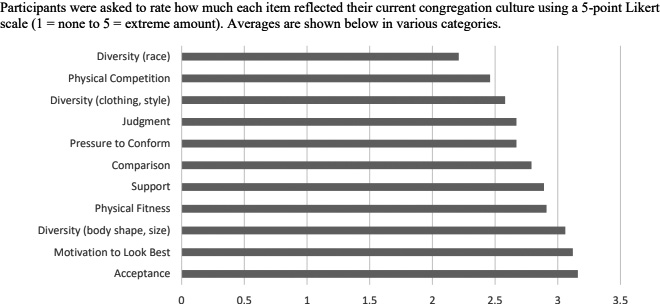
Body esteem was measured using The Body Esteem Scale (BES) for adolescents and adults.22 It included statements such as “I like what I see when I look in the mirror” and “I am satisfied with my weight,” and responses were measured on a scale ranging from 1 (never) to 5 (always). Higher scores indicated a more positive body esteem, and reliability was acceptable, α = .91. Lastly, perceived Church culture was measured using twelve different aspects: some considered positive (for example, acceptance, diversity) and others negative (for example, comparison, pressure to conform). Participants were asked to rate how much each item reflected their perception of their current congregation culture using a 5-point Likert scale, from 1 (none) to 5 (extreme amount).
Analyses. There was overlap between the qualitative and quantitative data collected and similarity of themes. Researchers analyzed the data in a way to provide systemic context, and qualitative quotes were pulled out to highlight themes related to quantitative findings.
Initially, descriptive statistics and a series of bivariate correlations were conducted on body image and a variety of aspects of congregation culture as identified in the qualitative reports. See table 1 for all correlations. Table 2 shows the means for all Church culture variables.
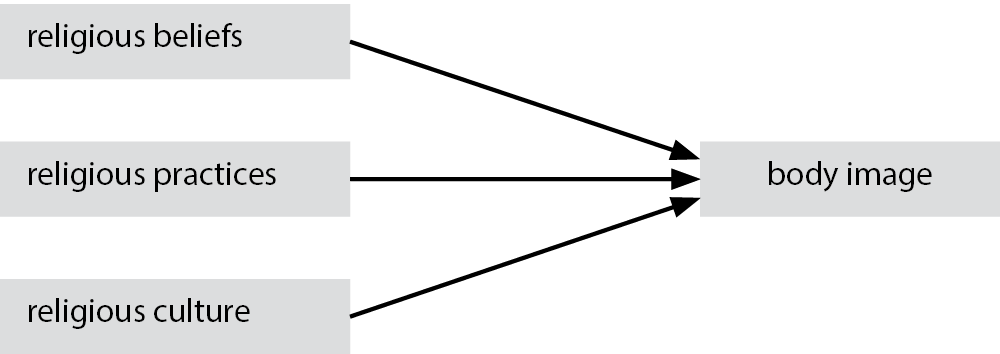
For our main analyses, an exploratory factor analysis using Varimax rotation was conducted on the culture items to examine whether any meaningful factors emerged from the data. An examination of the screen plot and individual factor loadings suggested two factors—one suggestive of more negative cultural practices (such as judgment, competitiveness) and one suggestive of more positive cultural practices (such as acceptance, diversity in clothing). These distinctions were confirmed by estimating a measurement model with the maximum likelihood method using Mplusversion8.4,23 where positive and negative culture items were modeled as latent variables. The measurement model showed adequate fit, χ2(51) = 268.03, p < .001, Comparative Fit Index (CFI) = .943, Tucker-Lewis index (TLI) = .926, Root Mean Squared Error of Approximation (RMSEA) = .057, with all factor loadings above .40. A structural equation model was created by modeling positive and negative cultures on body esteem (as displayed in fig. 1). Age and sex were controlled for in the model. Model fit was acceptable,24 χ2(85) = 384.09, p < .001, CFI = .918, TLI = .900, RMSEA = .053.
Positive culture was significantly and positively associated with body esteem (in that the more positive the culture was, the better the body esteem), β = .12, p = .003. Negative culture was negatively associated with body esteem (in that the more negative the culture was, the worse the body esteem), β = −.13, p < .001. Additionally, positive and negative cultures were negatively related, β = −.36, p < .001. In terms of controls, participant gender was positively related to body esteem, with males having better body esteem, β = .15, p < .001 (0 = female, 1 = male); age was negatively related, with older participants having better body esteem, β = −.10, p < .001.
Table 1: Quantitative Beliefs and Practices Result Frequencies
Beliefs and Practices
Extremely negative
Negative
Neutral/no influence
Positive
Extremely positive
Beliefs
Divine Heritage
1.98
5.40
23.82
46.19
22.60
Embodied Heavenly Father
1.83
6.17
34.81
43.26
13.94
Embodied Heavenly Mother
2.13
6.25
30.62
38.54
22.47
Physical Body in Plan of Salvation
2.21
7.76
29.60
43.76
16.67
Body Is a Temple
3.05
15.08
23.84
43.72
14.32
Jesus Christ’s Atonement
1.90
4.49
32.72
38.81
22.07
Perfection
13.00
4.45
32.85
15.06
4.64
Priesthood
6.01
18.02
52.32
16.43
7.22
Law of Chastity
9.44
26.41
26.94
27.55
9.97
Practices
Modesty
16.01
31.33
22.71
23.86
6.10
Word of Wisdom
3.12
13.40
27.04
44.25
12.19
Multiply and Replenish
8.09
23.97
32.82
26.56
8.55
Calling of Parenthood
4.95
16.59
27.78
39.67
13.01
Wearing of Garments
8.24
22.27
28.60
27.23
13.65
Note: Frequency percentages note how specific doctrine and teachings influence body satisfaction.
Though these results cannot represent every member of the Church in every situation, researchers sought diverse sampling to represent as many as was possible. Many digital interviews were conducted via Zoom due to worldwide procedures surrounding caution and COVID-19 implications. We use both the qualitative and quantitative studies to show the most representative aspects.
Figure 1
Figure 1
Beliefs
Overall, religious beliefs were most highly related to positive body esteem (49.69%). Many participants rated the following beliefs as having a positive or extremely positive impact on their body image: belief in Divine Heritage (68.79%), Embodied Heavenly Mother and Father (59.1%), Jesus Christ’s Atonement (60.88%), and the Plan of Salvation (60.43%). In contrast, beliefs surrounding perfection had the highest percentage (13%) of being rated as having an extremely negative influence on body image among beliefs (see table 1 for all percentages). When participants discussed the teaching of perfection, they often described how their understanding (or lack thereof) regarding the topic related to body esteem.
Heather, a young international woman, explained her misunderstanding of perfection having a negative effect on the way she felt about her body: “I didn’t understand the point of perfection very well. I felt like I need to be perfect inside and outside. So ‘perfect me’ is being a good student, being a good member of the Church, and taking care of my body by eating the right things, not overeating. So, I wanted to be perfect. And it felt like whenever I overdid it, I was getting out of that path to perfection.”
Practices
There was a much wider variability in answers regarding religious practices (see table 1 for all percentages). For example, 29.96% felt modesty had a positive impact on their body image while 47.34% felt it was negative and 22.71% reported modesty practice as neutral. Practices around the Word of Wisdom (56.44% positive) and the “calling of parenthood” (52.68% positive) tended to be related to better body esteem in both quantitative and qualitative data. Several women shared how they came to appreciate their bodies during pregnancy and the postpartum period, acknowledging the spiritual significance of their bodies in bringing children into the world.
As one participant, Jan, shared, “It’s a miracle. I think that having children is just a miracle with your body, so I didn’t ever think it as a negative thing at all, I just felt like that was just the process and the purpose of a body actually as being a woman. It was more of a positive for me.”
However, for others, like Tiffany, it was a different experience. “I think as far as being a woman, like my experience having a woman’s body is . . . (and this comes from family background too, and Church culture) that there’s so much pressure put on women as their bodies are only to have children, and so the body is only viewed as useful and worthy if it’s having babies. So, I think that’s also very negative and harmful because I think the body is for so much more than that.”
Attitudes and experiences toward modesty and the wearing of temple garments varied greatly, with some participants valuing these practices and others reporting that modesty and garments had a distinctly negative effect on their body image. For example, Camille, a young woman from Utah, described how she was taught about modesty. She explained, “It’s your fault if someone else is looking at you. The whole analogy and influence of, ‘If you roll around in mud, then you’re gonna attract pigs.’ If you wear provocative clothing, you’re asking for it. I was taught that.”
Culture
Similarly, both the qualitative and quantitative samples showed that each congregation tends to develop its own localized culture—a set of implicit norms and expectations—that can shape how individuals in that congregation feel about their bodies. In congregations where the prevailing culture was perceived to place a more negative emphasis on physical appearance—characterized by competition, pressure to conform, high levels of comparison, and judgment—participants often reported lower body esteem compared to those in congregations with a more body-affirming climate. During qualitative interviews, participants frequently mentioned a culture centered on “looking your best,” “competition,” and “judgment,” noting that a lack of diversity in terms of race, clothing, and body shape and size might contribute to lower body esteem. One participant, Ellie, shared,
Obviously, we have doctrine on becoming perfect, but it’s the act of making improvements, right? . . . I think what a lot of people see as the definition of being perfect, [as being] without flaw. I feel like perfection in the Church . . . is taken to an extreme. I think people don’t understand the difference between the two. And I think that’s where culture starts. . . . So there is this underlying pressure to literally be perfect. The perfect mom, what is that? I’m not entirely sure. But everyone’s striving for it. The perfect house, and the perfect body. . . . And that, I feel like is more the idea of being perfect, but it’s the cultural implication of it and not the doctrinal.
Discussion
Religion is one of the many facets of contemporary life that may influence perceptions, treatment, and parameters of one’s body. The Church of Jesus Christ of Latter-day Saints is not unique in this aspect; many other religions also have guidelines around one’s relationship with and treatment of the body.25 Religion, in general, tends to be protective of body image. In fact, individuals who report being more spiritual or religious tend to have much more positive body image.26 As shown by both the qualitative and quantitative responses in this study, religious beliefs, practices, and culture can contribute to the development of body image (see fig. 1), with each part playing a unique role in the journey of an individual. We use this framework as a guide to discuss each of the major themes that came up in the research.
Beliefs
Religious beliefs were most highly related to more positive body esteem. Discussion and depth in some beliefs (such as Embodied Heavenly Father and Mother and Christ’s Atonement) might encourage people to be more accepting of their bodies, while other beliefs had a potentially negative influence (such as Perfection) on body esteem. The correlation between these beliefs and their perceived effects on an individual depended partly on their understanding of that belief and how much they considered these beliefs in their daily decision-making process.
For example, some individuals may internalize a different definition of grace than the one the gospel teaches. While Church doctrine teaches that “grace is a gift from Heavenly Father,”27 some individuals believed that they must earn salvation by making themselves perfect rather than by relying on grace. This may be true of the 6% that viewed Jesus Christ’s Atonement as having a negative impact on their body image. The message of earning salvation can be harmful for individuals with a negative body image. Helping individuals understand the real meaning of grace, “the divine help or strength extended to us through the Atonement of the Lord Jesus Christ,”28 may be beneficial to all within the faith. Adam Miller taught, “A grace-filled partnership with Christ is the original plan, full stop—not an unfortunate intervention necessitated by my failure to save myself.”29 Indeed, people who believe they must win or deserve salvation and who have higher socioeconomic status may be more likely to consider receiving cosmetic enhancements based on this limited sample. In the study, the belief in earning grace was consistently related to a more negative body image and the desire for cosmetic enhancements or surgery.30
Many participants highlighted the significance of understanding the Atonement of Jesus Christ in relation to their own body acceptance. This was especially evident among those recovering from eating disorders, who frequently expressed that belief in Christ’s Atonement was healing and empowering. As many participants explored their belief on a deeper and personal level, it helped them better understand the purpose of their body and led to greater acceptance and patience with themselves. Therefore, it is not just the belief itself but also the individual’s perspective and experiences with Christ’s Atonement that could promote a more positive body image.
To help individuals form a healthier body image, the authors suggest focusing on the doctrines of divine nature, the role of the body in the plan of salvation, the Atonement of Jesus Christ, and embodied heavenly parents. These doctrines can be taught and emphasized when discussing the body (or soul) in classes, starting from nursery age, and reemphasized in other circumstances as conversations allow. Congregation leaders, teachers, and members could ask questions such as, How is this lesson/talk/activity helping members feel more secure in their relationship to God?31 and How does knowing I’m a beloved son or daughter of God give me meaning and purpose?32
Practices
Similar to beliefs, how practices are taught within congregations and demographic areas may influence their potential effect on individuals, as well as how individuals might internalize and act upon different religious practices. Modesty was rated by 47% of participants as having a more negative influence on their body image. In line with current Church practices, parents, leaders, and members might consider focusing on principles as opposed to practices when teaching about modesty. As Elder Neal A. Maxwell said, “The doctrines of Jesus Christ are so powerful that any one of these doctrines, having been broken away from the rest, goes wild and mad. . . . The principle of love without the principles of justice and discipline goes wild. Any doctrine, unless it is woven into the fabric of orthodoxy, goes wild. The doctrines of the kingdom need each other just as the people of the kingdom need each other.”33 In other words, when modesty is framed primarily in terms of visible inches of skin, we may overlook the deeper principles at its foundation.
For example, discussions around respect, humility, and empowerment will be more impactful than those that focus on specific practices.34 Individuals might consider eliminating discussions or ideas that focus on women dressing modestly in order to protect men’s thoughts and prevent their inappropriate and derogatory actions. When women become responsible for men’s thoughts, this shift in responsibility shames and objectifies women. Such practice was universally viewed as negative in these studies.
In addition, instead of enforcing a strict dress code, congregation leadership and parents can encourage youth to wear what the youth feel is appropriate and respectful to themselves and others given the activity, as instructed in the new For the Strength of Youth: “As you make decisions about your clothing, hairstyle, and appearance, ask yourself, ‘Am I honoring my body as a sacred gift from God?’”35 This question helps individuals develop a personal relationship with their Savior and allows them to expand modesty beyond simple clothing into a more accurate and broad definition.
Additionally, members can have open conversations around how Church practices (such as wearing temple garments, obeying the Word of Wisdom, and modesty) are related to body image and healthy living. The participants had much to say on these topics, but they often mentioned that they struggled to talk about their own feelings in a larger setting for fear of being judged poorly and rejected by others. Open and honest conversations around certain practices might be healing and let others know that they are not alone in their wonders and struggles. Often, Word of Wisdom conversations tend to err on the side of things not to do, but it would be beneficial for discussions to also focus on encouraging good health practices such as adequate sleep, eating a wide variety of foods, eating with moderation, and incorporating daily movement and exercise. Indeed, research has found that focusing on aspects like intuitive eating and self-compassion can help individuals have a more positive body image and potentially protect against forming an eating disorder.36 Conversations surrounding these topics may be best between same-sex individuals and classes (such as elders quorum or Relief Society) where individuals may share the positive impacts these practices have on their body esteem.
Culture
Though it can be difficult to objectively measure the culture of one’s congregation, our findings indicate that how members treat and view one another, as well as the perceived culture in a congregation, may play a crucial role in individuals developing a positive or negative body image (see table 2). For instance, the commonly taught practice of wearing one’s Sunday best to services might be implicitly or explicitly taught in a harmful way that prioritizes physical appearance over spiritual principles and doctrine. The problematic impact on body esteem of focusing too much on our physical appearance at church could be exacerbated by a competitive atmosphere where congregants compare their physical appearances (such as makeup, clothing, shoes, accessories) to one another. Although social comparison and a need for belonging are natural human drives, when physical appearance is repeatedly scrutinized and compared, the body becomes an object to perfect rather than a sacred vessel given to enjoy our mortality. Religious leaders and community members may want to closely examine their personal and congregational culture to identify any negative practices or attitudes that could increase the risk of members developing low body esteem.37
Likewise, individual members can focus on celebrating and encouraging diversity of not only skin color but also body size, style, ability, and shape.38 Where visible racial diversity does not exist in a congregation, wards could consider displaying artwork that celebrates and includes other cultures, body sizes and shapes, clothing styles, various skin tones, and abilities or functions. Celebrating diversity might also apply to discussions around body shape and size or dress (both inside and outside of a Church meeting). Wards and branches can foster flexibility and embrace diversity while maintaining the gospel principles of respect and reverence appropriate for the occasion. Individuals can concentrate on choosing to create a Church culture that emphasizes acceptance, love, and warmth. Congregation leaders may take a careful look at their culture and engage in honest dialogue with members around current practices, paying particular attention to divisions or implicit and explicit standards around homogeneity. Seeking to improve connection within the membership encourages all individuals to come together as sons and daughters of heavenly parents regardless of external differences. More practical applications that leaders, teachers, and members can use to improve body image and create a more inclusive environment are listed below the article.
Overall, participants rated their current ward congregations as generally accepting and supportive, yet they also perceived moderate pressure to look their best and to fit in and reported engaging in comparison. Appearance-related norms such as fitness, clothing style, and body-shape expectations were not extreme in the congregations of study participants. Warm and accepting congregations may still carry subtle cues that could influence body image and self-presentation.
Conclusion
Many beliefs, practices, and aspects within The Church of Jesus Christ of Latter-day Saints help individuals develop a healthy body image. While there may also be some harmful or damaging aspects—especially when understood incorrectly—there are slight changes that can be made, and some have already been made. For example, the latest For the Strength of Youth focuses on principle-based learning and actions individuals can take, rather than checklists of do’s and don’ts. We encourage all to think about how religiosity might be currently affecting the way they feel about their body and how they might utilize their beliefs to cultivate more positive momentum in their body image. Ultimately, every person is on a journey with their own body image.
Talise Hirschi is a graduate student at Brigham Young University. Her research interests revolve around body image and the many factors that influence it, such as religion, sports, parental body esteem, and social media use.
Lauren A. Barnes is a clinical professor and Director of Clinical Training for the Marriage and Family Therapy graduate programs in the School of Family Life at Brigham Young University. She has been a licensed marriage and family therapist (LMFT) for over fifteen years with specialized focus on empowering women to challenge harmful cultural messages while cultivating connection and confidence.
Kyla Yetter is a student in the marriage and family therapy master’s program at Brigham Young University. Her research interests include the relationship between body image and religion and split alliances in couples therapy.
Sarah M. Coyne is a professor of human development in the School of Family Life at Brigham Young University. She studies media, mental health, gender, and body image.
For Educators: Practical Applications for Improving Body Image Doctrines in Latter-day Saint Contexts
Teach Church Doctrine Clearly and Compassionately
Emphasize the eternal significance of the body in lessons (for example, divine parentage, divine embodiment, resurrection).
Use doctrinal language that affirms the worth of all bodies, regardless of size, skin, or ability (for example, body as temple).
Differentiate Between Perfection and Progression
Help differentiate between “being perfect” and striving to progress.
Integrate teachings about grace, atonement, divine help, repentance, and patience.
Reframe and Broaden Modesty
Center discussions around respect, dignity, and self-worth rather than shame- or fear-based discussions of appearance.
Frame modesty as an act of honoring divine identity; avoid framing modesty as protection for others’ thoughts and actions.
Foster Open Conversations
Create opportunities in classroom and ward settings to discuss body image, media pressures, and body esteem for all individuals.
Model nonjudgmental, inclusive dialogue, especially when discussing topics like health, appearance, and ability.
Celebrate Diversity
Include varied representations that affirm diversity in race, body shape and size, ability, and dress.
Discourage competitive or appearance-based comparison cultures.
Focus on the Do’s of the Word of Wisdom
When teaching health principles, include guidance on sleep, mental health, joyful movement, connection, and self-compassion.
Focus on the guidance in Doctrine and Covenants 89 and incorporate research-based practices that support these principles.
Support Agency and Self-Reflection
Encourage students to ask, “How does this belief help me see my body as sacred?”
Reinforce that spiritual growth includes learning to love and care for one’s body without comparison or perfectionism.
Talise Hirschi is a graduate student at Brigham Young University. Her research interests revolve around body image and the many factors that influence it, such as religion, sports, parental body esteem, and social media use.
Lauren A. Barnes is a clinical professor and Director of Clinical Training for the Marriage and Family Therapy graduate programs in the School of Family Life at Brigham Young University. She has been a licensed marriage and family therapist (LMFT) for over fifteen years with specialized focus on empowering women to challenge harmful cultural messages while cultivating connection and confidence.
Kyla Yetter is a student in the marriage and family therapy master’s program at Brigham Young University. Her research interests include the relationship between body image and religion and split alliances in couples therapy.
Sarah M. Coyne is a professor of human development in the School of Family Life at Brigham Young University. She studies media, mental health, gender, and body image.
Notes
1. Chris J. Boyatzis, Sarah Kline, and Stephanie Backof, “Experimental Evidence that Theistic-Religious Body Affirmations Improve Women’s Body Image,” Journal for the Scientific Study of Religion 46, no. 4 (2007): 553.
2. “LDS females were found to have more positive body image than non-LDS females generally.” But note that “LDS females in Utah have less positive body images than LDS females residing in other states.” Monika Sandberg, “Eating and Substance Use: A Comparison of Latter-day Saint and Non-Latter-day Saint College-Age Females” (PhD diss., Brigham Young University, 2008), abstract, https://scholarsarchive.byu.edu/etd/1394.
3. Judith Rodin, Lisa Silberstein, and Ruth Striegel-Moore, “Women and Weight: A Normative Discontent,” in Nebraska Symposium on Motivation, 1984, vol.32, Psychology and Gender, ed. Theo B. Sonderegger (University of Nebraska Press, 1985), 267–307.
4. April E. Fallon and Paul Rozin, “Sex Differences in Perceptions of Desirable Body Shape,” Journal of Abnormal Psychology 94, no. 1 (1985): 102.
6. Kathryn Graff Low and others, “Internalization of the Thin Ideal, Weight and Body Image Concerns,” Social Behavior and Personality 31, no. 1 (2003): 81–89; see also Bonnie Leadbeater, Kara Thompson, and Vincenza Gruppuso, “Co-occurring Trajectories of Symptoms of Anxiety, Depression, and Oppositional Defiance from Adolescence to Young Adulthood,” Journal of Clinical Child & Adolescent Psychology 41, no. 6 (2012): 719–30.
7. M. Elizabeth Lewis Hall and Chris J. Boyatzis, “God in the Bod: Charting the Course of Research on Religiosity and the Body,” Mental Health, Religion & Culture 19, no. 1 (2016): 1–7; Sarah L. Weinberger-Litman, Yael Latzer, Leib Litman, and Rachel Ozick, “Extrinsic Religious Orientation and Disordered Eating Pathology Among Modern Orthodox Israeli Adolescents: The Mediating Role of Adherence to the Superwoman Ideal and Body Dissatisfaction,” Journal of Religion and Health 57, no. 1 (2018): 209–22.
8. See Jessica Coblentz, “Catholic Fasting Literature in a Context of Body Hatred: A Feminist Critique,” Horizons 46, no. 2 (2019): 215–45; Sarah Demmrich, Sümeyya Atmaca, and Cüneyt Dinç, “Body Image and Religiosity Among Veiled and Non-Veiled Turkish Women,” Journal of Empirical Theology 30, no. 2 (2017): 127–47; Leonie Wilhelm, Andrea S. Hartmann, Julia C. Becker, Melahat Kişi, Manuel Waldorf, and Silja Vocks, “Body Covering and Body Image: A Comparison of Veiled and Unveiled Muslim Women, Christian Women, and Atheist Women Regarding Body Checking, Body Dissatisfaction, and Eating Disorder Symptoms,” Journal of Religion and Health 57 (2018): 1808–28.
9. Cindel J. M. White, Adam Baimel, and Ara Norenzayan, “How Cultural Learning and Cognitive Biases Shape Religious Beliefs,” Current Opinion in Psychology 40 (2021): 34–39.
10. Sandberg, “Eating and Substance Use,” abstract.
11. Sarah M. Coyne, Megan Gale, Jane Shawcroft, Emilie Davis, and Chenae Christensen-Duerden, “Plastic Piety: A Mixed-Methods Study of the Connection Between Religiosity, Cosmetic Surgery, and Body Image,” Psychology of Religion and Spirituality 15, no. 3 (2023): 454; see also Corinne Clarkson, Kolene Anderson, and Susan R. Madsen, “Cosmetic Surgery and Body Image Among Utah Women: A 2025 Update,” Utah Women Stats: Research Snapshot, no. 63 (October 23, 2025), https://www.usu.edu/uwlp/files/snapshot/63.pdf.
12. Clarkson, Anderson, and Madsen, “Cosmetic Surgery and Body Image.”
13. Hall and Boyatzis, “God in the Bod,” 1–7; Jennifer Ann Harriger and J. Kevin Thompson, “Hollywood and the Obsession with the Perfect Body,” Sex Roles 66 (2012): 695–97.
14. Diane L. Spangler, “The Body, a Sacred Gift,” Ensign, July 2005, 16.
15. Jeffery R. Holland, “To Young Women,” Ensign, November 2005, 29.
16. AnnMarie Carroll and Diane L. Spangler, “A Comparison of Body Image Satisfaction Among Latter-day Saint and Non-Latter-day Saint College-Age Students,” Issues in Religion and Psychotherapy 26, no. 1 (2001): 9; Monika Sandberg and Diane L. Spangler, “Eating, Substance Use, and Body Image: A Comparison of Latter-day Saint and Non-Latter-day Saint College Age Females,” Issues in Religion and Psychotherapy 31, no. 1 (2007): 2–3.
17. W. Justin Dyer, “Latter-day Saints and Perfectionism,” BYU Studies 63, no. 4 (2024): 163; Michael A. Goodman, “Religion and Perfectionism,” BYU Studies 63, no. 4 (2024): 100–102.
18. Sarah M. Coyne and others, “Beliefs, Practices, or Culture? A Mixed-Method Study of Religion and Body Esteem,” Psychology of Religion and Spirituality 15, no. 3 (2023): 437–48.
19. Mary‐Anne Cotton, Christopher Ball, and Paul Robinson, “Four Simple Questions Can Help Screen for Eating Disorders,” Journal of General Internal Medicine 18, no. 1 (2003): 53–56.
20. Kathy Charmaz and Linda L. Belgrave, “Grounded Theory,” in The Blackwell Encyclopedia of Sociology, ed. George Ritzer (Wiley, 2015), 479–83.
21. John W. Creswell and J. David Creswell, Research Design: Qualitative, Quantitative, and Mixed Methods Approaches, 5th ed. (SAGE, 2017), 276.
22. Beverley K. Mendelson, Morton J. Mendelson, and Donna R. White, “Body-Esteem Scale for Adolescents and Adults,” Journal of Personality Assessment 76, no. 1 (2001): 90–106.
23. Linda K. Muthén and Bengt O. Muthén, Mplus: Statistical Analysis with Latent Variables; User’s Guide, 8th ver. (Muthén & Muthén, 2017).
25. Carroll and Spangler, “Comparison of Body Image Satisfaction,” 9.
26. See Coblentz, “Catholic Fasting Literature,” 215–45; Demmrich and others, “Body Image and Religiosity Among Veiled and Non-Veiled Turkish Women,” 127–47; Wilhelm and others “Body Covering and Body Image,” 1808–28; Weinberger-Litman and others, “Extrinsic Religious Orientation,” 209–22.
31. See also Mike Madsen, “Planning Activities—Take the Lead,” New Era, October 2015, 20–23.
32. See Brian K. Taylor, “Am I a Child of God?” Liahona, May 2018, 12–14; Gregorio E. Casillas, “God Loves All His Children,” Liahona, November 2024, 21–22.
33. Neal A. Maxwell, “Spiritual Ecology,” New Era, February 1975, 35–36.
34. See Becky Craven, “Careful Versus Casual,” Liahona, May 2019, 9–11; Holland, “To Young Women,” 28–30.
36. Jake Linardon, “Positive Body Image, Intuitive Eating, and Self‐Compassion Protect Against the Onset of the Core Symptoms of Eating Disorders: A Prospective Study,” International Journal of Eating Disorders 54, no. 11 (2021): 1967–77.