Minerva Teichert was asked to give the eulogy at the funeral of her agent, mentor, and friend, Alice Merrill Horne, in 1948. “I think one of the greatest things [Horne] did,” Teichert mused in her speech, “was to insist that I get a washing machine. I had lived too long in Fort Hall Bottoms. I looked open-eyed, almost horror stricken, as I said—‘You don’t mean an electric washer, do you?’ ‘Of course I do,’ she answered, ‘why not? No one deserves one more than you. I’ll sell some thing and help you out. You’d have your washing done in an hour instead of a whole day and you wouldn’t be worn out for the rest of the week either.’” Then Teichert told the assembled audience, “Wonder of wonders, it worked! And so I painted.”
The result of Teichert’s painting was a body of more than two hundred works of art, held in museums and private collections across the American West and in buildings belonging to The Church of Jesus Christ of Latter-day Saints—the religion to which Teichert belonged. In 2010, there was a fire in the Provo Tabernacle. Among the catastrophic losses that occurred that day, a Minerva Teichert painting, Restoration of the Melchizedek Priesthood, burned with the building. In response to that painful loss, The Church of Jesus Christ of Latter-day Saints examined how it could better care for the legacy of Teichert, an effort that resulted in evaluating original art in Church-owned buildings, conserving other works by Teichert in the Church’s stewardship, and opening an exhibition at the Church History Museum. I began working as the art curator at the museum in 2019 and was delighted that my first assignment was a Teichert exhibition. I worked on the exhibition for four years. With This Covenant in My Heart: The Art and Faith of Minerva Teichert opened on July 6, 2023. It is anticipated the show will run through August 2024.
Any exhibition begins with a research phase. In several sources, I found repeated one quotation by scholar Marian Ashby Johnson. In 1988, Johnson published “Minerva’s Calling,” an article in the spring issue of Dialogue. She began: “[Teichert] created . . . in a virtual vacuum, working on an isolated ranch in Cokeville, Wyoming, for nearly forty-five years with no associates who understood her effort to translate Mormon values into art, no professional art community to reinforce her efforts or pose as a critical foil for her work, and no warmly appreciative audience of admiring patrons.” Certainly, living on a cattle ranch distant from art centers was a challenge. But between 1929 and 1947, when Teichert produced many of her religious works, she had associates, an art community, a critical foil, and an appreciative audience either in the person of or because of Alice Merrill Horne (fig. 1).
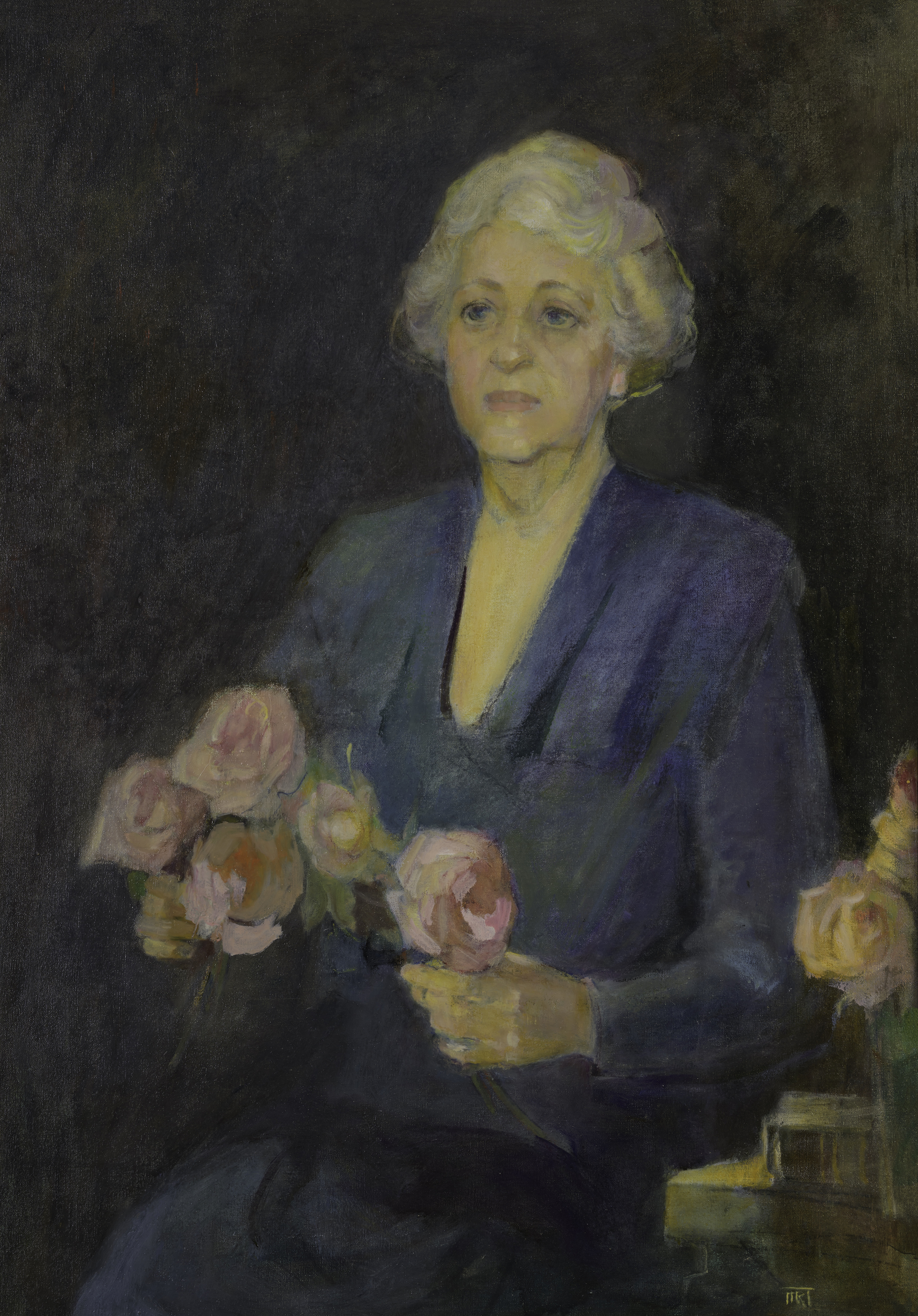 Figure 1
. Minerva Teichert (1888–1976),
Portrait of Alice Merrill Horne, undated, oil on canvas, 39 × 27 inches. Courtesy Mary Alice Clark and the Springville Museum of Art.
Horne was the biggest player in the Utah art world for the first half of the twentieth century and served on the Relief Society general board. Horne’s connections gave Teichert an art community and made The Church of Jesus Christ of Latter-day Saints Teichert’s primary patron for two decades. Horne had trained as an artist and offered Teichert critical feedback of her work. She was also a mother and was in a unique position to lend support to Teichert as a woman balancing multiple roles in life. Beyond that, she was a friend. The Church History Museum exhibition With This Covenant in My Heart: The Art and Faith of Minerva Teichert spends some time exploring the relationship between these women. Gratefully, this space in BYU Studies affords me room to tell more.
When Horne was in her fifties, she published an account in the Relief Society Magazine about an important experience from her childhood. She said that Eliza R. Snow gave her a blessing in the presence of Zina D. H. Young, Bathsheba Smith, and Emmeline B. Wells. Snow blessed Horne “to bring forward a work which no one else could do and which would bring great joy in its accomplishment.” Horne felt she was personally called to what she called the “gospel of beauty.” She explained, “Life in the influence of art trains the soul to respond to the God-like in man and nature, to feel the beautiful and to cherish and follow higher ideals. Soul greatness is the ultimate end and aim of all effort.”
As a child in the 1870s, Alice Merrill Horne lived with her grandmother Bathsheba Smith. Smith (later the fourth Relief Society General President) was an early Latter-day Saint artist who had taken art lessons from William Major, a significant early Latter-day Saint artist in Nauvoo, Illinois. Smith had carried her paintbrushes and paints across the plains and was eager to share these resources with her young granddaughter. Bathsheba was married to George A. Smith, counselor to Brigham Young in the Church’s First Presidency and the Church Historian and Recorder. In his travels, President Smith had gathered visual resources from Europe, and this library of art information uniquely available to Horne in Salt Lake was influential. As she grew, Horne took lessons from nineteenth-century Utah art greats: George Ottinger, James Harwood, Mary Teasdel, and John Hafen. Although Horne decided her contributions would be as an art advocate, her training made her more than an agent; she gave detailed critiques to the artists she championed.
In addition to learning art under the tutelage of her grandmother, Horne learned how to lead. Bathsheba’s dearest friends included Eliza R. Snow, Zina D. H. Young, and Emmeline B. Wells. While serving as the Relief Society General President, Snow encouraged Horne to organize a “Juvenile Association” with herself as president where the girls in the neighborhood met weekly to bear testimony, sing hymns, pray, quilt, and gather donations for the poor and the Salt Lake Temple construction.
In 1898, Horne determined that Utah needed a state initiative to advance the arts, and she was elected to the Utah State Legislature (the third woman elected) on a platform of founding a state arts agency. Her art bill passed the Senate unanimously and was also passed by the House. This measure created the Utah Arts Institute, established an annual art exhibition, and created a plan to purchase art annually for a state arts collection.
By the time Minerva Teichert sought an association with Alice Merrill Horne, Horne (twenty years her senior) had been influential in the Utah art world for nearly thirty years and had earned the title “Mother Horne” from Utah artists. Thirty-nine-year-old Teichert and her husband, Herman A. Teichert, had purchased a ranch in Cokeville, Wyoming, in 1927. Teichert longed for a way to incorporate painting into her ranch life; she began by affixing a canvas to her ranch home wall and maintained correspondence with Robert Henri, her art instructor from the Art Students’ League in New York. Despite these efforts, at Henri’s death in 1929, she had not sold many paintings in nearly a decade. In 1929 the stock market crashed, and the Teicherts, having assumed a mortgage in better times, were unable to make payments on the ranch. The family began to operate a dairy to increase their income. By 1931, Teichert sought a way to make her painting profitable. She wrote to Alice Merrill Horne, requesting an exhibition. Horne responded, asking Teichert to bring her a sample of her work.
Teichert had donated a painting to the Church as tithing in 1929 that hung in her local church building (fig. 2). She retrieved the painting from the Cokeville meetinghouse, rolled it up, and showed it to Horne, who was hanging an exhibition at the Newhouse Hotel in Salt Lake City. “Mrs. Horne,” Horne remembered Minerva saying, “please look at my work.” Horne described the painting. “It unrolled to reveal a wonderful handcart picture; two men, red heads, drew the cart! At the back of the cart, a lady walked supporting a baby as it sat up. A little girl went along, holding with one hand the lady’s dress. I was amazed!” Horne promised to adjust her busy exhibition calendar and host a show for Teichert in two weeks. She explained, “Mrs. Teichert said she must hurry back to look after the milking—so was gone.” Horne held that first exhibition for Teichert in July 1931. The Salt Lake Tribune, under the headline “Wyoming Painter Introduced,” described the show. “With the exhibition now hung at the Newhouse gallery, an artist unfamiliar to its patrons makes [her] initial appearance—a portraitist and mural painter of Cokeville, Wyo., who is Minerva Kohlhepp Teichert.”
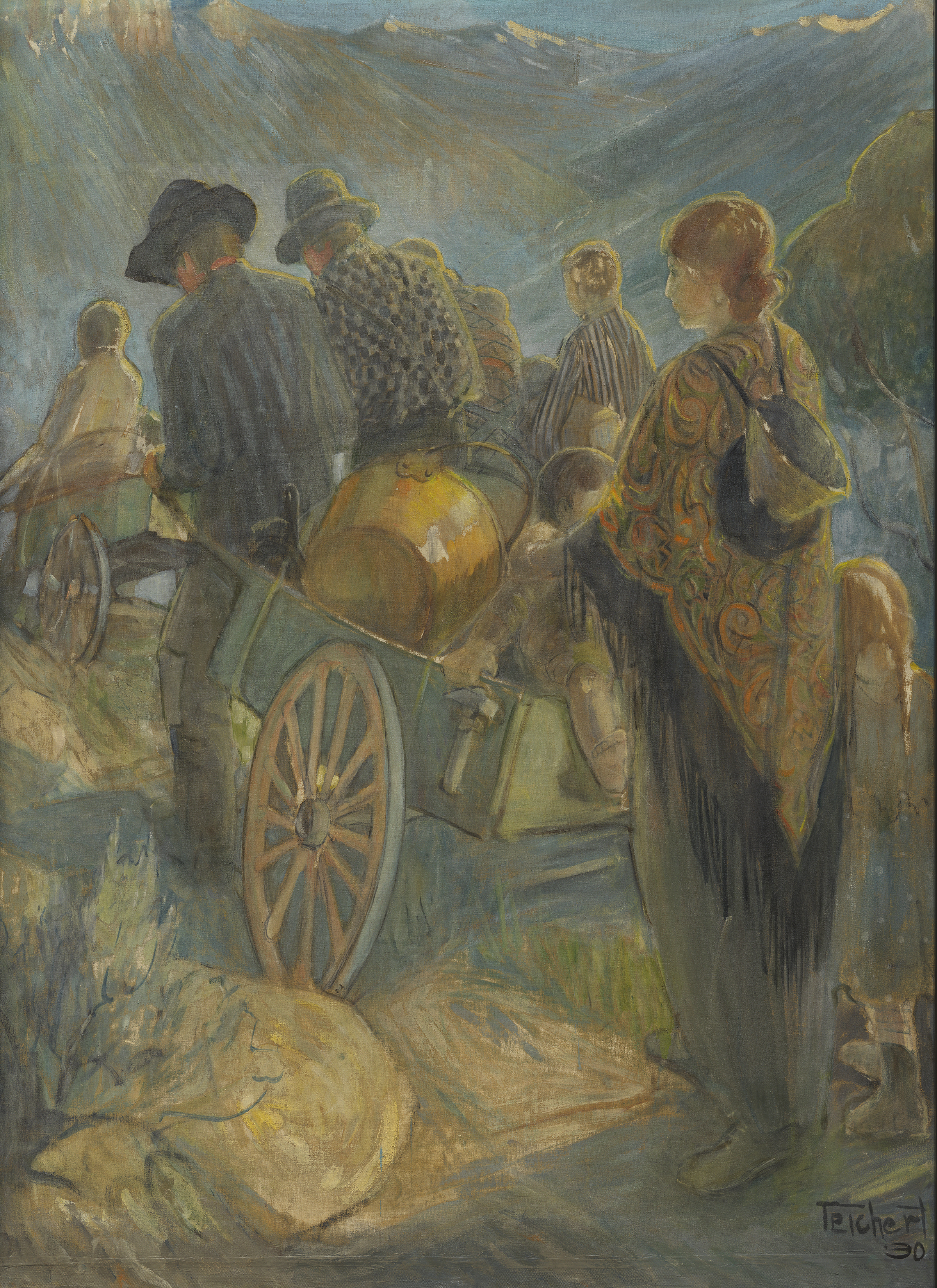 Figure 2
. Minerva Teichert (1888–1976),
Handcart Pioneers, 1930, oil on canvas, 72½ × 52½ inches. Courtesy Museum of Church History and Art.
In September 1931, Horne wrote Teichert a letter to hash out their business arrangement. “Dear Minerva,” she wrote, “you must let me put the prices on your pictures. I do not add commission to your price, you must make your price include my commission so that if you sell or I sell they must be the same.” She then offered, “Nothing does so much good as to sell a picture. Nothing damages so much as to give a picture away, it is unprofessional.”
By February 1932, Teichert confessed the desperate situation of the Teichert ranch. “I can not tell you how sorry I am to receive your letter,” Horne responded. “Nothing stirs me so much as your danger of losing your old home.” Horne then made a plan to use her excellent connections with Church leaders: “Do this for me, send the man’s name (what Smith?) who has your mortgage and I will get some influential people to see him and see if something can be done til I can make some sales.” Those influential people included David O. McKay, Apostle and General Superintendent of the Deseret Sunday School Union; Louise Yates Robinson, General President of the Relief Society; Ruth May Fox, General President of the Young Women’s Mutual Improvement Association; George Albert Smith, Apostle and General Superintendent of the Young Men’s Mutual Improvement Association; and May Anderson, General President of the Primary Association. Robinson proposed that each organization pay one hundred dollars to purchase Handcart Pioneers. Since she was selling a painting to the Church that it already owned as a tithing donation, Horne made a stop to see Presiding Bishop Sylvester Q. Cannon. Horne explained that Teichert planned to make another painting to substitute as her tithes and offerings and asked Cannon to step in if any of the organizations did not pay one hundred dollars. Horne followed up on the amount owed in a letter to Teichert, asking, “Please let me know right away so that I can have the Bishop (Cannon) assist us. He is converted to art.”
In the end, each organization paid one hundred dollars, and the Presiding Bishopric accepted a substitute painting as Teichert’s tithing. The debt on the ranch was paid. This sale cemented a relationship that would last nearly two decades. Horne quickly began using her influence to get Teichert published in Church magazines. Horne met with Harrison R. Merrill, editor for the Improvement Era, to arrange use of Teichert’s Not Alone as the frontispiece for the February 1933 issue. “I told [Merrill] you were the most important Western artist,” Horne wrote in a letter to Teichert. “Some have taken exceptions to my championing you but I have just kept on and intend to just keep doing it.” Teichert paintings would appear in the Instructor, the official magazine of the Deseret Sunday School Union in July 1936, July 1939, August 1941, and December 1941, and in the Relief Society Magazine in December 1944 (fig. 3).
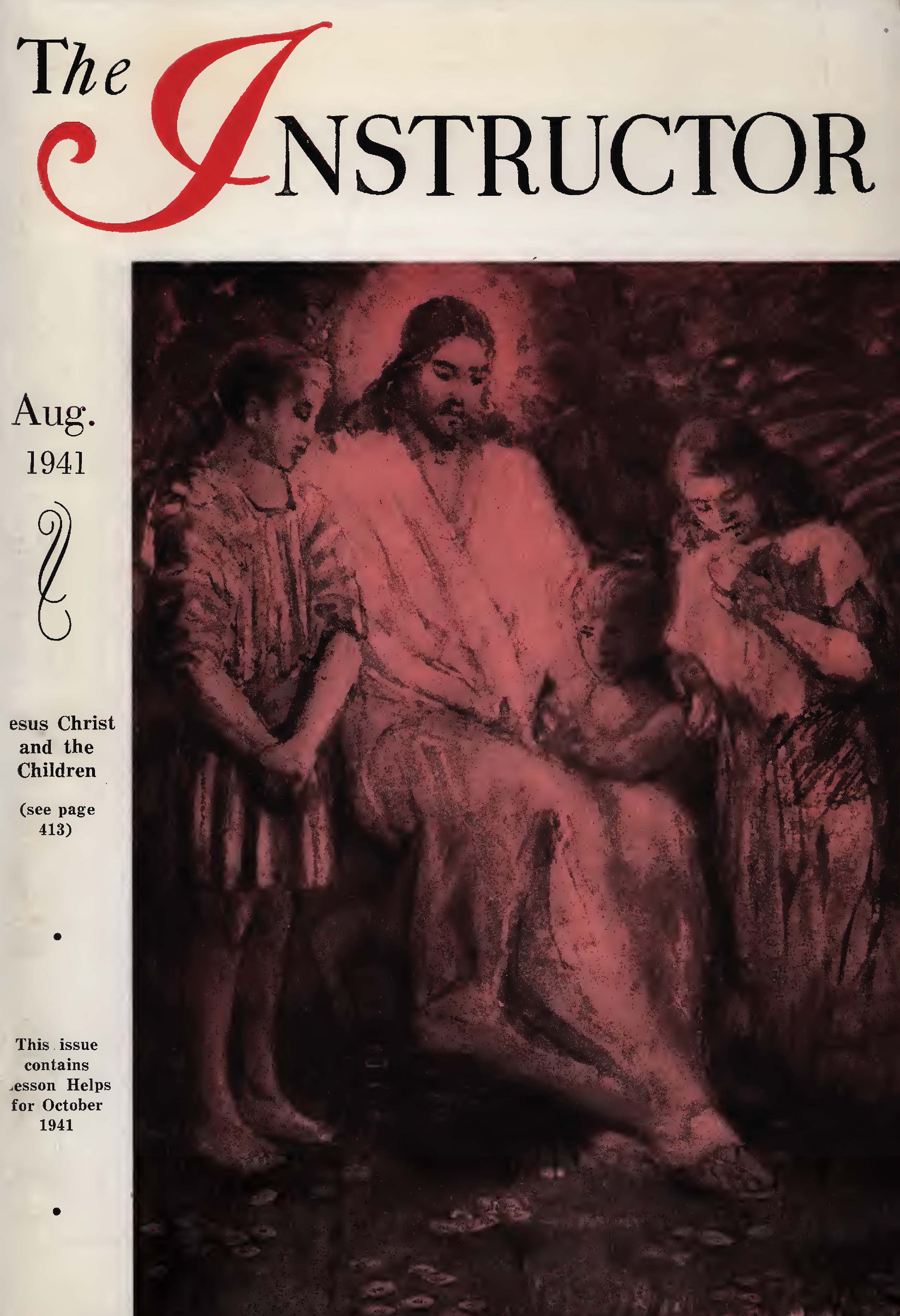 Figure 3
. Cover of the Instructor, August 1941, showing Minerva Teichert’s
Christ the Shepherd and His Sheep. Courtesy Church History Library.
Soon, Horne arranged for a number of large commissions. “I have the best news for you,” Horne wrote Teichert in 1935. Teichert would paint two very large murals for the President’s Suite in the Hotel Utah (figs. 4 and 5). The paintings needed to measure eight feet by twelve feet and were to illustrate handcart and covered wagon pioneers. Horne suggested Teichert paint them onsite, adding wryly, “I wonder if they can feed the cows and chickens and water the stock and horses without you. Ha! Ha!” Whether Teichert’s family could do without her was not determined. Teichert’s daughter Laurie recalled her mother painting these enormous paintings in her living room studio. Teichert folded each canvas in half, tacked the canvas to her living room wall and painted one half at a time. When she finished both halves, Teichert took the canvases outside and attached them to the end of her house so she could see the entire painting at once.
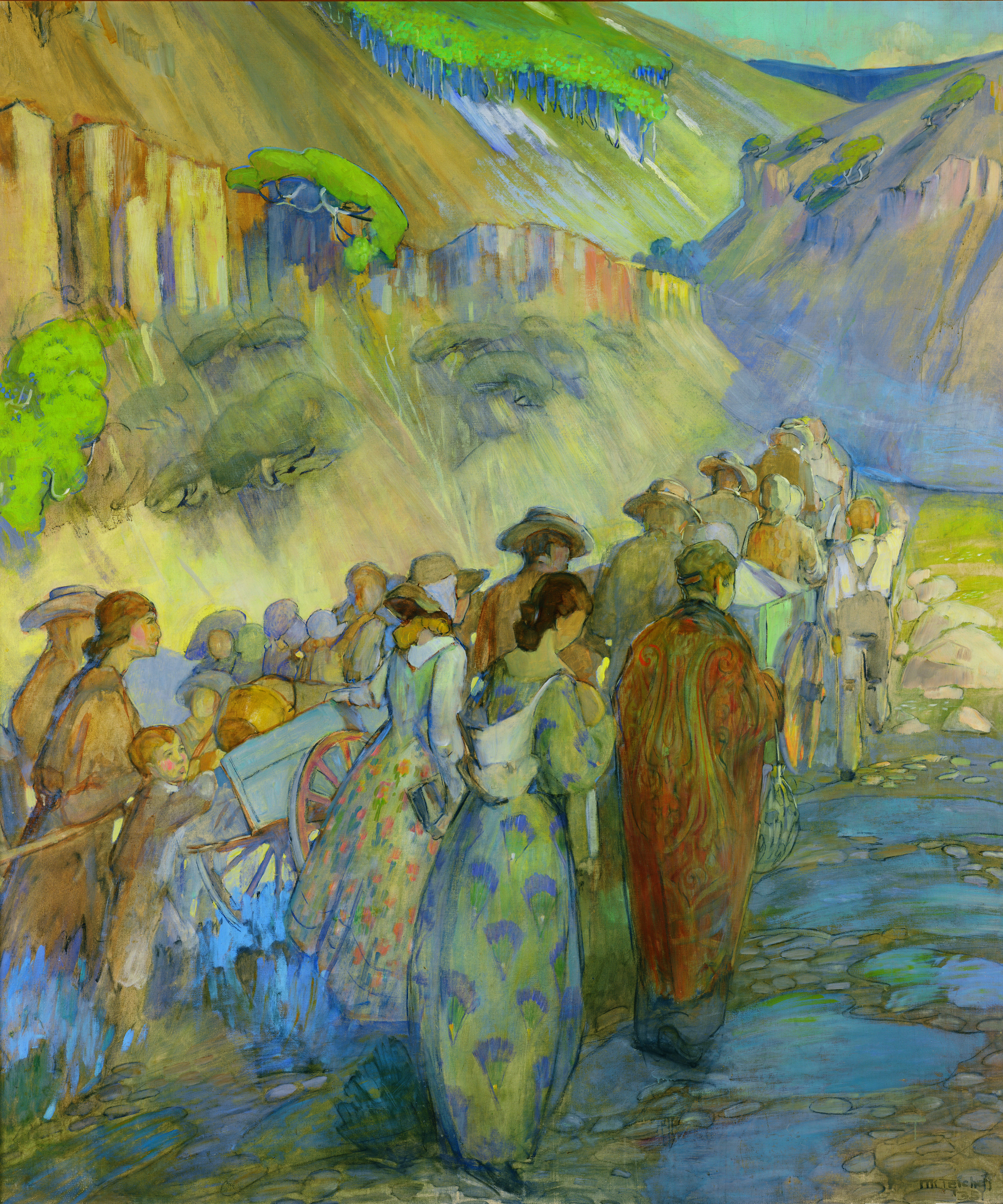 Figure 4
. Minerva Teichert (1888–1976),
Handcart Pioneers, 1935, oil on canvas, 101 × 85 inches. Courtesy Church History Museum.
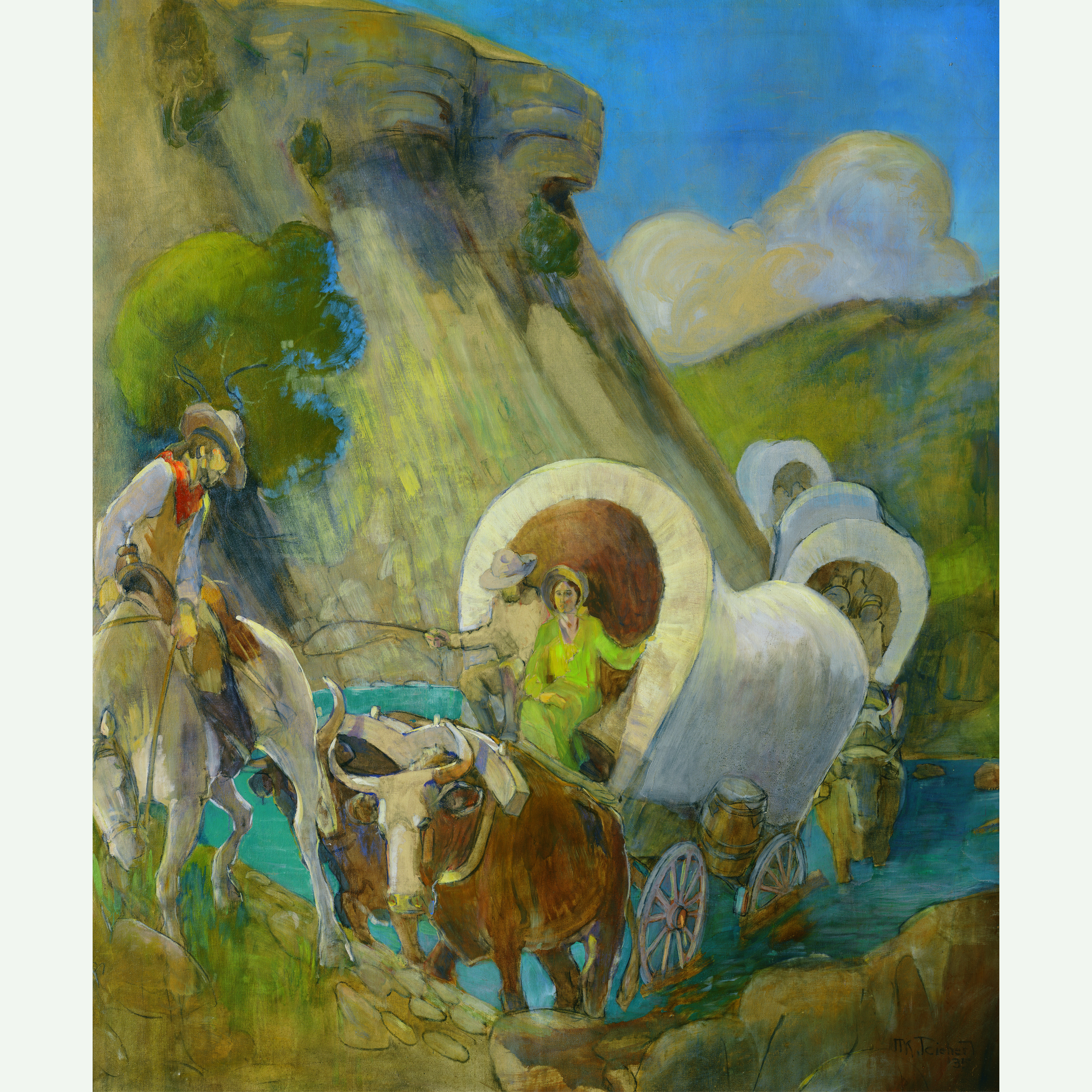 Figure 5
. Minerva Teichert (1888–1976),
Covered Wagon Pioneers, 1935, oil on canvas, 101 × 85 inches. Courtesy Church History Museum.
One of Horne’s most successful endeavors was to place original art in public schools, including several by Teichert. With “soul-greatness” the purpose of art, Horne sought to have art accessible to all Utah children. Sometimes children contributed their own money to the project. Often, donor Ella Quayle Van Cott contributed money toward Horne’s goal. This project is the basis for the art collections in many Utah school districts today, although some districts have auctioned off their collections. While several Teichert paintings were placed in public schools through this program, a large collection of Teichert murals, including a work titled Trappers, was purchased by Van Cott and placed in South High School in Salt Lake City. Horne would say of this collection, “Perhaps no other high school in the country has a finer original collection of western life.”
Alice Merrill Horne was still looking for places for Minerva Teichert’s art when The Church of Jesus Christ of Latter-day Saints renovated the Manti Temple in the 1940s. The Manti Temple, dedicated in 1888, had murals painted directly onto plaster in some of its interior rooms. C. C. A. Christensen painted the room designated as the Creation Room, and it is believed Danquart Weggeland painted two other rooms: the Garden Room and World Room. But by the 1940s, the plaster was failing in the Garden and World Rooms. The rooms were replastered in 1946 and canvas was adhered to receive new murals.
Although it is not certain how Teichert’s name was submitted for consideration for the Manti project, it seems reasonable, given Alice Merrill Horne’s decade-and-a-half of championing Teichert with Church leaders, that Horne was involved. Certainly, Horne staged a conveniently timed exhibition at the Z.C.M.I. Tiffin Room in Salt Lake City while Church leaders were mulling over approvals. Teichert wrote her daughter on March 14, 1947, “Yesterday we . . . had meeting on Manti murals. . . . Church Authorities will visit my exhibition enmasse about tomorrow.”
For the Manti Temple, Teichert submitted a proposal for a peopled narrative outlining the gathering of Israel and the Gentiles to Zion (fig. 6). Once the plan was approved, Teichert worked quickly, finishing the bulk of the murals in just twenty-three days. After dating a letter to her daughter May 8, Teichert wrote with a mix of exhaustion and pride: “Laurie dear, I’m guessing at the date. The authorities told me to do this thing speedily and believe me as it nears conclusion it has been the speediest giant any American painter ever concocted.” Teichert would continue to be called back to the project several times to lay the paint down thicker, and Horne was her companion on at least one occasion.
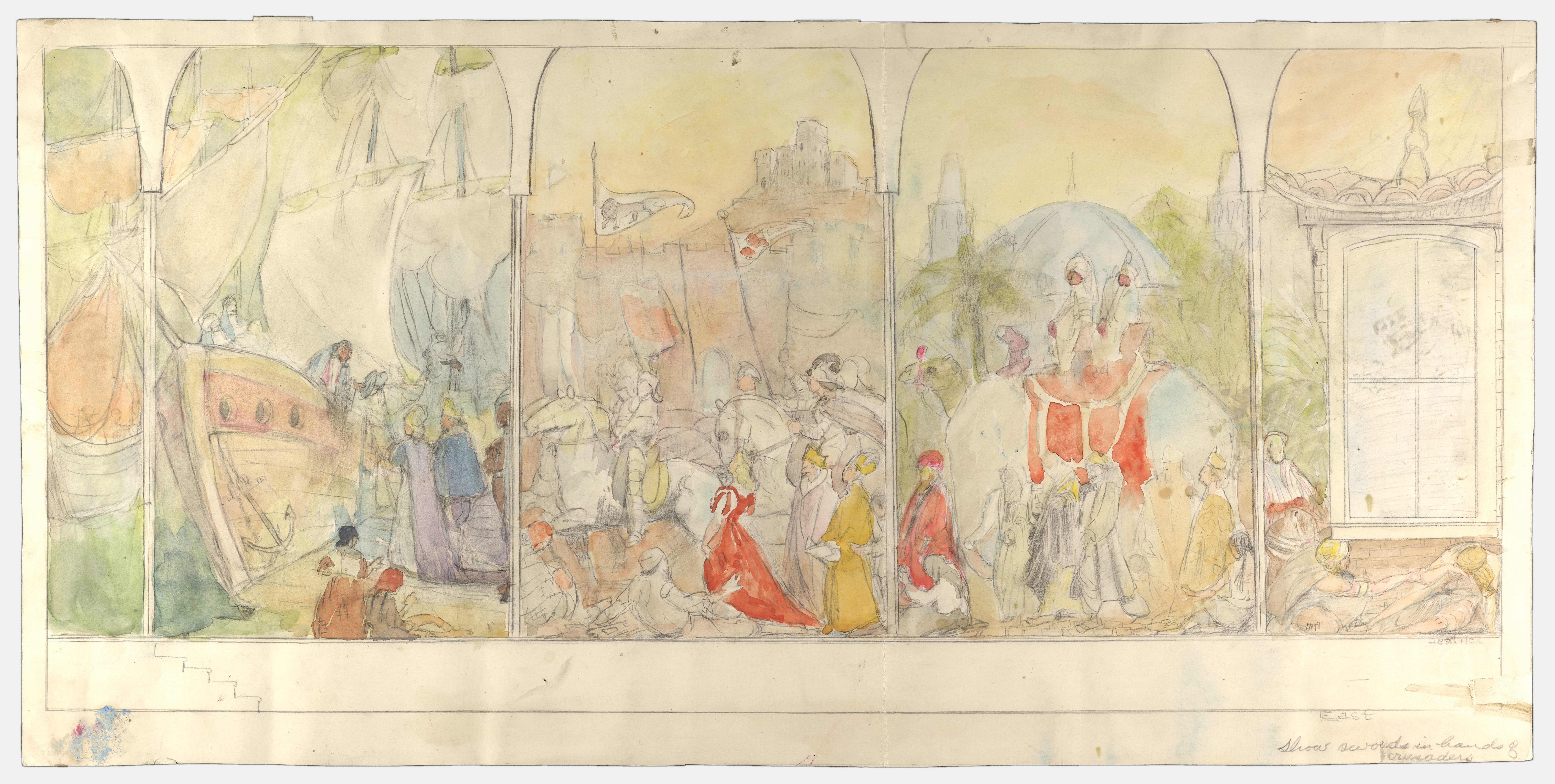 Figure 6
. Minerva Teichert (1888–1976),
Manti Temple North Wall World Room Mural Study Sketch, 1947, watercolor and graphite on paper, 14½ × 29½ inches. Courtesy Church History Museum.
Horne came down to observe the murals after Teichert’s twenty-three-day push. On June 15, after Teichert had finished the bulk of the work, Horne exclaimed, “You don’t know how fresh I feel with that work by your side. There is so much to learn when I am with you. I called Mr. [Edward O.] Anderson and told him about what you had accomplished in the short week. He is delighted, also that I went along. He thinks it will help them to appreciate and value what you have accomplished.” Horne returned to Manti in August and wrote to Teichert: “My brother had to go to Manti so I went along and the gardiner let me in to look at the room you paint on. It would be even lovelier if you could paint or someone else could paint the ceiling blue. It would stop its feeling like a box. . . . But much as I love all of it the thing most artistic, great is the unfortunate things down in the shadow contrasting with the great and well dressed—the perfumed set.”
Besides selling her works and helping her earn commissions, Alice Merrill Horne gave Teichert access to a connected art community. Horne had shown the works of at least seventy artists in her many exhibitions. Horne’s stationery on which she addressed letters to Teichert in 1935 advertised an organization Horne headed called the “Utah Artists’ Exhibitions” (fig. 7). The motto inscribed at the top of the letterhead proclaimed, “Foster the Climbing Artists that Presently They Will Be the Old Masters.” On the left were listed “Artist Advisors.” In addition to Teichert, the stationary lists esteemed Utah artists including Mahonri Young, Florence Ware, Waldo Midgley, Mary Teasdel, J. T. Harwood, Myra Sawyer, B. F. Larsen, Irene Fletcher, Caroline Van Evera, Bessie Alice Bancroft, Henri Moser, and J. M. Stanfield. Horne’s wider influence is apparent as some of the advisory patrons included were President and Mrs. Heber J. Grant, and President and Mrs. Anthony W. Ivins, two members of the First Presidency of the Church and their wives.
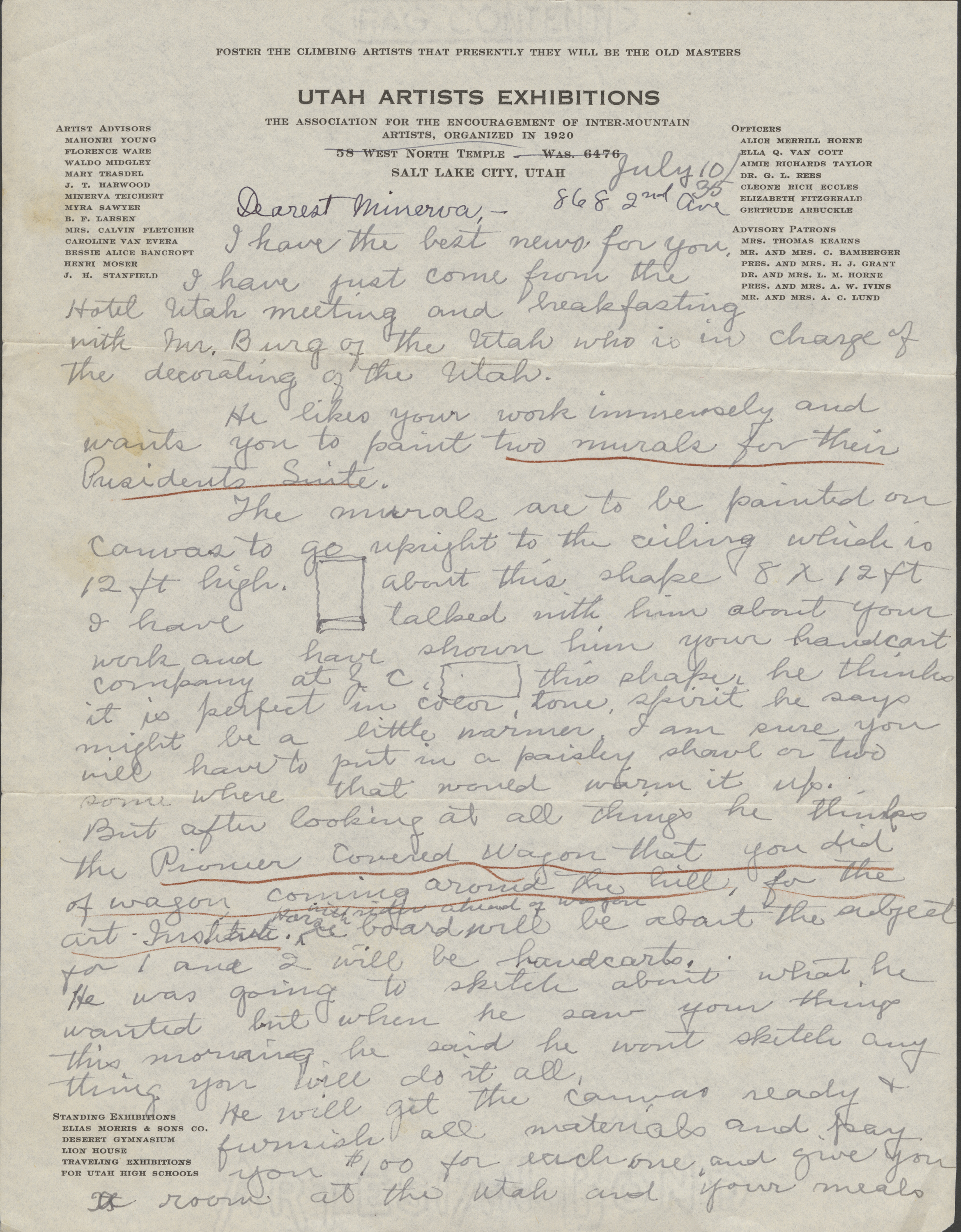 Figure 7
. Letter from Alice Merrill Horne to Minerva Teichert, July 10, 1945. Courtesy L. Tom Perry Special Collections.
Horne solicited feedback from the larger art community for Teichert’s works. She showed a work Horne called Indian Blankets to Florence Ware and J. T. Harwood, who praised the painting. Horne wrote to Teichert, “Another thing Harwood wondered if you had put on the color thick enough to cover the canvas so that after a while it could be varnished. He wondered if the varnish would go through the canvas. I think you told me that you put schalack on before starting to paint. We are in such a dirty state that these will need washing so have to be varnished when well dried.” In 1933, Horne wrote, “I am glad you know so much, dear Minerva, you fill me with satisfaction. The artists delight in your work.”
Horne also gave specific feedback on Teichert’s paintings. She praised changes Teichert had made in the 1935 painting, Miracle of the Gulls (fig. 8). “The pink lady is much better,” Horne said assuredly. “I think, I feel the body in the dress now and before it did not give me the impression of a solid figure. Especially around the waist line I feel an improved modeling. The head is much lovelier with the curl on her shoulder. Yes it is pink but there is something that reminds me of those changeable silks my grandmother had that was brought from England. The sleeves are good and she is kneeling more solidly—before I hardly knew whether her knees were touching the grain field. You have perhaps put a few dark notes there or what you did on other parts have influenced that.” After discussing another painting, Horne returned to Miracle of the Gulls: “It was worth while to send [the painting] back if only for the curl on her shoulder.”
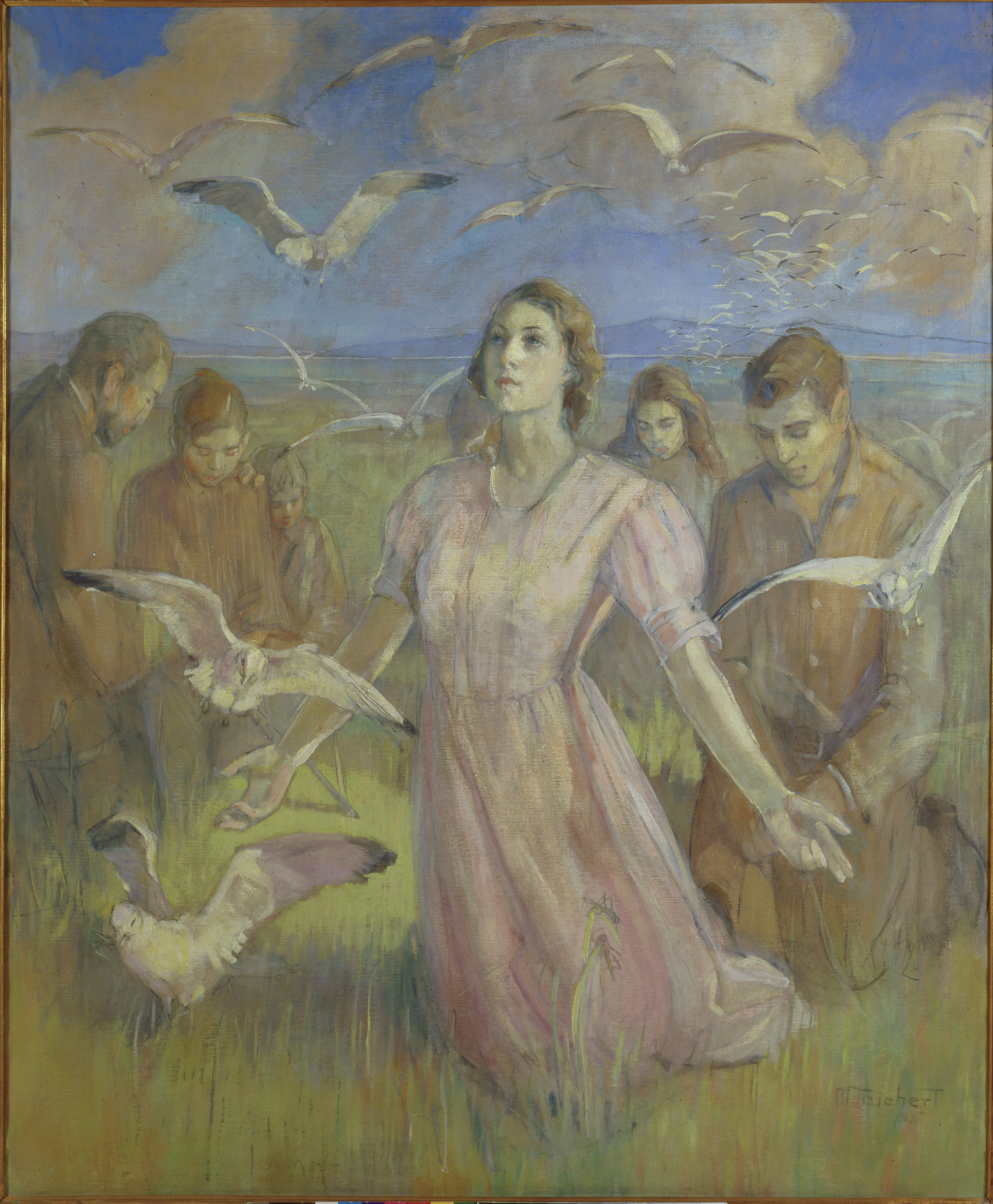 Figure 8
. Minerva Teichert (1888–1976),
The Miracle of the Gulls, c. 1935, oil on canvas, 69⅝ × 57⅝ inches. Brigham Young University Museum of Art, gift of Flora Sundberg, 1936.
In response to Handcart Pioneers, painted for the Hotel Utah, Horne wrote Teichert, “I have been thinking all night that your handcart people are up in the mountains and going up” (fig. 4). “There is little sky,” Horne continued. “That is what gives so much dignity to your canvas. There is a lofty feeling that with lots of sky they will be lost.” Horne counseled Teichert to be inspired by hymns: “Read the Morning Breaks the shadows flee Lo Zion’s standard is unfurled only morning hasn’t broken yet. I love the stones and flowers used as you do—nothing to distract from that Zion’s band.”
Horne also served as a sounding board for topics to paint. As early as 1935, Teichert desired to paint scenes from the Book of Mormon. Horne, perhaps desiring Teichert to paint more marketable scenes, encouraged her: “After you have done six more of trappers and Indians of Utah and Western early life will be time to think of Book of Mormon—that must come but don’t break in until you have reached a certain facility you are surely acquiring, that would mean defeat.” Horne assured Teichert that she was the right advisor. “Keep this to yourself,” she counseled. “Talking much of these precious ambitions to those not close to you, you lose something of purpose a weakening of ambition comes with talk, I always think. However, to me it will help and stimulate you to achievement, I believe.”
In addition to counseling Teichert in artistic matters, Horne gave her advice on how to balance home and public life. Horne was a mother and had six children (one of whom passed away shortly after birth). When her oldest child, Mary, was a toddler, Horne’s husband, George, was called on a mission to the southern states. While he was away, Horne taught school and advanced her education with her daughter in tow. Horne wrote the experience from Mary’s perspective: “In the afternoons, on her Mother returning from the Washington school, Mary would often accompany her ma to the Art class or ‘Hart’ class as Mary would call it. She was quite the idol of the class, and all the students would take much interest in the young art student.” Later, as Horne’s children grew and she was busy hanging exhibitions, her son remembered driving a car full of paintings from one location to another. Indeed, Horne understood the difficulties of balancing a public life and a home life. It was with experience that Horne told Teichert, “Well, your greatest masterpieces are your children. You’ll never paint any thing to equal them—but you could put the little darlings to sleep earlier. It would be better for them and better for you, then paint for an hour while they sleep.”
Horne also served as Teichert’s friend. “My dear Minerva,” Horne began one letter. “Mr. Wade told me the morning you were very sick with the Flu. I cannot write how sorry I am and do hope that you will be better when this reaches you. If there is anything I can do do not hesitate to let me know. We have been together thru so many of our troubles and my heart aches for you now. My prayers and thots will be all for you until I hear that you better again. Always your sincere friend, Alice.” Because of that friendship, Teichert was supported as Horne challenged her: “I am constrained to still remember you and hope and pray that your life may be spared to do the things no one but you are prepared to do.” Teichert’s daughter-in-law Shirley Teichert, who often helped Teichert paint the background of her paintings, commented on their determined friendship: “If you ever wanted to see anything cute, you should have seen those two little whiteheaded ladies just hustling and bustling around here talking about paintings.”
In 1935, as Teichert sought a way for her son to attend Brigham Young University, Horne arranged with Franklin S. Harris, president of the university, to exchange Teichert’s paintings for tuition. “I am enclosing a copy of the letter I have just written to Mrs. Horne,” Harris wrote to Teichert. “If this arrangement is agreeable to all concerned we shall be glad to send you credit for the $800, and then shall charge to this account the $86.50 for this year’s tuition.” For the next sixteen years, nineteen young people, including several neighbors from Cokeville, would attend BYU due to Teichert’s paintings and Horne’s arrangement.
Alice Merrill Horne passed away in 1948. With her death, Teichert and the rest of the Utah artists lost their best contact with The Church of Jesus Christ of Latter-day Saints. Church organizations largely stopped spending money on art in the 1950s, and Teichert, who was feeling ready to paint Book of Mormon scenes, was unable to convince Church leaders it was worth the investment. Her disappointment in these later decades underscores the importance of Horne and her significance to Church patronage.
Teichert painted a large mural of indigenous women riding in procession as a tribute to Horne and hoped to have an exhibition in her honor (fig. 9). Teichert was asked to give a eulogy at Horne’s funeral. She tenderly recalled, “Last night I held the hand of a beloved friend. She could not hear me speak but I felt a responsive pressure of her hand in mine. So soon she crossed the threshold and stepped into the big reception room, then probably on through beautifully lighted galleries and massive halls. I almost envied her for I’m still out in the kitchen scrubbing floors, rattling pans and preparing eats for a few of us hungry mortals.” Teichert used the opportunity to celebrate Horne’s encouragement: “Always was this great woman looking after the welfare of the artists, hoping they would be able to ‘make a go of it’ financially and still grow in spirit. Few people are so forgetful of self. Sometimes she’d lose patience with those she thought worldly, if they didn’t see her way. Sometimes she forgot on what a pinnacle she stood. We couldn’t crane our necks high enough to get her lofty view point. I have eaten with her, wept and prayed with her. I have slept with her and dreamed with her. How great were our dreams!”
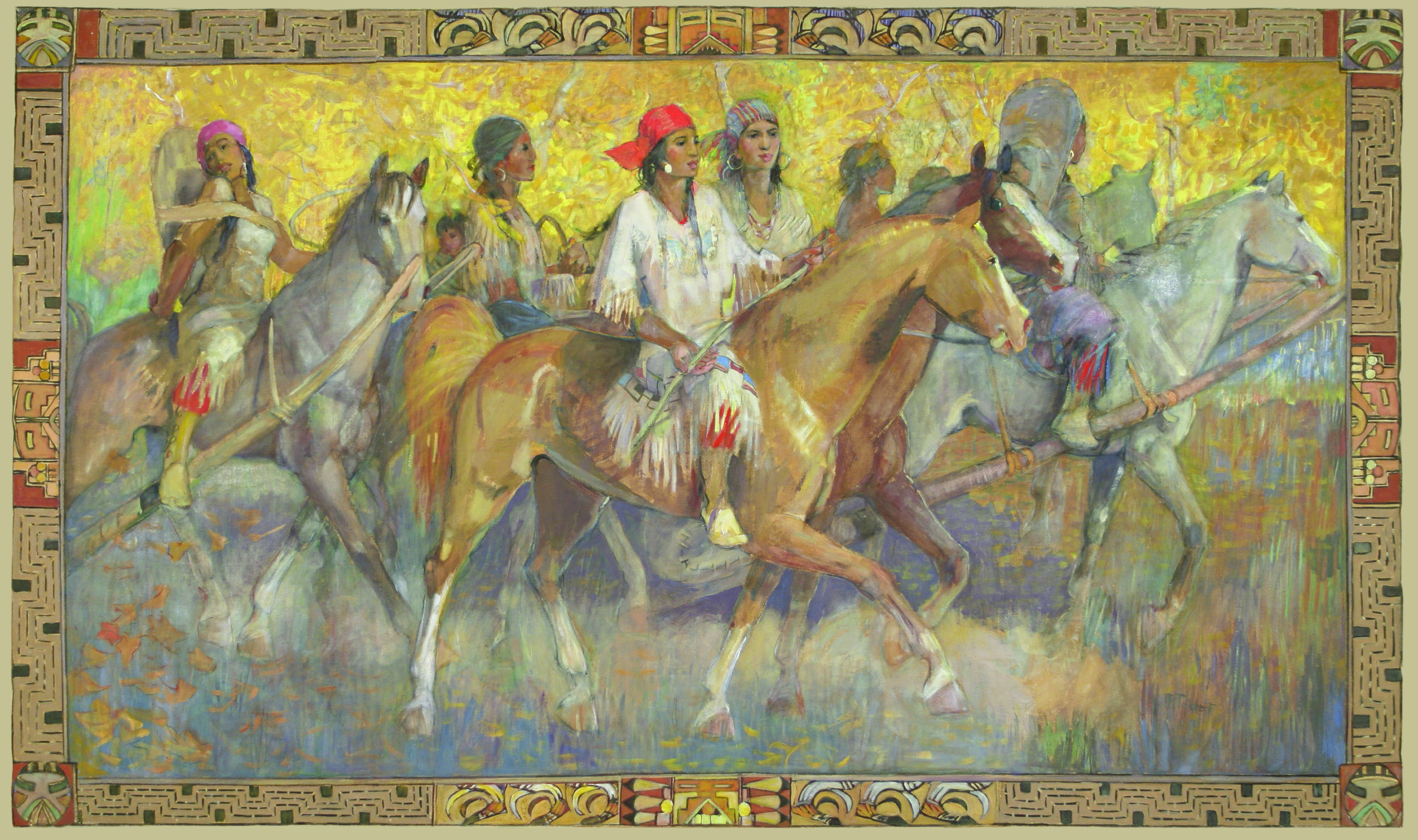 Figure 9
. Minerva Teichert (1888–1976),
Moving South, 1949, oil on canvas, 59½ × 101¼ inches. Brigham Young University Museum of Art, gift of the Stark Museum of Art, Orange, Texas, 2012.
Teichert would find another agent, a woman in Laramie, Wyoming, named Ethel Murrell. Teichert continued to paint prolifically, but the majority of her sales were of western scenes without religious context. In addition to the Book of Mormon scenes she painted, Teichert self-published an illustrated book, Selected Sketches of the Mormon March, and hoped her scenes would be useful to the Church. She painted until she broke her hip in 1970. In her 1937 autobiography, Teichert expressed, “Eternity seems very real to me. It’s just a continuation. I want a touch of red in my heaven and to be able to paint after I leave here. Even though I should come back 9 times I still would not have exhausted my supply of subjects and one life time is far too short.”
The works of Minerva Teichert have inspired Latter-day Saints worldwide. Many find inspiration in the way she balanced her life; others are inspired by her style, looser than other artists whose illustrative paintings have been reproduced by the Church. But it is important to remember the rich partnership of Horne and Teichert. Indeed, it is likely that without Alice Merrill Horne, the Latter-day Saint world would not know Minerva Teichert.


