


Notes
1. See Aristotle, Aristotle’s Nicomachean Ethics, trans. Robert C. Bartlett and Susan D. Collins (University of Chicago Press, 2012); Peter van Inwagen, An Essay on Free Will (Oxford University Press, 1986); see also Thomas Hobbes, “Of the Interior Beginnings of Voluntary Motions; Commonly Called the Passions; and the Speeches by Which They Are Expressed,” in Leviathan (National Geographic Books, 2017); Keith Lehrer, “Freedom of Preference: A Defense of Compatiblism,” The Journal of Ethics 20, no. 1 (2016): 35–46.
In this essay, “free will” refers to “libertarian” free will, the idea that humans have genuine ability to make choices independent of external influences. Libertarian free will stands in contrast to determinism, the idea that human choices are not free but rather are determined by external influences. Note that “compatibilist free will” is a form of determinism. Also called compatibilism or soft determinism, it is the idea that humans can make choices in accord with their preferences, but those preferences are determined by external influences.
2. See Jonathan Edwards, The Freedom of the Will (Dover Publications, 2012); and Reinhold Niebuhr, “The Self and the Dramas of History,” in Reinhold Niebuhr: Major Works on Religion and Politics, ed. Elisabeth Sifton (Library of America, 2015), 847–67.
3. See C. S. Lewis, The Complete C. S. Lewis Signature Classics (Harper Collins, 2001), 47–51, especially 47–48.
4. “If ye shall say there is no sin, ye shall also say there is no righteousness. . . . And if these things are not there is no God” (2 Ne. 2:13). See also Leigh Vicens, “Christianity and the Problem of Free Will,” in Cambridge Elements: The Problems of God (Cambridge University Press, 2023), abstract.
5. Loraine Boettner, “Section I: Statement of the Doctrine,” and “Section II: The Five Points of Calvinism,” in The Reformed Doctrine of Predestination (Gideon House Books, 2017), 63–171.
6. Rita Nakashima Brock and Rebeca Ann Parker, Proverbs of Ashes: Violence, Redemptive Suffering, and the Search for What Saves Us (Beacon Press, 2001), 19.
7. Jean-Jacques Rousseau, The Social Contract and the Discourses, trans. G. D. H. Cole (Everyman’s Library, 1993), 182–83.
8. See Sam Harris, Free Will (Simon & Schuster, 2012), 1.
9. See Aristotle, Nicomachean Ethics, 42–51; Romans 8; Ephesians 1; Thomas Aquinas, “The Will of God,” in Summa Theologica, trans. the Fathers of the Dominican Province (Christian Classics, 1981), 1.19.10; David Hume, “Of Liberty and Necessity,” in An Enquiry Concerning Human Understanding; [with] Hume’s Abstract of A Treatise of Human Nature; [and] A Letter from a Gentleman to His Friend in Edinburgh, ed. Eric Steinberg, 2nd ed. (Hackett Publishing, 1993), §8; Immanuel Kant, “Transition from the Metaphysics of Morals to the Critique of Pure Practical Reason,” in Groundwork of the Metaphysics of Morals, trans. and ed. Mary Gregor and Jens Timmermann (Cambridge University Press, 2012), 56–72; John Stuart Mill, “Chapter III: On Individuality, as One of the Elements of Well-Being,” in On Liberty, ed. Kathy Casey (Dover Publications, 2002), 46–62; William James, “The Will to Believe,” in The Will to Believe and Other Essays in Popular Philosophy (CreateSpace Independent Publishing Platform, 2012), 1–15. See also Robert Kane, The Oxford Handbook of Free Will, 2nd ed. (Oxford University Press, 2011); Robert Kane, “Making Sense of a Free Will That Is Incompatible with Determinism: A Fourth Way Forward,” Journal of Philosophical Theological Research 23, no. 3 (2021): 5–28.
10. Kant, “Transition from the Metaphysics of Morals,” 52–66.
11. Kant, “Transition from the Metaphysics of Morals,” 52.
12. I do not presume to speak for the Church; these thoughts are my own understanding of scripture. I look to God’s living prophet to pronounce official doctrine (see D&C 1:24–28; D&C 21:1, 4–5; D&C 28:2, 5–7).
13. This sentence is my own. I present it as containing and relating the core concepts of every extant approach to the debate: the nature of the chooser, the choosing, and the choice.
14. See René Descartes, “Meditation VI: Concerning the Existence of Material Things, and the Real Distinction Between Mind and Body,” Meditations on First Philosophy: In Which the Existence of God and the Distinction of the Soul from the Body Are Demonstrated (Hackett Publishing, 1993), 47–58.
15. See American Dictionary of the English Language, under “Immaterial” and “Matter,” accessed June 26, 2026, https://webstersdictionary1828.com/Dictionary/immaterial and https://webstersdictionary1828.com/Dictionary/matter; Isaac Newton, The Principia: The Authoritative Translation and Guide: Mathematical Principles of Natural Philosophy, trans. I. Bernard Cohen, Anne Whitman, and Julia Budenz (University of California Press, 2016).
We may ask if the term immaterial matter meant to Joseph Smith what it means today. This is appropriate since many aspects of nineteenth-century Newtonian reality are now considered invalid. Fortunately, Webster’s 1828 American English definitions of immaterial and matter are functionally identical to those I use in this essay.
16. See Descartes, “Meditation VI,” 47–58; Immanuel Kant, Critique of Practical Reason, trans. Thomas Kingsmill Abbott (Project Gutenberg, 2004), 5.
17. Doctrine and Covenants 29:34–35 makes this same point, though in reverse. Here God says, “All things unto me are spiritual, and not at any time have I given unto you a law which was temporal; neither any man, nor the children of men; neither Adam, your father, whom I created. Behold, I gave unto him that he should be an agent unto himself.” This scripture rejects the material-immaterial split from the other direction, but whether everything is material or everything is spiritual, Latter-day Saint scripture rejects a fundamental difference in composition between spirit and matter.
18. I sympathize with those who find this a hard read. I believe its meaning becomes clear in the context of verses 23–26. In verse 23, Abraham notes that God “stood among those that were spirits.” Verse 24 describes “these” spirit children of God as being clothed in “these materials” (mortal bodies). In my view, then, “intelligences that were organized” in verse 22 must mean “intelligences that were organized into spirits.” Finally, this is the only way to make sense of the reference to first and second estates in verse 26.
19. See James E. Faulconer with Susannah Morrison, “The King Follet Discourse: Pinnacle or Peripheral?,” in “Yet to Be Revealed,” ed. Eric A. Eliason and Terryl L. Givens, special issue, BYU Studies Quarterly 60, no. 3 (2021): 85–104. Here, Faulconer and Morrison trace evolution of this understanding over the century or so after the scripture was first given.
20. See David L. Paulsen, “Joseph Smith Challenges the Theological World,” BYU Studies 44, no. 4 (2006): 192–93 with n. 51; James E. Faulconer, Faith, Philosophy, Scripture (Neal A. Maxwell Institute for Religious Scholarship, 2010), 45, 50. I understand Paulsen’s position that intelligences are uncaused, uncreated, and eternal as consistent with my view. I also understand Faulconer’s emphasis on covenantal response in our lived (material) context offering similarly sympathetic grounds for identifying our intelligences as the fount of our free will, though he takes pains to point out that we have free will whether or not we articulate a cogent rationale for it.
21. See, for instance, John Calvin, Institutes of the Christian Religion, trans. Henry Beveridge (Hendrickson Publishers, 2008), 1.16.8–9, 1.18.1–4.
22. To the age-old question of why God would thus unleash evil in the world, Latter-day Saint theodicy offers a uniquely satisfying answer: God empowers us to express our innate good and evil in order to develop us to our greatest eternal joy (see D&C 93:33–34; 88:29–33; 2 Ne. 2:25). Joy is a function of agency—without agency, there is no joy (2 Ne. 2:23; Mosiah 2:41; D&C 88:32–33). And since letting us express our innate nature means letting us choose to “take happiness in sin” (Morm. 2:13) as well as in virtue (Moses 7:32–33), God let his Beloved Son freely choose to atone for our evil choices (Abr. 3:27; Heb. 12:2; 2 Ne. 26:24) so that freeing us to exercise our moral agency would not doom us to “an endless duration” of corruption (2 Ne. 9:7). God’s grace expressed through Christ’s Atonement lovingly frees us from the damning consequences of our evil choices and magnifies the saving consequences of our good choices.
23. Calvin, Institutes of the Christian Religion, 2.2.12–27; Boettner, Reformed Doctrine of Predestination, 63–82.
24. Since God revealed the existence of eternal intelligence/s, Latter-day Saint thinkers have speculated widely on its/their nature. To maintain focus I do not delve into that here, but I recommend the following to interested readers: Faulconer, Faith, Philosophy, Scripture; Truman G. Madsen, Eternal Man (Deseret Book, 1976); Bruce R. McConkie, A New Witness for the Articles of Faith (Deseret Book, 1985); Sterling M. McMurrin, The Theological Foundations of the Mormon Religion (University of Utah Press, 1974); Blake T. Ostler, Exploring Mormon Thought: The Attributes of God (Greg Kofford Books, 2001); Blake T. Ostler, Exploring Mormon Thought, vol. 2, The Problems of Theism and The Love of God (Greg Kofford Books, 2006); Blake T. Ostler, Exploring Mormon Thought, vol. 3, Of God and Gods (Greg Kofford Books, 2008); Paulsen, “Joseph Smith Challenges the Theological World;” David L. Paulsen, “Divine Determinateness and the Free-Will Defense,” Analysis 41, no. 3 (1981): 150–53; Orson Pratt, The Seer (Seagull Book and Tape, 1993); Orson Pratt, “Great First Cause,” in The Pamphlets of Orson Pratt, ed. David Hammer (CreateSpace, 2017), 404–28; Parley P. Pratt, Key to the Science of Theology (Wentworth Press, 2019); B. H. Roberts, “Immortality of Man,” Improvement Era, April 1907, 401–22; B. H. Roberts, “Intelligence or Mind and Minds,” in The Truth, The Way, The Life, 2nd ed. (BYU Studies, 1996), 164–73; Joseph Smith Jr., “The King Follett Sermon,” Ensign, April 1971, 12–17; May 1971, 13–17; John A. Widtsoe, A Rational Theology as Taught by The Church of Jesus Christ of Latter-day Saints (Hassell Street Press, 2021).
25. Oxford English Dictionary, under “can (v.1),” accessed January 28, 2025, https://www.oed.com/dictionary/can_v1?tab=meaning_and_use#10266561.
26. See Kant, “Transition from the Metaphysics of Morals,” 66–68.
27. Another implication of “can” is that not all choices need to be free for some choices to be free. To say “I can choose freely” implies that I may sometimes choose freely without necessarily always doing so. Thus, detractors of free will who show that one choice was made deterministically have not shown that all choices are the same.
28. Aristotle, Nicomachean Ethics, 3.2–5.
29. Oxford English Dictionary, under “choose (v.),” accessed April 29, 2026, https://www.oed.com/dictionary/choose_v?tab=meaning_and_use#9559999.
30. See Hubert L. Dreyfus, Being-in-the-World: A Commentary on Heidegger’s Being and Time, Division I (MIT Press, 1990), 40–59. I perceive some distant similarity to Dreyfus’s description of Heidegger’s eigentlich, or “ownmost potentiality-for-Being,” but I do not believe eigentlich is a common conception of free will.
31. See Daniel Dennett, Elbow Room: The Varieties of Free Will Worth Wanting (Bradford Book, 1984), 23–29; see also Moritz Schlick, “When Is a Man Responsible?,” in The Problem of Free Will: Selected Readings, ed. Willard Finley Enteman (Scribner’s Sons, 1967).
32. Aquinas, “The Will of God,” in Summa Theologica, 1.19.10.
33. Finding truth in another faith tradition should not worry Latter-day Saints in the least since a tenet of our religion is that “the Lord doth grant unto all nations, of their own nation and tongue, to teach his word, yea, in wisdom, all that he seeth fit that they should have” (Alma 29:8).
34. Werner Heisenberg, Physics and Philosophy: The Revolution in Modern Science (Harper Perennial Modern Classics, 2007); Douglas Hofstadter, I Am a Strange Loop (Basic Books, 2007); John Jamieson Carswell Smart, “Sensations and Brain Processes,” Philosophical Review 68, no. 2 (April 1959): 141–156; Harry G. Frankfurt, “Freedom of the Will and the Concept of a Person,” Journal of Philosophy 68, no. 1 (1971): 5–20; Humberto R. Maturana and Francisco J. Varela, The Tree of Knowledge: The Biological Roots of Human Understanding (Shambhala, 1992); Gregg D. Caruso, Free Will and Consciousness: A Determinist Account of the Illusion of Free Will (Lexington Books, 2012); Marco Masi, “An Evidence-Based Critical Review of the Mind-Brain Identity Theory,” in Frontiers in Psychology 14 (2023), article 10641890, https://doi.org/10.3389/fpsyg.2023.1150605, accessed September 15, 2025.
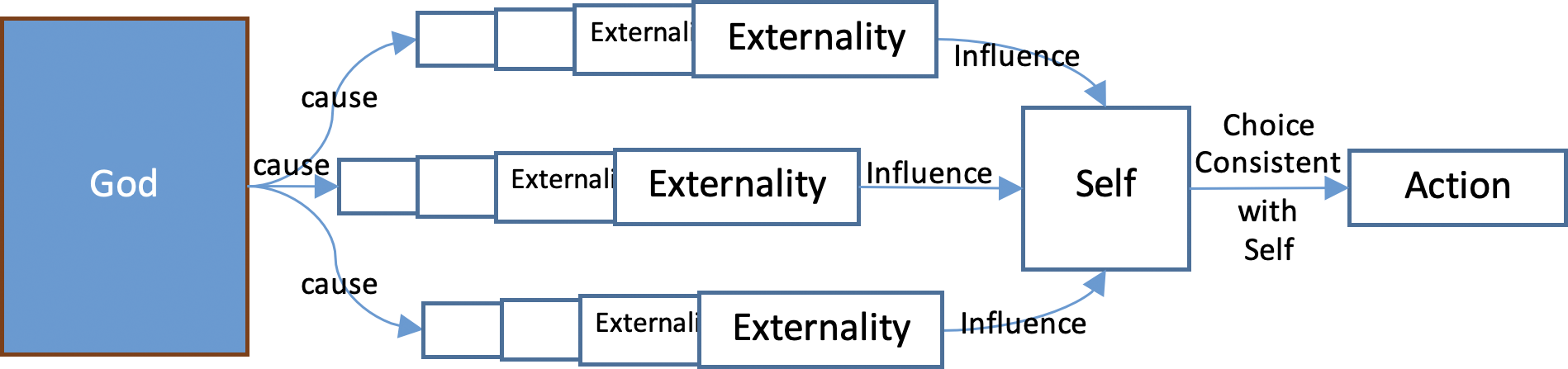
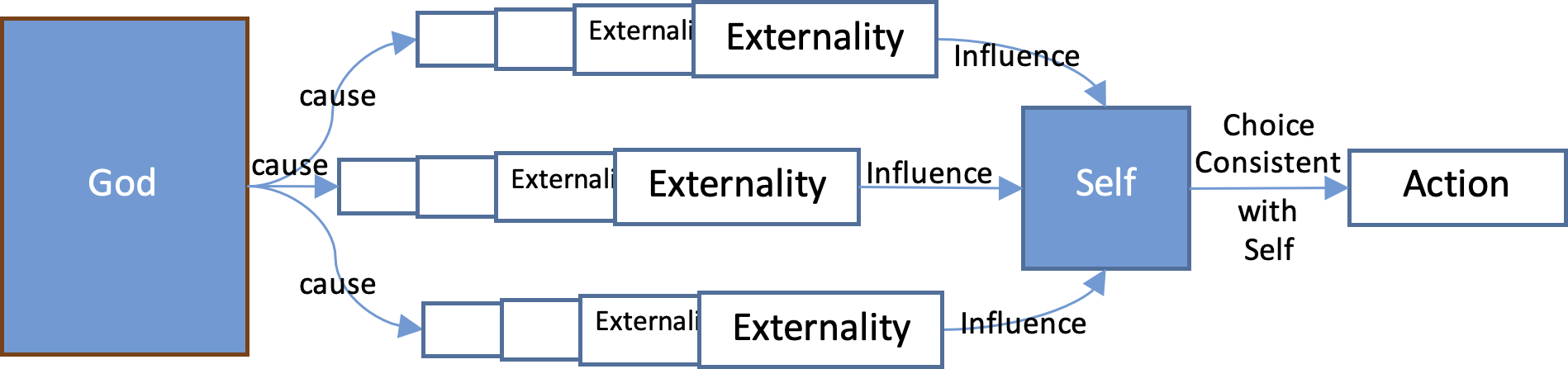
Figures 1 and 2 may appear simplistic since they do not explicitly reflect (1) implications of quantum uncertainty for free will and (2) emergent-materialist conceptions of the self. I grant that the figures are simple, but they do not prevent readers who wish to do so from understanding them in terms of quantum uncertainty and emergent materialism. Since complicating them would not further clarify my point, I believe the diagrams as-is are sufficient for my present purpose.
35. Our wills are weak compared to God’s all-powerful will (Job 38–41) and compared to the gargantuan forces of the cosmos in which we live (Ps. 8:3–4). Therefore, God delicately arranges our lives with enticements to good and evil that balance us on the razor’s edge of our puny agency. This is why God is in the details of our lives—not to control us but to free us.
36. This is key to my thesis. It is why this is not just another form of compatibilism (apologies to Robson; see Kent E. Robson, “The Foundations of Freedom in Mormon Thought,” Sunstone 7, no. 5 [September–October 1982]: 51–54). Compatibilists present free will as illusory because our choices ultimately boil down to triggers outside us; this Latter-day Saint view acknowledges free will as genuine, seated in our self-existent, nonderivative intelligence.
37. Kant, Groundwork of the Metaphysics of Morals, xxxi, 60–71; Plato, “Phaedo,” in Plato: Five Dialogues: Euthyphro, Apology, Crito, Meno, Phaedo, 2nd ed., trans. G. M. A. Grube (Hackett Publishing, 1997); Arthur Schopenhauer, The World as Will and Idea, trans. R. B. Haldane, J. Kemp (Digireads Publishing, 2021). Interestingly, none other than the great Immanuel Kant seems to have had a somewhat similar notion. He founded his argument for human moral agency on the existence of a “noumenal self” of the Platonic ideal sort for us “phenomenal selves” here in mundane reality. The problem with Kant’s approach, as has been pointed out by minds brighter than mine (for example, Schopenhauer), is that he places the noumenal self outside the material world and so falls back into the trap of pitting free will against influence.
38. I consider this one way in which human beings are created “in the image of God” (Gen. 1:27).
39. Second Nephi 2:24 shows that God’s wisdom permeates every aspect of creation, including the circumstances in which we mortals make our life choices; nothing is purposeless. Second Nephi 26:23–24 shows that all God’s work in the world is motivated by his love for us and is for our benefit. Alma 7:11–13 shows that God intimately mediates our mortal pains and sicknesses through Christ’s Atonement (and those who would limit Christ’s mercy and grace by defining “his people” as only the faithful should remember 2 Ne. 26:23–24.). Doctrine and Covenants 121:7, 25; and 122:7–9 show God lovingly, tenderly comforting and counseling one of his imperfect children, telling him that God is with him every step of the way. Alma 36:3 is a general statement extending to each of the faithful the intimate comfort God gives to one suffering servant in Doctrine and Covenants 121 and 122. Romans 8:28 is a clear, comprehensive statement that all things are woven by divine providence; this certainly includes the circumstances of our life choices.
40. This idea of God perfectly knowing his own mind extends to other divine attributes as well. For example, God does not exercise faith as mortals do. Mortal faith is born of uncertainty, but God suffers no uncertainty; he does not believe, trust, expect, hope, forecast, or guess as we mortals use those words because he knows everything. Another example is “trying.” Mortals attempt, sometimes failing, sometimes succeeding. God does not attempt, he does; he always succeeds.
41. Note that our resurrected bodies will be exactly customized to do our will in its full maturity through Christ’s grace: “Every man shall receive according to his own works, his own dominion, in the mansions which are prepared; And they shall be servants of the Most High” (D&C 76:111–12, emphasis added). God will not empower our “natural man” to forever remain “an enemy to God” (Mosiah 3:19, except see D&C 76:31–39 regarding the sons of perdition).
42. See Jacob 5 for a graphic example of the variation in human responses to divine nurturing.
43. Just as God lets us mortals exercise our own wills, so he lets Jehovah exercise his own will (Abr. 3:27; D&C 93:10–13). That is, the Father did not force the Son into his mortal life; rather the Father freed the Son to live mortality in accord with the Son’s own will (John 10:17–18; 2 Ne. 2:7).
44. See also Moses 4:1–4, especially verses 3 and 4, for a contrast of Lucifer’s determinism and Jehovah’s agency.
45. In asserting that God always succeeds, Latter-day Saints find themselves in general agreement with Leibniz’s argument that this earth is “the best of all possible worlds,” though they might put it something like, “This earth is perfect for God’s purposes.” This stands in stark contrast to Voltaire’s picaresque mockery of that idea. G. W. Leibniz, Theodicy: Essays on the Goodness of God, the Freedom of Man, and the Origin of Evil, ed. Austin Farrer, trans. E. M. Huggard (Routledge & Kegan Paul, 1952), 228; Voltaire, Candide (Electronic Scholarly Publishing Project, 1998), http://www.esp.org/books/voltaire/candide.pdf.
46. Matthew Tindal, “Chap. III. That the Perfection and Happiness of All Rational Beings, Supreme as Well as Subordinate, Consists in Living Up to the Dictates of Their Nature,” in Christianity as Old as the Creation: or, The Gospel, a Republication of the Religion of Nature (London, 1732), 18–30.
47. I do not write this pejoratively. I willingly grant that the aesthetic appeal of an argument—how it “strikes me”—influences its cogency as well as does its logical validity.
48. Oxford English Dictionary, under “mechanistic (adj.1),” accessed February 10, 2025, https://doi.org/10.1093/OED/1206576706.
49. Francis S. Collins, The Language of God (Free Press, 2007), 93. Here Collins, a Christian and the former director of the Human Genome Project and the National Institutes of Health, chronicles his ongoing awe at the wondrous miracles—the “gaps” as he calls them—of the human genome and other unanswered questions of science. Though he did not originate the term, Collins gladly acknowledges “the God of the gaps.”
50. I did not make up these wonderful questions. Latter-day Saint thinkers have reasoned and dreamed about them and more since the nineteenth century. Note 24 lists some of these references.
51. Oxford English Dictionary, under “deism (n.1),” accessed February 10, 2025, https://www.oed.com/dictionary/deism_n?tab=meaning_and_use#7235313.
52. Could there be a clearer statement than this of God’s orderliness? See Genesis 1, as the entire chapter is about God organizing order from chaos. See also the repeated use of “organized” and “ordered” in Abraham 4:1, 7, 9, 11–12, 14–16, 18, 25, 27, 30–31. Isaiah 48:3 shows that God has ordered the progression of history from its start to its end. Acts 2:23 shows that God planned and appointed both the trials of Christ and their eventual happy outcome. Romans 9:18–23, so often a proof-text for Calvinist-style determinism, appears via Latter-day Saint self-determinism in its true light as a straightforward statement that God honors our primordial natures. First Nephi 9:6 shows that God’s omniscience and omnipotence—his orderliness, if you will—are absolute. Given this, how else could we mortals enjoy moral agency than by Latter-day Saint self-determinism? Abraham 2:8 shows that the whole history of creation from beginning to end was known to God before it started. This surely evidences divine orderliness. Doctrine and Covenants 38:1–2 shows that God knows everything everywhere all at once.
53. Luke 4:18–19. Jesus quoted from Isaiah 61:1–2 in his inaugural address to the Nazarenes. It is his mission statement, the thesis of his ministry, his promise to save us from ourselves. Marvelously, Mosiah 3:11, Alma 7:9–12, and other scriptures reveal that Christ also atones for the evil we unwittingly cause.
54. Some may wonder why God would inspire Lehi (and every other prophet) to plead with us to choose Christ if we are just going to do what our self-existent, nonderivative wills determine we will do. But this is falling into the flawed thinking of herein-discredited misconceptions of free will. Remember we exist in the material world, affecting and being affected by it. This means externalities do influence our choices, and so (for instance) Lehi remonstrating with his sons (and us by extension) is entirely appropriate because it does affect them (and us). Exactly what that effect is, is a function of their (and our) self-existent, nonderivative wills.